

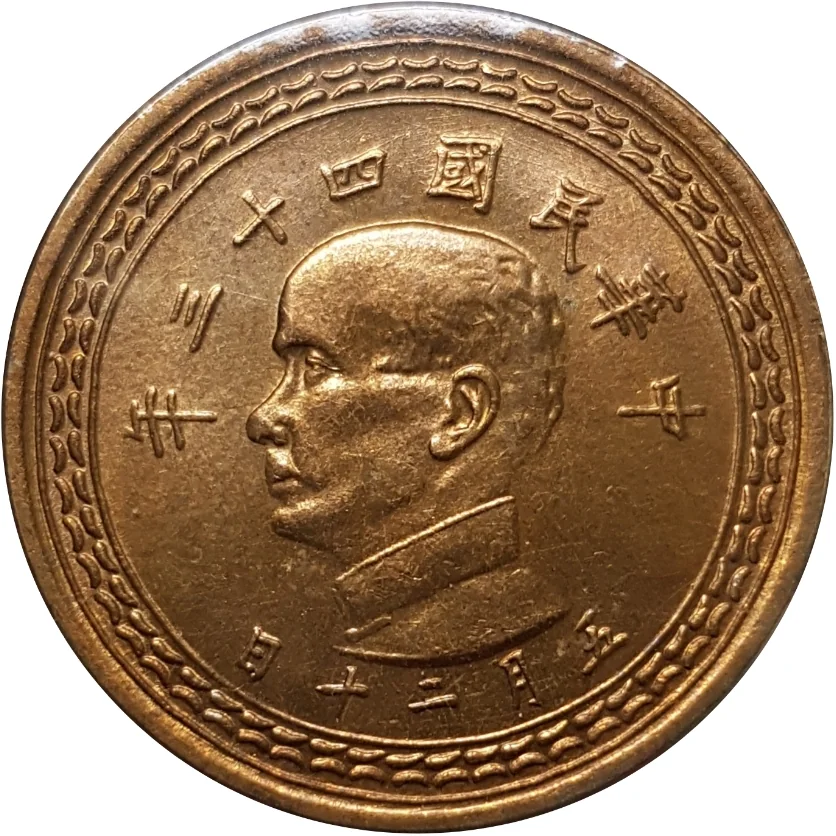
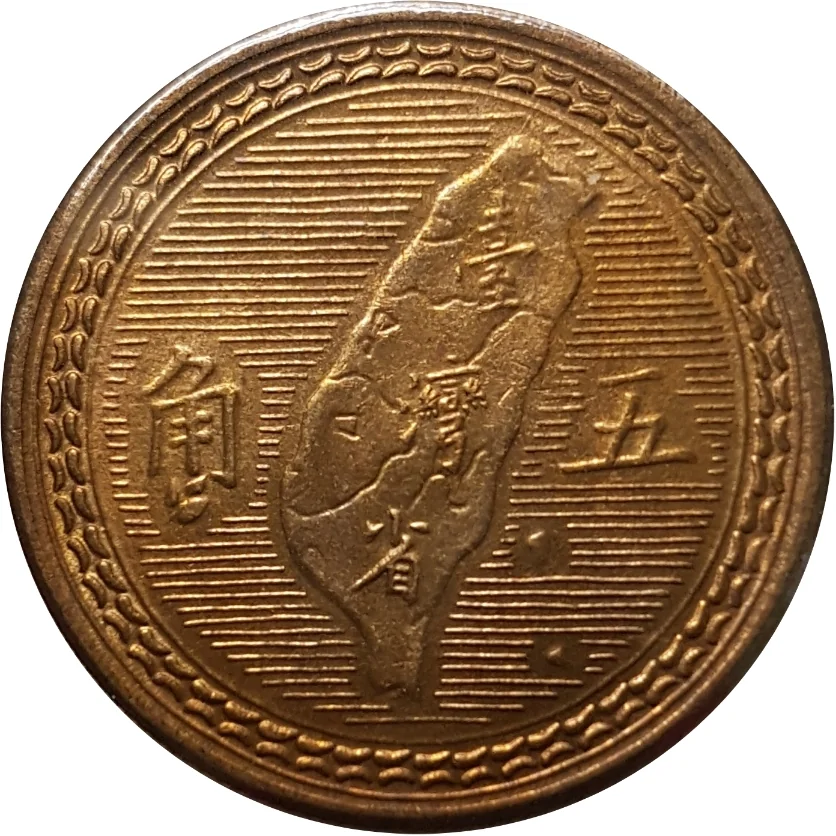
5 Jiao – Taiwan
China
Context
Year: 1954
Chinese republican Year: 43
Country: China 
Issuer: Taiwan 
Period:
(since 1949)
Currency:
(since 1949)
Subdivision: 5 Jiao = 50 Fen
Demonetized: Yes
Total mintage: 279,624,000
Material
References
Y: #Click to copy to clipboard535
Numista: #4476
Value
Exchange value: 0.5 TWD
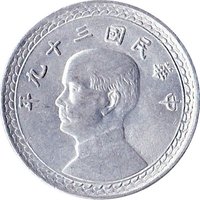
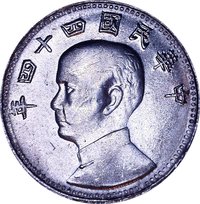
Obverse
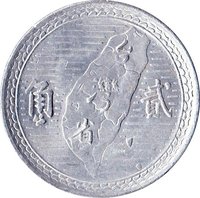
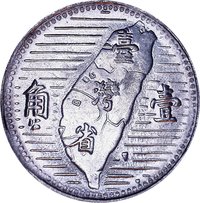
Reverse
Edge
Reeded
Categories
| Map |
| Person> Politician |
Mintings
| Year | Mint Mark | Mintage | Quality | Collection |
|---|---|---|---|---|
| 1954 | — | 279,624,000 |
Historical background
In 1954, Taiwan's currency situation was defined by the aftermath of hyperinflation and the ongoing stabilization efforts of the Republic of China (ROC) government, which had retreated to the island in 1949. The New Taiwan Dollar (NTD), first issued in 1949 to replace the old Taiwan Dollar, had become the sole legal tender. Its introduction, backed initially by gold and foreign exchange reserves, was a critical step in severing the island's monetary system from the catastrophic hyperinflation plaguing the mainland Chinese currency. By 1954, the currency reform was largely considered a success, having restored basic public confidence and providing a stable medium of exchange for Taiwan's postwar recovery.
Economically, the period was characterized by strict financial controls and dependence on U.S. aid. The government maintained a fixed exchange rate, and the Central Bank of China (which had re-established operations in Taipei in 1961) exercised tight control over money supply and foreign exchange. This conservative monetary policy was essential for controlling inflation, but it also reflected a managed, inward-looking economy. Crucially, massive U.S. economic and military aid, which began in 1951 under the Sino-American Mutual Defense Treaty, provided the foreign exchange and material resources necessary to support the currency's stability and fund reconstruction without resorting to the inflationary printing of money.
The context of 1954 was also intensely political, with the currency serving as a symbol of sovereignty and separate administration. The ROC government on Taiwan insisted it was the legitimate government of all China, and its stable currency stood in stark contrast to the monetary reforms and instability occurring on the mainland under the People's Republic of China. Thus, the New Taiwan Dollar was not merely an economic tool but a key pillar in the ROC's claim to effective governance and its project of building a "base for the recovery of the mainland," all while operating under a martial law regime that would last for decades.
Economically, the period was characterized by strict financial controls and dependence on U.S. aid. The government maintained a fixed exchange rate, and the Central Bank of China (which had re-established operations in Taipei in 1961) exercised tight control over money supply and foreign exchange. This conservative monetary policy was essential for controlling inflation, but it also reflected a managed, inward-looking economy. Crucially, massive U.S. economic and military aid, which began in 1951 under the Sino-American Mutual Defense Treaty, provided the foreign exchange and material resources necessary to support the currency's stability and fund reconstruction without resorting to the inflationary printing of money.
The context of 1954 was also intensely political, with the currency serving as a symbol of sovereignty and separate administration. The ROC government on Taiwan insisted it was the legitimate government of all China, and its stable currency stood in stark contrast to the monetary reforms and instability occurring on the mainland under the People's Republic of China. Thus, the New Taiwan Dollar was not merely an economic tool but a key pillar in the ROC's claim to effective governance and its project of building a "base for the recovery of the mainland," all while operating under a martial law regime that would last for decades.
🌱 Very Common