

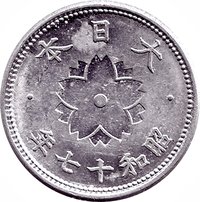
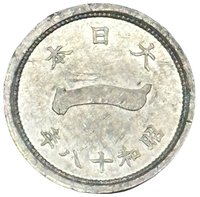
Obverse
Description:
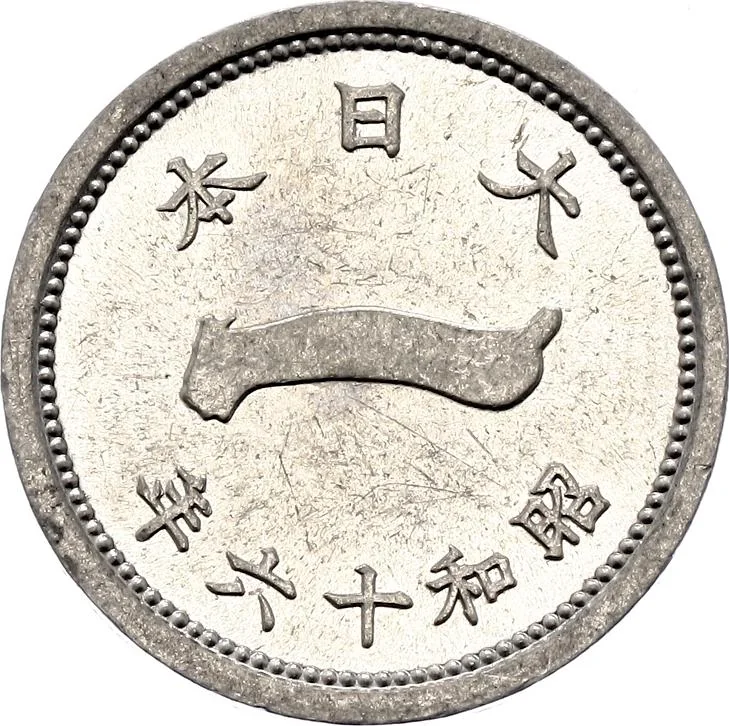
Central value, authority above, date below.
Inscription:
本 日 大
一
年 八 十 和 昭
一
年 八 十 和 昭
Translation:
The 18th year of Showa, a great day.
Language: Japanese
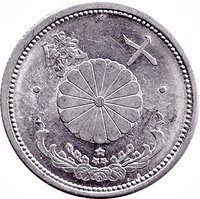
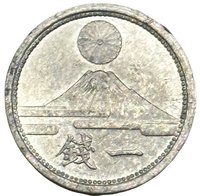
Reverse
Description:
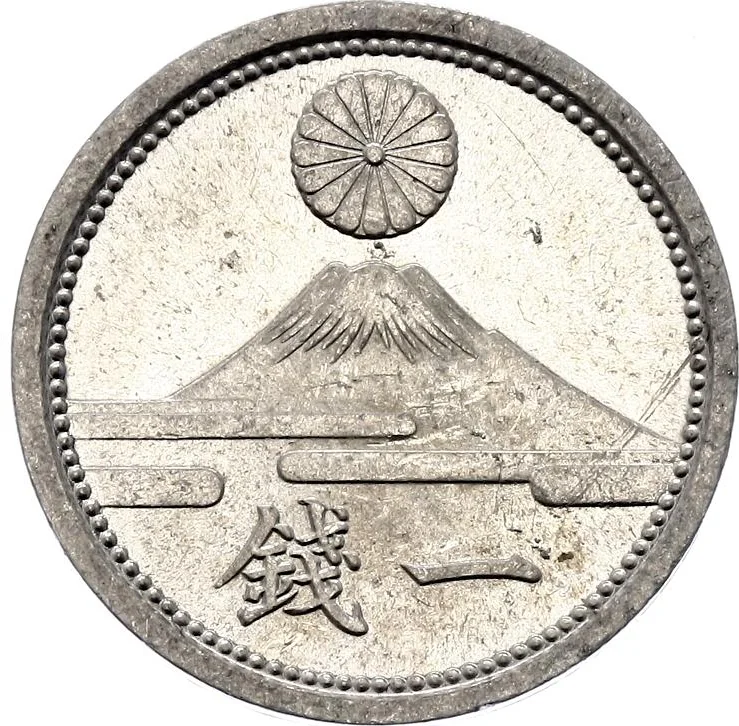
Chrysanthemum over Fuji, value beneath.
Inscription:
錢 一
Translation:
One coin
Language: Chinese
Edge
Plain
Mintings
| Year | Mint Mark | Mintage | Quality | Collection |
|---|---|---|---|---|
| 1941 | — | 1,016,620,734 | ||
| 1942 | — | 119,709,832 | ||
| 1943 | — | 1,163,949,434 |
Historical background
In 1941, Japan’s currency system was a tightly controlled instrument of its wartime economy and imperial ambitions. The yen, managed by the Bank of Japan, was no longer a freely convertible currency but was pegged to a gold standard in name only. In reality, its value and issuance were dictated by the state's need to finance massive military expansion and the ongoing war in China, which began in 1937. This led to growing inflation, suppressed by comprehensive price controls and rationing of essential goods. The financial system was fully mobilized to channel capital into munitions and heavy industry, with strict laws regulating foreign exchange and gold transactions to conserve scarce hard currency reserves for purchasing vital overseas resources like oil and scrap metal.
Internationally, the yen operated within the "Yen Bloc," a sphere of economic influence encompassing Japan’s occupied territories such as Manchuria, Korea, and parts of China. In these areas, yen-linked currencies (like the Manchurian yuan) were forced into circulation to bind the economies to Tokyo and facilitate the extraction of resources for the Japanese war machine. This bloc was designed to create a self-sufficient economic zone insulated from the dollar and sterling-based global system, but it remained dependent on imports from outside areas, particularly from the United States and European colonies in Southeast Asia.
By late 1941, Japan's currency and financial situation was increasingly precarious. Years of deficit spending had created inflationary pressures, while dwindling foreign reserves—exacerbated by the U.S. freeze on Japanese assets and the oil embargo in July—severely limited its ability to conduct international trade. This economic stranglehold was a primary catalyst for the decision to go to war with the United States and European powers, aiming to seize the resource-rich territories of Southeast Asia. Thus, on the eve of the attack on Pearl Harbor, the yen was fundamentally a siege currency, underpinning an economy on a total war footing and staking its survival on military conquest.
Internationally, the yen operated within the "Yen Bloc," a sphere of economic influence encompassing Japan’s occupied territories such as Manchuria, Korea, and parts of China. In these areas, yen-linked currencies (like the Manchurian yuan) were forced into circulation to bind the economies to Tokyo and facilitate the extraction of resources for the Japanese war machine. This bloc was designed to create a self-sufficient economic zone insulated from the dollar and sterling-based global system, but it remained dependent on imports from outside areas, particularly from the United States and European colonies in Southeast Asia.
By late 1941, Japan's currency and financial situation was increasingly precarious. Years of deficit spending had created inflationary pressures, while dwindling foreign reserves—exacerbated by the U.S. freeze on Japanese assets and the oil embargo in July—severely limited its ability to conduct international trade. This economic stranglehold was a primary catalyst for the decision to go to war with the United States and European powers, aiming to seize the resource-rich territories of Southeast Asia. Thus, on the eve of the attack on Pearl Harbor, the yen was fundamentally a siege currency, underpinning an economy on a total war footing and staking its survival on military conquest.
🌱 Very Common