

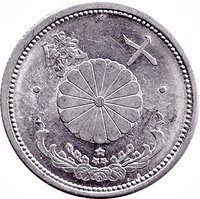
Obverse
Description:
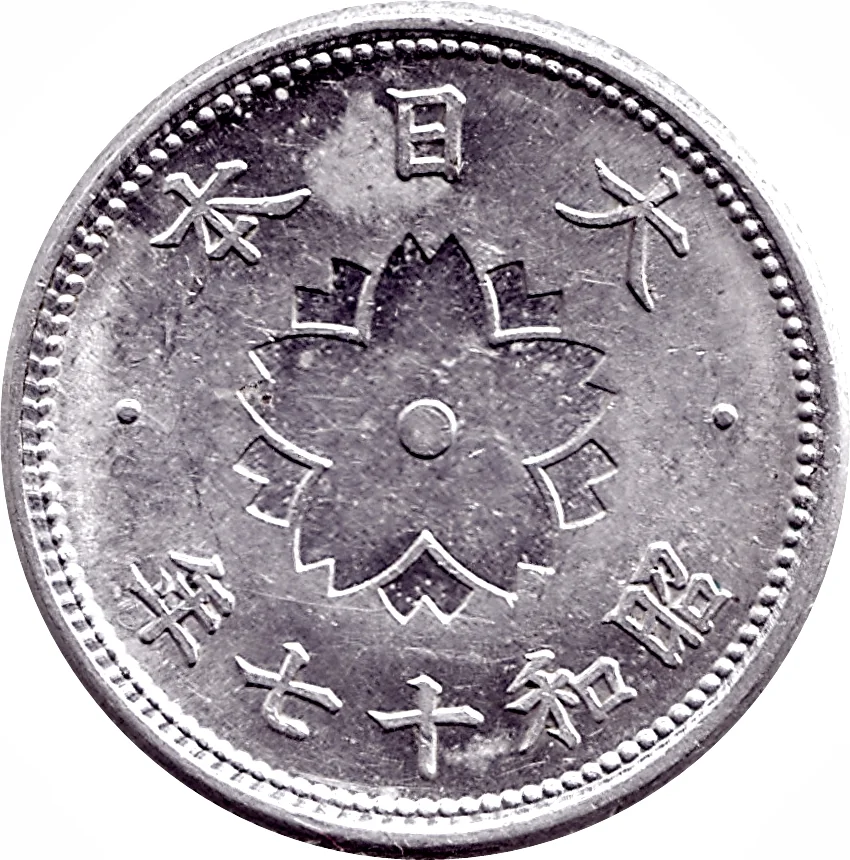
Cherry blossom with double petals, dots on sides, authority above, date below.
Inscription:
· 本日大 ·
年七十和昭
年七十和昭
Translation:
On this very day, at the age of seventy, harmoniously and brightly.
Language: Classical Chinese
Reverse
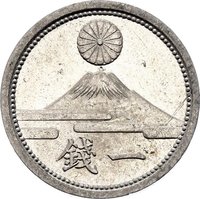
Description:
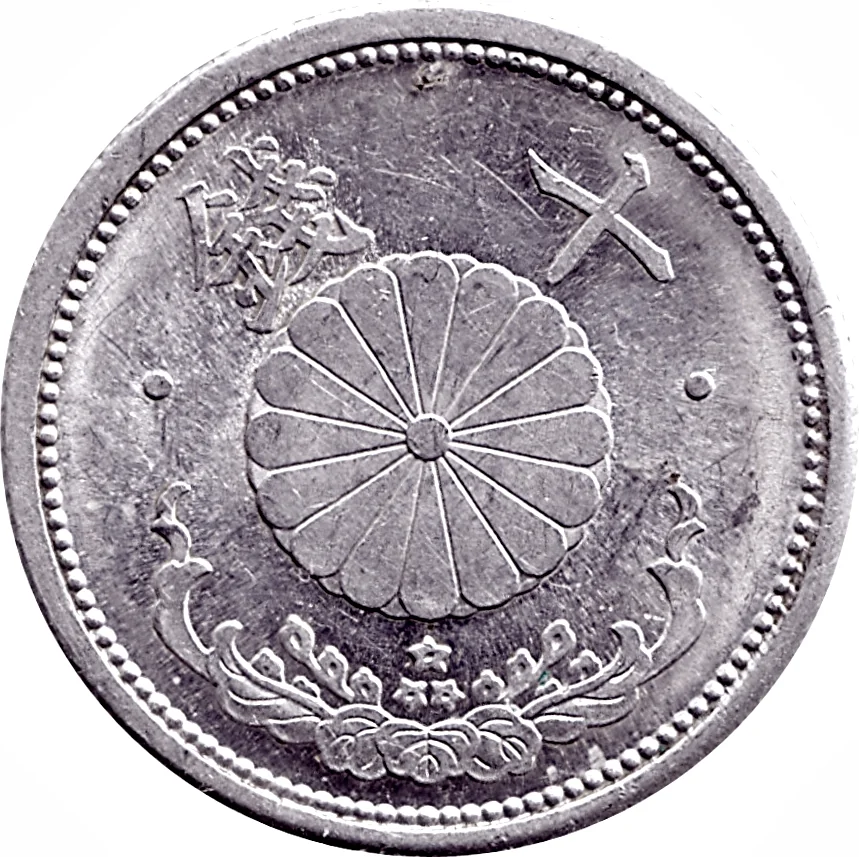
Chrysanthemum with dots above, paulownia leaves below.
Inscription:
錢 十
Translation:
Ten Cash
Language: Classical Chinese
Edge
Reeded
Categories
| Plants> Flower |
| Symbols> Coat of Arms |
Mintings
| Year | Mint Mark | Mintage | Quality | Collection |
|---|---|---|---|---|
| 1940 | — | 575,600,000 | ||
| 1941 | — | 944,900,000 | ||
| 1942 | — | — | ||
| 1943 | — | 756,000,000 |
Historical background
By 1940, Japan’s currency situation was fundamentally shaped by its ongoing war in China and the drive toward a militarized, state-controlled economy. The yen, which had been on the gold standard until 1931, was now a managed currency, with its value and issuance tightly controlled by the government and the Bank of Japan to serve national policy. The enormous and escalating costs of the Second Sino-Japanese War (begun in 1937) were financed not by taxation but primarily by deficit spending and bond issuance, which the central bank was compelled to purchase. This effectively monetized the debt, increasing the money supply and planting the seeds for wartime inflation, though strict price controls initially masked its full effects.
The financial system was entirely mobilized for war. The government enforced a series of laws, most notably the Temporary Funds Adjustment Law (1937) and the National General Mobilization Law (1938), which directed all capital and credit toward heavy industry and munitions production. Foreign exchange and gold reserves were severely depleted due to the need to pay for vital raw material imports like oil, scrap metal, and rubber from the United States and European colonies. This growing economic isolation and resource scarcity made Japan increasingly dependent on the territories within its "Greater East Asia Co-Prosperity Sphere," where the yen was being imposed as a bloc currency to integrate conquered economies.
Internationally, the yen’s convertibility was suspended, and its value was set by official fiat rather than market forces. As diplomatic relations with Western democracies deteriorated over Japan’s aggression, access to global capital markets and key resources became strained, leading to a crisis in balance of payments. The currency regime of 1940 was thus one of rigid internal control and external vulnerability, a managed system designed to extract maximum resources for military expansion while struggling against the tightening constraints of international opposition and dwindling financial reserves, setting the stage for the more severe inflation and economic collapse that would follow in the Pacific War.
The financial system was entirely mobilized for war. The government enforced a series of laws, most notably the Temporary Funds Adjustment Law (1937) and the National General Mobilization Law (1938), which directed all capital and credit toward heavy industry and munitions production. Foreign exchange and gold reserves were severely depleted due to the need to pay for vital raw material imports like oil, scrap metal, and rubber from the United States and European colonies. This growing economic isolation and resource scarcity made Japan increasingly dependent on the territories within its "Greater East Asia Co-Prosperity Sphere," where the yen was being imposed as a bloc currency to integrate conquered economies.
Internationally, the yen’s convertibility was suspended, and its value was set by official fiat rather than market forces. As diplomatic relations with Western democracies deteriorated over Japan’s aggression, access to global capital markets and key resources became strained, leading to a crisis in balance of payments. The currency regime of 1940 was thus one of rigid internal control and external vulnerability, a managed system designed to extract maximum resources for military expansion while struggling against the tightening constraints of international opposition and dwindling financial reserves, setting the stage for the more severe inflation and economic collapse that would follow in the Pacific War.
🌱 Very Common