

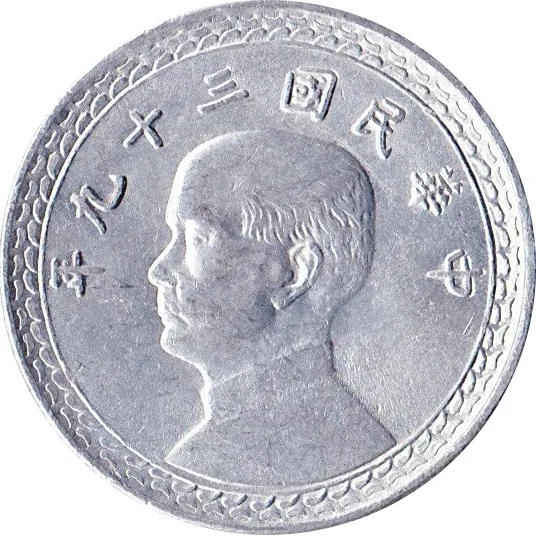
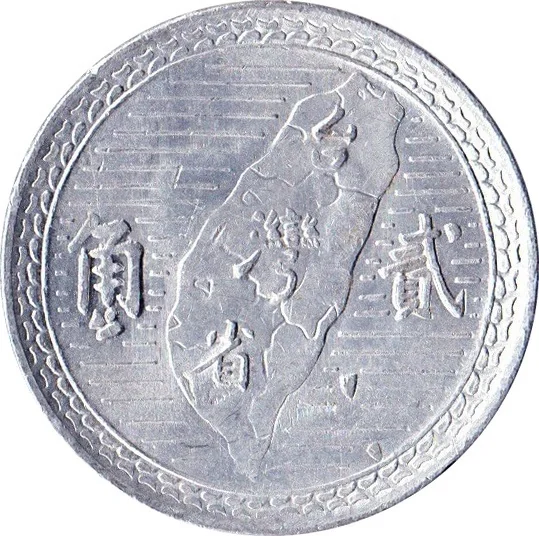
2 Jiao – Taiwan
China
Context
Year: 1950
Chinese republican Year: 39
Country: China 
Issuer: Taiwan 
Period:
(since 1949)
Currency:
(since 1949)
Subdivision: 2 Jiao = 20 Fen
Demonetized: Yes
Total mintage: 327,495,000
Material
References
Y: #Click to copy to clipboard534
Numista: #5984
Value
Exchange value: 0.2 TWD
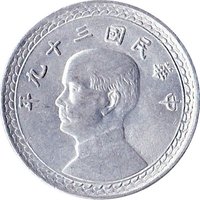
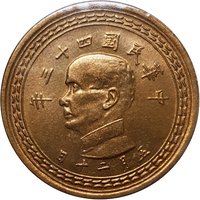
Obverse
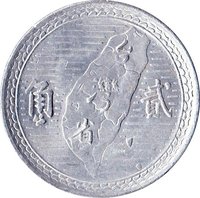
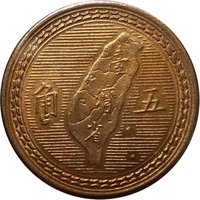
Reverse
Edge
Plain
Categories
| Person> Politician |
| Map |
Mintings
| Year | Mint Mark | Mintage | Quality | Collection |
|---|---|---|---|---|
| 1950 | — | 327,495,000 |
Historical background
In 1950, Taiwan's currency situation was one of severe instability and hyperinflation, a direct legacy of the Chinese Civil War. The Kuomintang (KMT) government, having retreated from the mainland, brought with it the deeply devalued "Gold Yuan" currency. This currency, already in a state of collapse due to the mainland's economic disintegration and rampant money printing to fund the war, flooded the Taiwanese economy. The result was a devastating loss of public confidence and a vicious cycle of soaring prices, which crippled economic recovery and daily life on the island.
To confront this crisis, the government enacted a radical monetary reform in June 1949, introducing the New Taiwan Dollar (NTD) as the provincial currency. The reform was strict: it imposed a ceiling on the amount of old currency that could be exchanged and was backed by substantial reserves, including gold, silver, and foreign currency, along with key economic assets like sugar and rice. Critically, the government pegged the new currency to the US Dollar at a rate of 5 NTD to 1 USD and established a currency reserve board to prevent the unchecked printing of money that had doomed previous currencies.
By 1950, these measures had begun to stabilize the monetary system, but the situation remained fragile. The outbreak of the Korean War in June 1950 proved to be a pivotal turning point, as it led to the resumption of significant US military and economic aid to Taiwan. This American support, part of a broader strategy to contain communism in Asia, provided the foreign exchange and material backing that the new currency desperately needed to maintain its credibility. Thus, while the foundational reforms of 1949 had halted the hyperinflation, it was the geopolitical shift in 1950 that secured the New Taiwan Dollar's survival and set the stage for Taiwan's future economic development.
To confront this crisis, the government enacted a radical monetary reform in June 1949, introducing the New Taiwan Dollar (NTD) as the provincial currency. The reform was strict: it imposed a ceiling on the amount of old currency that could be exchanged and was backed by substantial reserves, including gold, silver, and foreign currency, along with key economic assets like sugar and rice. Critically, the government pegged the new currency to the US Dollar at a rate of 5 NTD to 1 USD and established a currency reserve board to prevent the unchecked printing of money that had doomed previous currencies.
By 1950, these measures had begun to stabilize the monetary system, but the situation remained fragile. The outbreak of the Korean War in June 1950 proved to be a pivotal turning point, as it led to the resumption of significant US military and economic aid to Taiwan. This American support, part of a broader strategy to contain communism in Asia, provided the foreign exchange and material backing that the new currency desperately needed to maintain its credibility. Thus, while the foundational reforms of 1949 had halted the hyperinflation, it was the geopolitical shift in 1950 that secured the New Taiwan Dollar's survival and set the stage for Taiwan's future economic development.
🌱 Common