

10 cash – Sinkiang Province
Add to wishlist
China
Context
Years: 1921–1922
Country: China
Issuer: Sinkiang Province
Period:
(1912—1949)
Currency:
(1939—1949)
Demonetized: Yes
Material
References
Y: #
Numista: #42030
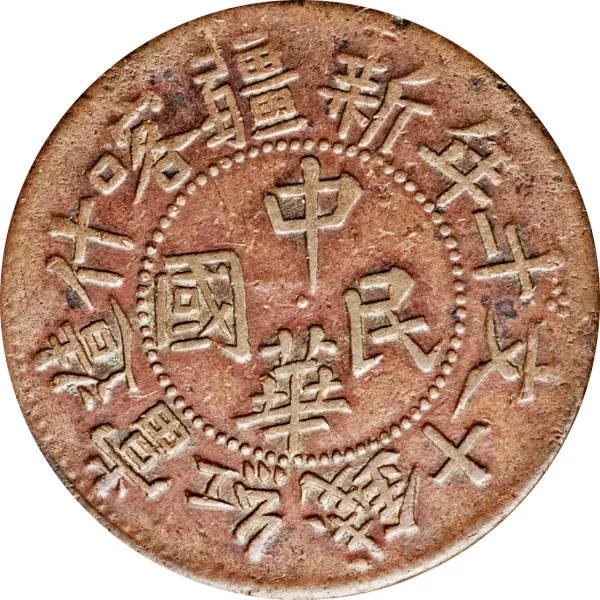
Obverse
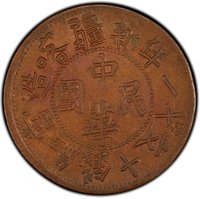
Description:
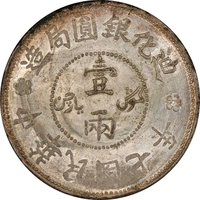
Four ideograms read vertically, right to left, encircled by more characters.
Inscription:
造什喀疆新年一十文十錢紅當
中
國民
華
中
國民
華
Translation:
Made in Kashgar. Republic of China. Ten Wen. Ten Cash. Red Coin. Equivalent to Ten.
Language: Chinese
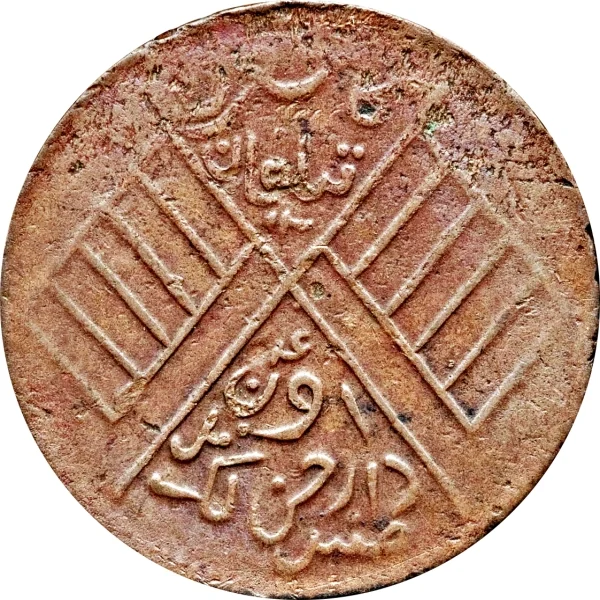
Reverse
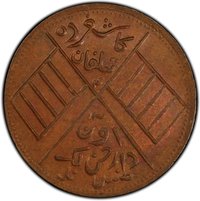
Description:
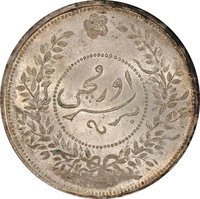
Crossed flags with Arabic text above and below.
Inscription:
ضو ب
كاشنو
۱۳۴٠
مس جل
اون داچن ليک
كاشنو
۱۳۴٠
مس جل
اون داچن ليک
Translation:
Struck at
Kashan
1340
Mass Jule
One Dachen Lik
Kashan
1340
Mass Jule
One Dachen Lik
Language: Persian
Edge
Mintings
| Year | Mint Mark | Mintage | Quality | Collection |
|---|---|---|---|---|
| 1921 | — | — | ||
| 1922 | — | — |
Historical background
In 1921, Sinkiang (Xinjiang) Province existed in a state of monetary fragmentation and instability, characteristic of the wider Chinese warlord era. The province was under the de facto autonomous rule of Governor Yang Zengxin, who maintained a fragile balance between the Republic of China's nominal sovereignty and his own practical control. The currency system reflected this political reality, consisting of a chaotic mix of legacy currencies, local issues, and foreign imports. The primary medium was the Xinjiang Tael (yinliao), a silver-based unit used for large transactions and official accounts, but the actual physical currency in circulation was a diverse array of silver coins (including Mexican and old Imperial Chinese dollars), copper cash coins, and most notably, paper notes issued by Yang's provincial government.
These locally printed paper notes, denominated in taels, yuan, and jiang piao (新疆紙鈔), were the workhorse of the everyday economy but suffered from severe depreciation and regional inconsistency. Yang Zengxin issued currency to finance provincial expenditures without sufficient metallic backing, leading to inflation and a deep distrust of paper money among the populace, particularly outside the capital of Dihua (Ürümqi). Furthermore, the vast geography and poor integration of Sinkiang's oases meant that notes issued in one district often traded at a steep discount in another, hampering trade. The situation was exacerbated by the province's economic isolation and the disruption of traditional Silk Road trade.
Compounding the complexity was the influence of foreign currencies along the borders. Russian Tsarist rubles and, following the Bolshevik Revolution, Soviet rubles circulated heavily in the Ili and northern regions due to cross-border trade. In the south, Indian rupees and British trade dollars had some presence. This multi-currency environment, with its competing paper issues and varying metallic values, created a landscape ripe for arbitrage and merchant speculation. Ultimately, the monetary chaos of 1921 Sinkiang was a direct manifestation of its political separation from central China, its ruler's fiscal policies, and its position as a contested economic crossroads of Inner Asia.
These locally printed paper notes, denominated in taels, yuan, and jiang piao (新疆紙鈔), were the workhorse of the everyday economy but suffered from severe depreciation and regional inconsistency. Yang Zengxin issued currency to finance provincial expenditures without sufficient metallic backing, leading to inflation and a deep distrust of paper money among the populace, particularly outside the capital of Dihua (Ürümqi). Furthermore, the vast geography and poor integration of Sinkiang's oases meant that notes issued in one district often traded at a steep discount in another, hampering trade. The situation was exacerbated by the province's economic isolation and the disruption of traditional Silk Road trade.
Compounding the complexity was the influence of foreign currencies along the borders. Russian Tsarist rubles and, following the Bolshevik Revolution, Soviet rubles circulated heavily in the Ili and northern regions due to cross-border trade. In the south, Indian rupees and British trade dollars had some presence. This multi-currency environment, with its competing paper issues and varying metallic values, created a landscape ripe for arbitrage and merchant speculation. Ultimately, the monetary chaos of 1921 Sinkiang was a direct manifestation of its political separation from central China, its ruler's fiscal policies, and its position as a contested economic crossroads of Inner Asia.

✨ Legendary