

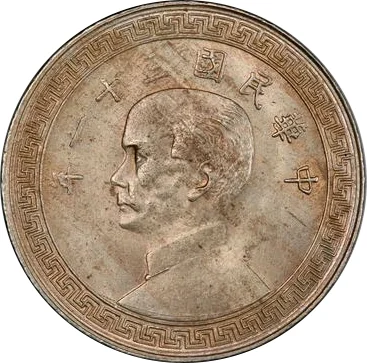
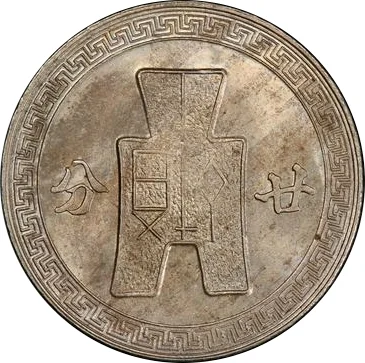
20 fen – Republic of China
Add to wishlist
China
Context
Year: 1942
Chinese republican Year:: 31
Country: China
Issuer: Republic of China
Period:
(1912—1949)
Currency:
(1912—1948)
Demonetized: Yes
Total mintage: 32,300,000
Material
Diameter: 24 mm
Weight: 4.87 g
Shape: Round
Composition: Copper-nickel
Technique: Milled
Alignment: Medal alignment
flip
References
Y: #
Numista: #38991
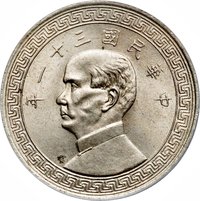
Obverse
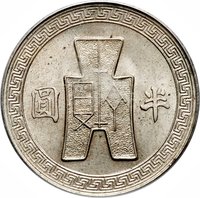
Reverse
Description:
Ancient Chinese spade coin with one ideogram per side within a decorative border.
Inscription:
分廿
貝齊
貝齊
Translation:
Twenty fen.
Qi coin.
Qi coin.
Script: Chinese
Language: Classical Chinese
Edge
Reeded.
Categories
| Currency> Coin depiction |
| Person> Politician |
Mintings
| Year | Mint Mark | Mintage | Quality | Collection |
|---|---|---|---|---|
| 1942 | — | 32,300,000 |
Historical background
In 1942, the Republic of China, under the Nationalist (Kuomintang) government, was in the eighth year of a brutal and costly total war against Japan. The currency situation was one of severe crisis and hyperinflation, directly stemming from the war's immense financial strain. The government had retreated to the provisional capital of Chongqing, controlling much of China's impoverished interior, while Japan occupied the economically vital coastal cities and ports. To finance the war effort, the government under Chiang Kai-shek relied heavily on printing currency without sufficient reserves, leading to a catastrophic devaluation of the official Fabi (Chinese National Currency). Simultaneously, multiple currencies circulated in occupied areas, including Japanese Military Yen and puppet regime notes, creating a fragmented and chaotic monetary landscape.
The primary driver of the crisis was the government's massive fiscal deficit, covered almost entirely by the Central Bank of China's printing presses. With industrial and tax bases drastically reduced, and military expenditures consuming over 70% of the budget, money supply exploded. This was compounded by supply-side shocks: blockades and lost territory severed access to key resources, causing severe shortages of everyday goods. As the quantity of Fabi skyrocketed and the availability of commodities plummeted, prices began an upward spiral. Although the full hyperinflationary collapse would peak after 1945, the inflationary trajectory was firmly established by 1942, eroding public confidence and savaging the living standards of soldiers, civil servants, and urban populations.
In response to the deteriorating situation, 1942 saw a significant but ultimately futile monetary reform. In February, the government officially abolished the Customs Gold Unit and centralized note-issuing authority, allowing only the Central Bank of China to issue Fabi. More importantly, it received a US$500 million loan from the United States, with half intended to stabilize the currency. This led to the introduction of a new, gold-standard-backed currency in April, but its circulation was limited and confidence was minimal. The fundamental problems of deficit financing and material scarcity remained unaddressed, rendering these measures palliative. Thus, the currency situation in 1942 was a critical tipping point, marking the descent from severe wartime inflation into the uncontrollable hyperinflation that would later cripple the Nationalist government's economy and legitimacy.
The primary driver of the crisis was the government's massive fiscal deficit, covered almost entirely by the Central Bank of China's printing presses. With industrial and tax bases drastically reduced, and military expenditures consuming over 70% of the budget, money supply exploded. This was compounded by supply-side shocks: blockades and lost territory severed access to key resources, causing severe shortages of everyday goods. As the quantity of Fabi skyrocketed and the availability of commodities plummeted, prices began an upward spiral. Although the full hyperinflationary collapse would peak after 1945, the inflationary trajectory was firmly established by 1942, eroding public confidence and savaging the living standards of soldiers, civil servants, and urban populations.
In response to the deteriorating situation, 1942 saw a significant but ultimately futile monetary reform. In February, the government officially abolished the Customs Gold Unit and centralized note-issuing authority, allowing only the Central Bank of China to issue Fabi. More importantly, it received a US$500 million loan from the United States, with half intended to stabilize the currency. This led to the introduction of a new, gold-standard-backed currency in April, but its circulation was limited and confidence was minimal. The fundamental problems of deficit financing and material scarcity remained unaddressed, rendering these measures palliative. Thus, the currency situation in 1942 was a critical tipping point, marking the descent from severe wartime inflation into the uncontrollable hyperinflation that would later cripple the Nationalist government's economy and legitimacy.
🌟 Uncommon