

1 fen – Republic of China
Add to wishlist
China
Context
Year: 1948
Chinese republican Year:: 37
Country: China
Issuer: Republic of China
Period:
(1912—1949)
Currency:
(1912—1948)
Demonetized: Yes
Material
References
Y: #
Numista: #42345
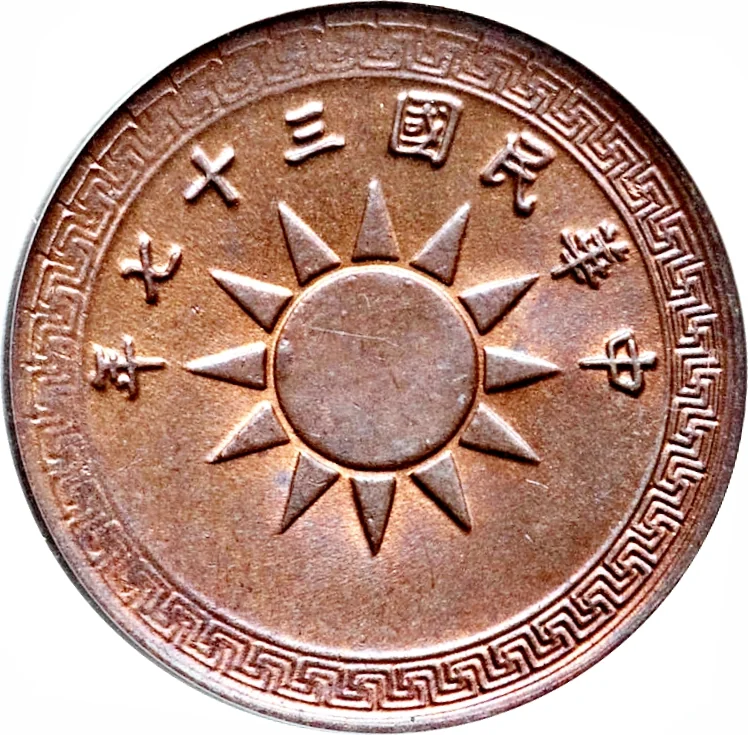
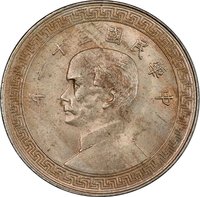
Obverse
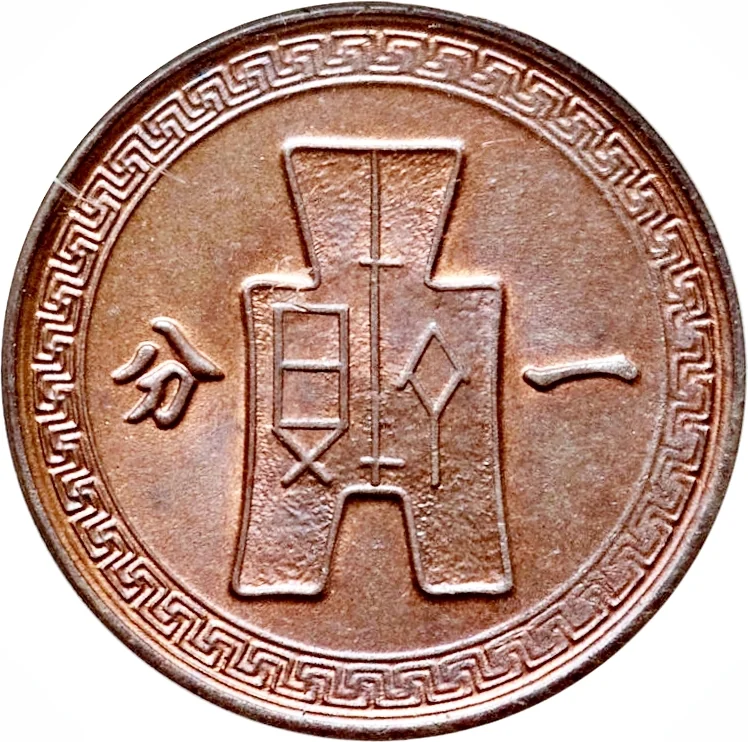
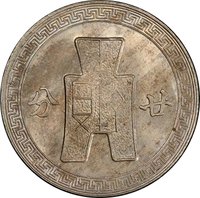
Reverse
Description:
Ancient Chinese spade coin with one ideogram per side within a decorative border.
Inscription:
分一
貝齊
貝齊
Translation:
Qi of Bei, One Fen.
Script: Chinese
Language: Classical Chinese
Edge
Plain
Categories
| Currency> Coin depiction |
Mintings
| Year | Mint Mark | Mintage | Quality | Collection |
|---|---|---|---|---|
| 1948 | — | — |
Historical background
By mid-1948, the Republic of China, under the Kuomintang (KMT) government, was in a state of profound economic and military crisis. The costly civil war against the Chinese Communist Party (CCP) drained the treasury, leading the government to finance deficits by printing money on a massive scale. This triggered hyperinflation of catastrophic proportions; prices doubled every few weeks, the national currency (the fabi) became virtually worthless, and public confidence in the financial system collapsed. The situation was exacerbated by widespread corruption, speculative hoarding of goods and foreign currency, and the loss of key economic regions to communist forces.
In a desperate attempt to stabilize the economy, the government launched a radical currency reform on August 19, 1948. It introduced the Gold Yuan (Jinyuanquan), which was to replace the fabi at an exchange rate of 1 Gold Yuan to 3 million fabi. The reform was accompanied by drastic measures: citizens were forced to surrender all gold, silver, and foreign currency in exchange for the new notes, and price controls were imposed. Initially, the reform briefly halted the inflation, as people complied under threat of severe punishment. However, the fundamental problems remained unaddressed; the government continued to print the new currency to fund the war without adequate gold or silver reserves to back it.
The Gold Yuan reform unraveled within months. As military defeats mounted, the government abandoned its own monetary discipline, printing Gold Yuan notes even more recklessly than the old currency. Price controls led to empty shelves and a thriving black market. By early 1949, hyperinflation returned with unprecedented ferocity, rendering the Gold Yuan worthless. The complete loss of public trust marked the final economic collapse of the KMT government on the mainland, contributing directly to its military defeat and retreat to Taiwan in 1949, where a separate and successful currency reform was later implemented.
In a desperate attempt to stabilize the economy, the government launched a radical currency reform on August 19, 1948. It introduced the Gold Yuan (Jinyuanquan), which was to replace the fabi at an exchange rate of 1 Gold Yuan to 3 million fabi. The reform was accompanied by drastic measures: citizens were forced to surrender all gold, silver, and foreign currency in exchange for the new notes, and price controls were imposed. Initially, the reform briefly halted the inflation, as people complied under threat of severe punishment. However, the fundamental problems remained unaddressed; the government continued to print the new currency to fund the war without adequate gold or silver reserves to back it.
The Gold Yuan reform unraveled within months. As military defeats mounted, the government abandoned its own monetary discipline, printing Gold Yuan notes even more recklessly than the old currency. Price controls led to empty shelves and a thriving black market. By early 1949, hyperinflation returned with unprecedented ferocity, rendering the Gold Yuan worthless. The complete loss of public trust marked the final economic collapse of the KMT government on the mainland, contributing directly to its military defeat and retreat to Taiwan in 1949, where a separate and successful currency reform was later implemented.
💎 Very Rare