

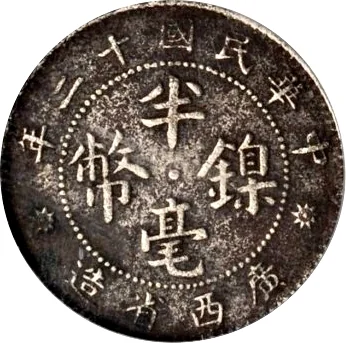
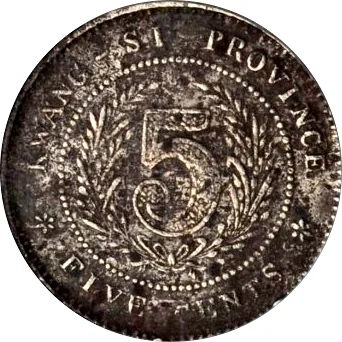
½ Jiao – Kwangsi Province
China
Context
Year: 1923
Chinese republican Year: 12
Country: China 
Issuer: Kwangsi Province
Period:
(1912—1949)
Currency:
(1905—1949)
Demonetized: Yes
Material
Shape: Round
Composition: Copper-nickel
Technique: Milled
Alignment: Medal alignment
flip
References
Y: #Click to copy to clipboardA415
Numista: #36550
Obverse
Reverse
Description:
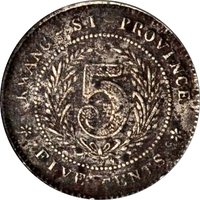
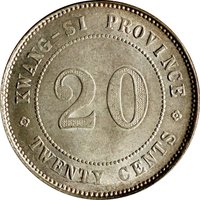
Value encircled by wreath with English inscription.
Inscription:
KWANG-SI PROVINCE
5
FIVE CENTS
5
FIVE CENTS
Script: Latin
Edge
Mintings
| Year | Mint Mark | Mintage | Quality | Collection |
|---|---|---|---|---|
| 1923 | — | — |
Historical background
In 1923, the currency situation in Kwangsi (Guangxi) Province was one of profound disorder and fragmentation, a direct reflection of the province's political instability during the warlord era. The province was effectively divided between two major militarist factions: the "Old Guangxi Clique" under Lu Rongting and the emerging "New Guangxi Clique" led by Li Zongren and Huang Shaohong. This political division meant there was no single, authoritative entity capable of issuing and maintaining a stable provincial currency. Instead, the monetary system was a chaotic patchwork of various forms of money, each with limited and uncertain acceptance.
The primary circulating media included national currencies, provincial issues, and private scrip. Silver dollars (particularly the "dragon dollar" and foreign trade coins like Mexican pesos), silver sycee (bullion), and copper cash coins still formed the traditional hard currency base, but their supply was inconsistent. More problematic were the paper notes issued by various provincial banks and military authorities, which were often overprinted, inadequately backed, and subject to drastic depreciation as the fortunes of their issuing warlords rose and fell. Furthermore, local merchants, chambers of commerce, and even military units frequently issued their own private tiepiao (credit notes) to facilitate trade and pay troops, creating a hyper-localized and unstable monetary environment.
This currency chaos severely hampered economic activity and burdened the local population. The value of paper notes could collapse overnight if a military patron was defeated, leading to sudden impoverishment and a loss of public trust. Trade between different districts within Kwangsi was complicated by the need to constantly exchange disparate notes at unfavorable discounts. Ultimately, the monetary disarray of 1923 was a symptom of the broader breakdown of central authority in China, illustrating how warlordism corroded the basic economic foundations of daily life, a situation that would only begin to resolve after the New Guangxi Clique consolidated power later in the decade and attempted financial reforms.
The primary circulating media included national currencies, provincial issues, and private scrip. Silver dollars (particularly the "dragon dollar" and foreign trade coins like Mexican pesos), silver sycee (bullion), and copper cash coins still formed the traditional hard currency base, but their supply was inconsistent. More problematic were the paper notes issued by various provincial banks and military authorities, which were often overprinted, inadequately backed, and subject to drastic depreciation as the fortunes of their issuing warlords rose and fell. Furthermore, local merchants, chambers of commerce, and even military units frequently issued their own private tiepiao (credit notes) to facilitate trade and pay troops, creating a hyper-localized and unstable monetary environment.
This currency chaos severely hampered economic activity and burdened the local population. The value of paper notes could collapse overnight if a military patron was defeated, leading to sudden impoverishment and a loss of public trust. Trade between different districts within Kwangsi was complicated by the need to constantly exchange disparate notes at unfavorable discounts. Ultimately, the monetary disarray of 1923 was a symptom of the broader breakdown of central authority in China, illustrating how warlordism corroded the basic economic foundations of daily life, a situation that would only begin to resolve after the New Guangxi Clique consolidated power later in the decade and attempted financial reforms.
✨ Legendary