

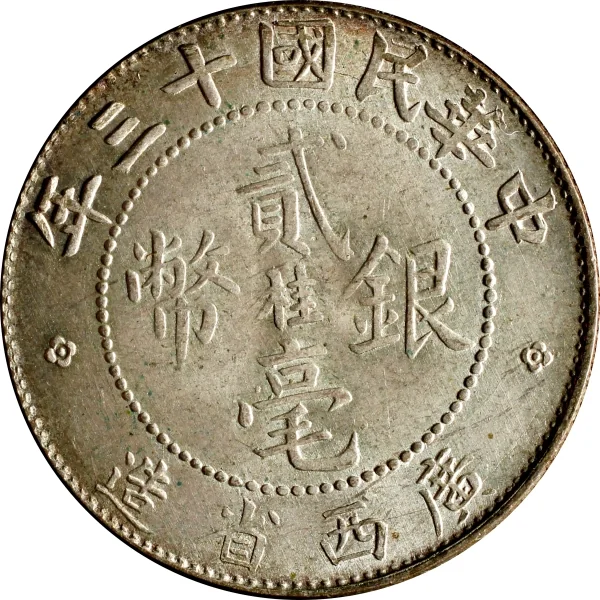
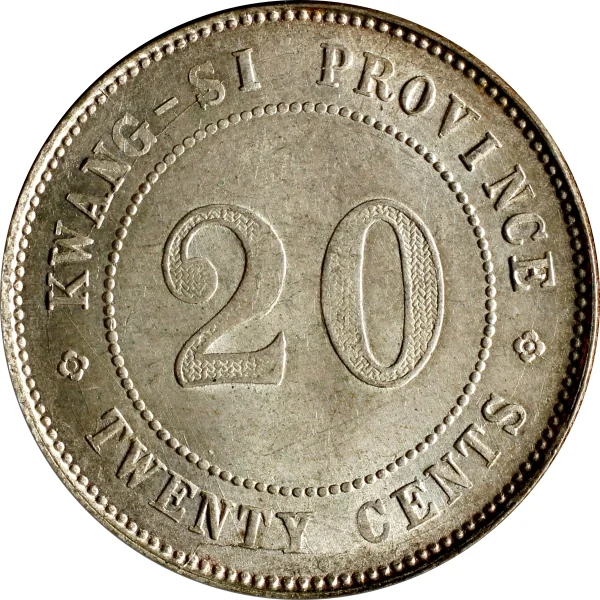
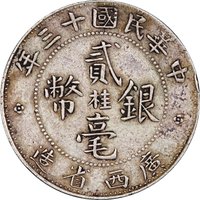
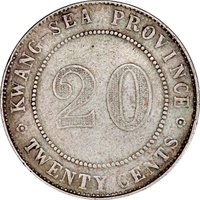
2 jiao – Kwangsi Province
Add to wishlist
China
Context
Year: 1924
Chinese republican Year:: 13
Country: China
Issuer: Kwangsi Province
Period:
(1912—1949)
Currency:
(1905—1949)
Demonetized: Yes
Material
References
Y: #
Numista: #275417
Value
Bullion value: $13.54
Obverse
Reverse
Edge
Reeded.
Mintings
| Year | Mint Mark | Mintage | Quality | Collection |
|---|---|---|---|---|
| 1924 | — | — |
Historical background
In 1924, the currency situation in Kwangsi (Guangxi) Province was one of profound disorder and fragmentation, characteristic of the wider warlord era in China. The province was under the unstable and contested control of local militarists, primarily the Old Guangxi Clique, though their authority was being challenged. With no central monetary authority from the beleaguered Beijing government reaching effectively into the region, Kwangsi's economy operated on a chaotic mix of currencies. These included old imperial silver coins (yuan), silver sycee (ingots), and a dwindling supply of copper cash coins, alongside a flood of banknotes issued by various provincial and private banks with little to no uniform regulation or sufficient reserves.
The most acute problem was the proliferation of unbacked paper money. To finance military campaigns and administration, warlord regimes and their affiliated banks, such as the Kwangsi Provincial Bank, issued vast quantities of local banknotes (Guangxi piào). These notes were often forced into circulation without proper metallic backing, leading to rapid depreciation and severe loss of public confidence. Merchants and the populace, wary of this worthless paper, increasingly hoarded silver, which drove the solid coinage out of circulation entirely—a classic example of Gresham's Law. This created a two-tier system where daily transactions were conducted in depreciating paper, while silver became the preferred store of value and medium for large or inter-regional trade.
Consequently, the monetary chaos severely disrupted commerce and exacerbated economic hardship for ordinary people. Inflation eroded livelihoods, and the varying discount rates on notes between cities and counties made trade difficult. The situation also reflected and reinforced Kwangsi's political isolation, as its unstable currency was not readily accepted in neighboring provinces like Kwangtung (Guangdong) or Yunnan. This financial disarray was a direct symptom of warlord rule, where short-term military survival was prioritized over economic stability, leaving the provincial economy fractured and the population to navigate a treacherous landscape of competing and devaluing currencies.
The most acute problem was the proliferation of unbacked paper money. To finance military campaigns and administration, warlord regimes and their affiliated banks, such as the Kwangsi Provincial Bank, issued vast quantities of local banknotes (Guangxi piào). These notes were often forced into circulation without proper metallic backing, leading to rapid depreciation and severe loss of public confidence. Merchants and the populace, wary of this worthless paper, increasingly hoarded silver, which drove the solid coinage out of circulation entirely—a classic example of Gresham's Law. This created a two-tier system where daily transactions were conducted in depreciating paper, while silver became the preferred store of value and medium for large or inter-regional trade.
Consequently, the monetary chaos severely disrupted commerce and exacerbated economic hardship for ordinary people. Inflation eroded livelihoods, and the varying discount rates on notes between cities and counties made trade difficult. The situation also reflected and reinforced Kwangsi's political isolation, as its unstable currency was not readily accepted in neighboring provinces like Kwangtung (Guangdong) or Yunnan. This financial disarray was a direct symptom of warlord rule, where short-term military survival was prioritized over economic stability, leaving the provincial economy fractured and the population to navigate a treacherous landscape of competing and devaluing currencies.
✨ Legendary