

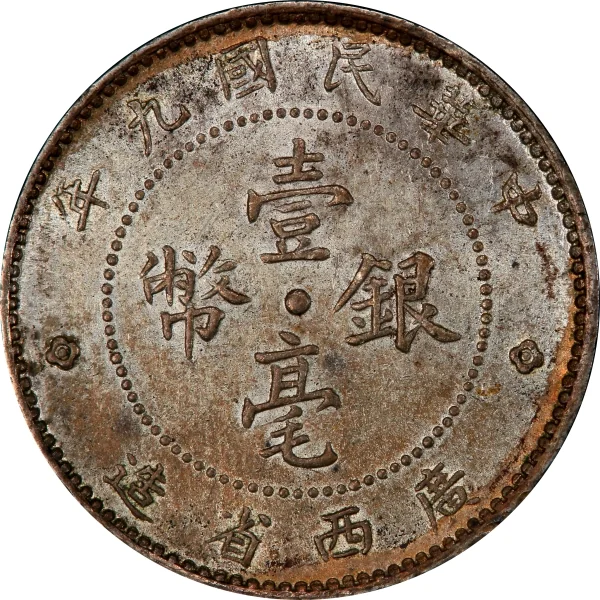
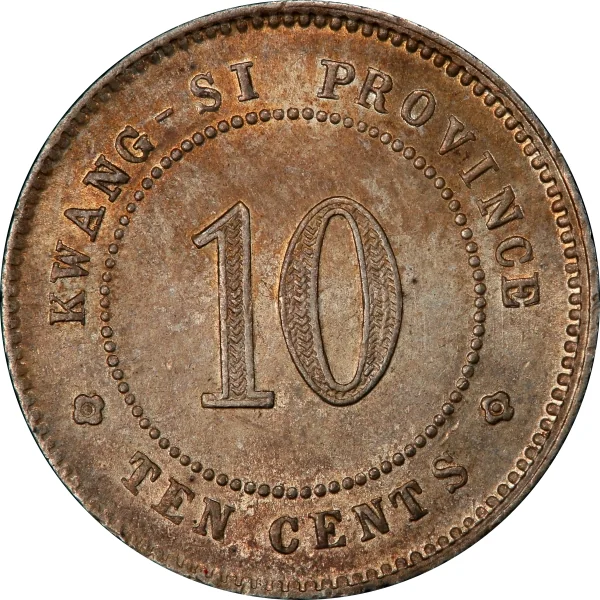
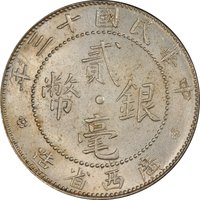
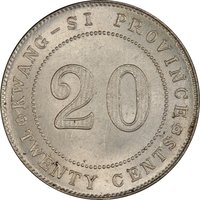
1 Jiao – Kwangsi Province
China
Context
Year: 1920
Chinese republican Year: 9
Country: China 
Issuer: Kwangsi Province
Period:
(1912—1949)
Currency:
(1905—1949)
Demonetized: Yes
Material
References
Y: #Click to copy to clipboard414
Numista: #36543
Value
Bullion value: $7.60
Obverse
Reverse
Edge
Reeded.
Mintings
| Year | Mint Mark | Mintage | Quality | Collection |
|---|---|---|---|---|
| 1920 | — | — |
Historical background
In the early 1920s, Kwangsi (Guangxi) Province, like much of Republican China, was characterized by severe monetary fragmentation and instability. The province was under the control of the Old Guangxi Clique, a militarist regime led by Lu Rongting, which prioritized military expansion over unified economic governance. The monetary system was a chaotic mix of national, provincial, and foreign currencies, including silver dollars (yuan), subsidiary copper coins, and a flood of paper notes issued by various provincial banks, military authorities, and even local merchants. The most prominent was the paper currency issued by the Bank of Kwangsi (Guangxi Yinhang), established in 1920, but its credibility was weak from the outset due to inadequate reserves and the regime's fiscal demands.
This currency chaos was exacerbated by Kwangsi's relative economic isolation and the warlord government's chronic budget deficits, which were funded by unrestrained printing of banknotes. As a result, the value of Kwangsi paper currency depreciated rapidly against silver, leading to severe inflation that eroded public trust. The situation was further complicated by the circulation of currencies from neighboring provinces and foreign trade, particularly with French Indochina, where the Indochinese piastre was often preferred for its stability. This created a multi-tiered currency environment where hard silver coins were hoarded, while devalued local notes were used for everyday transactions, harming peasants and urban workers alike.
Ultimately, the monetary disorder in Kwangsi was a direct reflection of the province's political fragmentation and the wider collapse of central monetary authority in China after the fall of the Qing Dynasty. It hindered internal trade, discouraged investment, and placed a heavy burden on the local populace. This financial instability would persist and evolve through the subsequent civil wars, only finding resolution years later with the monetary reforms implemented by the New Guangxi Clique in the 1930s and, ultimately, the unification of the currency system under the Nationalist government.
This currency chaos was exacerbated by Kwangsi's relative economic isolation and the warlord government's chronic budget deficits, which were funded by unrestrained printing of banknotes. As a result, the value of Kwangsi paper currency depreciated rapidly against silver, leading to severe inflation that eroded public trust. The situation was further complicated by the circulation of currencies from neighboring provinces and foreign trade, particularly with French Indochina, where the Indochinese piastre was often preferred for its stability. This created a multi-tiered currency environment where hard silver coins were hoarded, while devalued local notes were used for everyday transactions, harming peasants and urban workers alike.
Ultimately, the monetary disorder in Kwangsi was a direct reflection of the province's political fragmentation and the wider collapse of central monetary authority in China after the fall of the Qing Dynasty. It hindered internal trade, discouraged investment, and placed a heavy burden on the local populace. This financial instability would persist and evolve through the subsequent civil wars, only finding resolution years later with the monetary reforms implemented by the New Guangxi Clique in the 1930s and, ultimately, the unification of the currency system under the Nationalist government.
✨ Legendary