

5 fen – Kwangtung Province
Add to wishlist
China
Context
Year: 1919
Chinese republican Year:: 8
Country: China
Issuer: Kwangtung Province
Period:
(1912—1949)
Currency:
(1900—1949)
Subdivision: 5 fen = 5 Cents
Demonetized: Yes
Total mintage: 916,000
Material
Diameter: 19 mm
Weight: 2.6 g
Shape: Round
Composition: Copper-nickel
Technique: Milled
Alignment: Medal alignment
flip
References
Y: #
Numista: #36531
Obverse
Description:
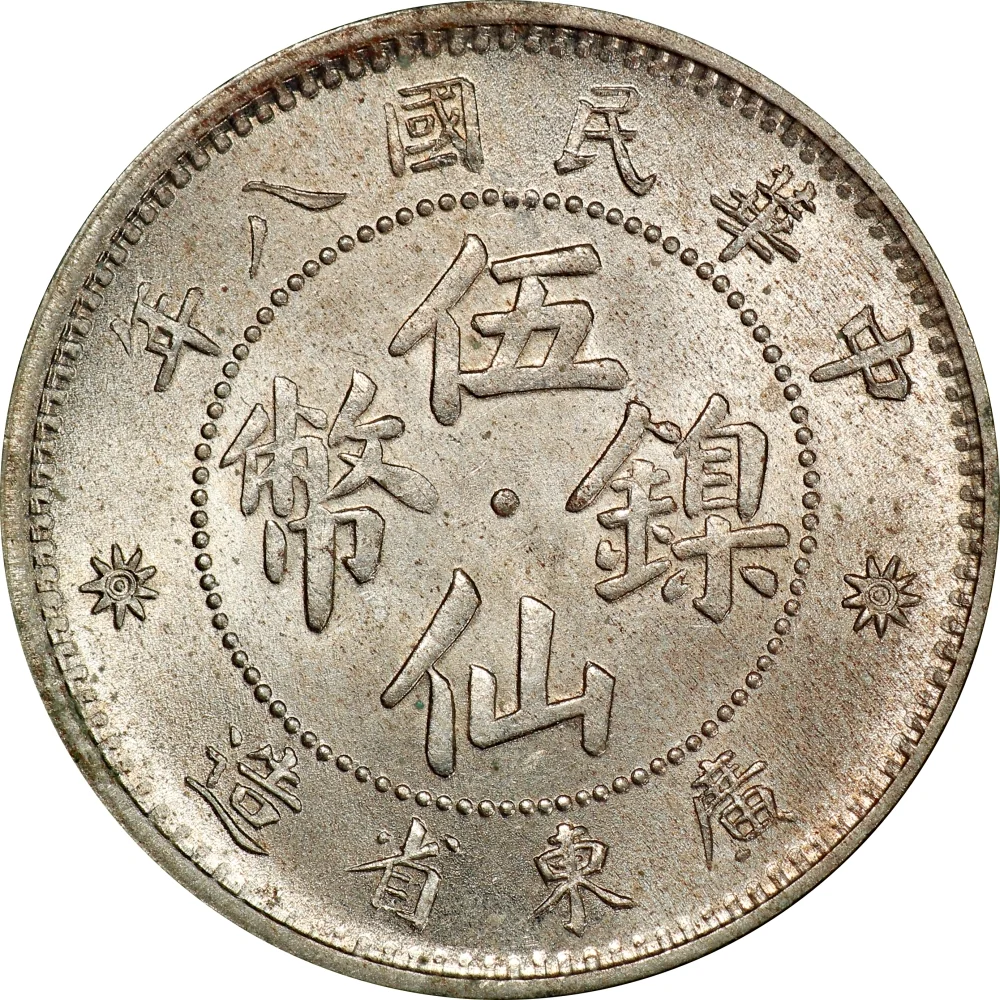
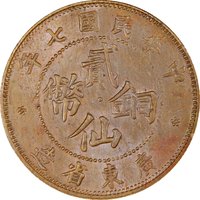
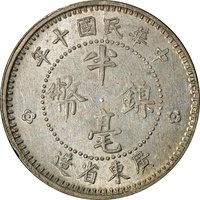
Four ideograms read vertically, right to left, encircled by more characters.
Inscription:
年八國民華中
伍
幣鎳
仙
造省東廣
伍
幣鎳
仙
造省東廣
Translation:
REPUBLIC OF CHINA YEAR 8
5
CASH NICKEL
CENT
MINTED GUANGDONG PROVINCE
5
CASH NICKEL
CENT
MINTED GUANGDONG PROVINCE
Scripts: Chinese (traditional, regular script)
Language: Chinese
Reverse
Description:
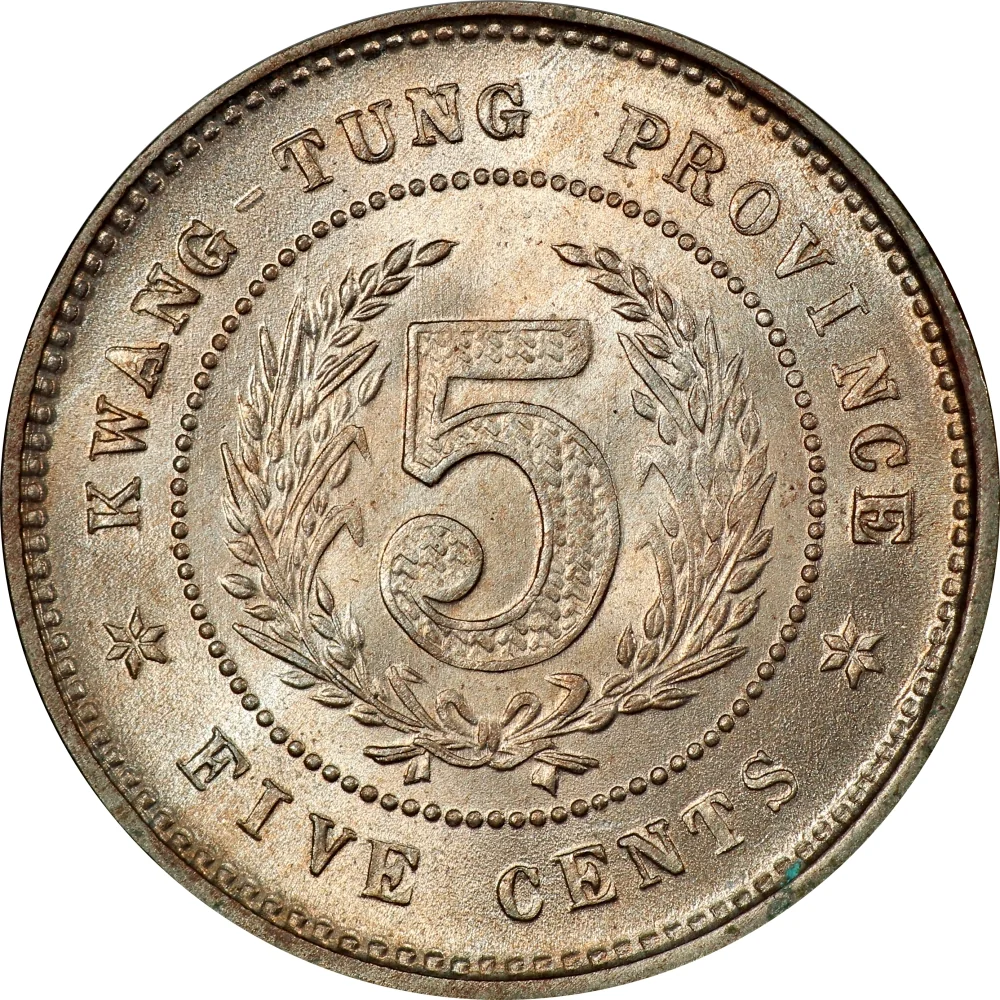
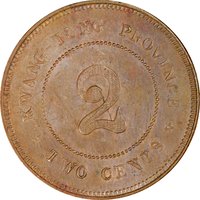
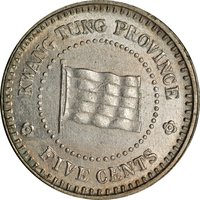
Value within wreath, English legend around.
Inscription:
KWANG-TUNG PROVINCE
5
FIVE CENTS
5
FIVE CENTS
Script: Latin
Edge
Plain
Mintings
| Year | Mint Mark | Mintage | Quality | Collection |
|---|---|---|---|---|
| 1919 | — | 916,000 |
Historical background
In 1919, Kwangtung (Guangdong) Province exemplified the monetary chaos of China's "warlord era." Following the collapse of the Qing dynasty and the failure of central authority, the province operated under the de facto rule of local militarists. The national currency system had fragmented, creating a complex and unstable multi-currency environment. While Yuan Shikai silver dollars and the theoretical unit of account, the yuan, were recognized, their actual value and acceptance were highly inconsistent.
The day-to-day monetary landscape was dominated by a proliferation of local and foreign instruments. Guangdong's own mint in Canton (Guangzhou) produced provincial silver coins (milled coins and "small Mace" subsidiary coins), but their quality and value fluctuated with the provincial government's finances. Crucially, the Mexican silver dollar and the British Hong Kong dollar remained dominant in trade, especially in the Pearl River Delta and treaty ports like Canton and Swatow (Shantou), due to their reliable silver content. Simultaneously, a flood of private banknotes (zhuangpiao) issued by local banks, pawnshops, and even merchant guilds circulated with varying degrees of trustworthiness, leading to frequent discounts and merchant disputes.
This monetary disarray severely hampered commerce and burdened the populace. Exchange rates between the myriad forms of money shifted constantly, creating opportunities for speculators while imposing hidden taxes on transactions. The instability was compounded by the provincial government's own fiscal pressures, which often tempted it to debase coinage or force the circulation of its own, potentially depreciated, notes. Thus, in 1919, Kwangtung's currency situation was not one of a unified system but a contested marketplace of metallic and paper promises, reflecting the broader political disintegration of China and the province's precarious position within both domestic and international trade networks.
The day-to-day monetary landscape was dominated by a proliferation of local and foreign instruments. Guangdong's own mint in Canton (Guangzhou) produced provincial silver coins (milled coins and "small Mace" subsidiary coins), but their quality and value fluctuated with the provincial government's finances. Crucially, the Mexican silver dollar and the British Hong Kong dollar remained dominant in trade, especially in the Pearl River Delta and treaty ports like Canton and Swatow (Shantou), due to their reliable silver content. Simultaneously, a flood of private banknotes (zhuangpiao) issued by local banks, pawnshops, and even merchant guilds circulated with varying degrees of trustworthiness, leading to frequent discounts and merchant disputes.
This monetary disarray severely hampered commerce and burdened the populace. Exchange rates between the myriad forms of money shifted constantly, creating opportunities for speculators while imposing hidden taxes on transactions. The instability was compounded by the provincial government's own fiscal pressures, which often tempted it to debase coinage or force the circulation of its own, potentially depreciated, notes. Thus, in 1919, Kwangtung's currency situation was not one of a unified system but a contested marketplace of metallic and paper promises, reflecting the broader political disintegration of China and the province's precarious position within both domestic and international trade networks.
🌟 Limited