

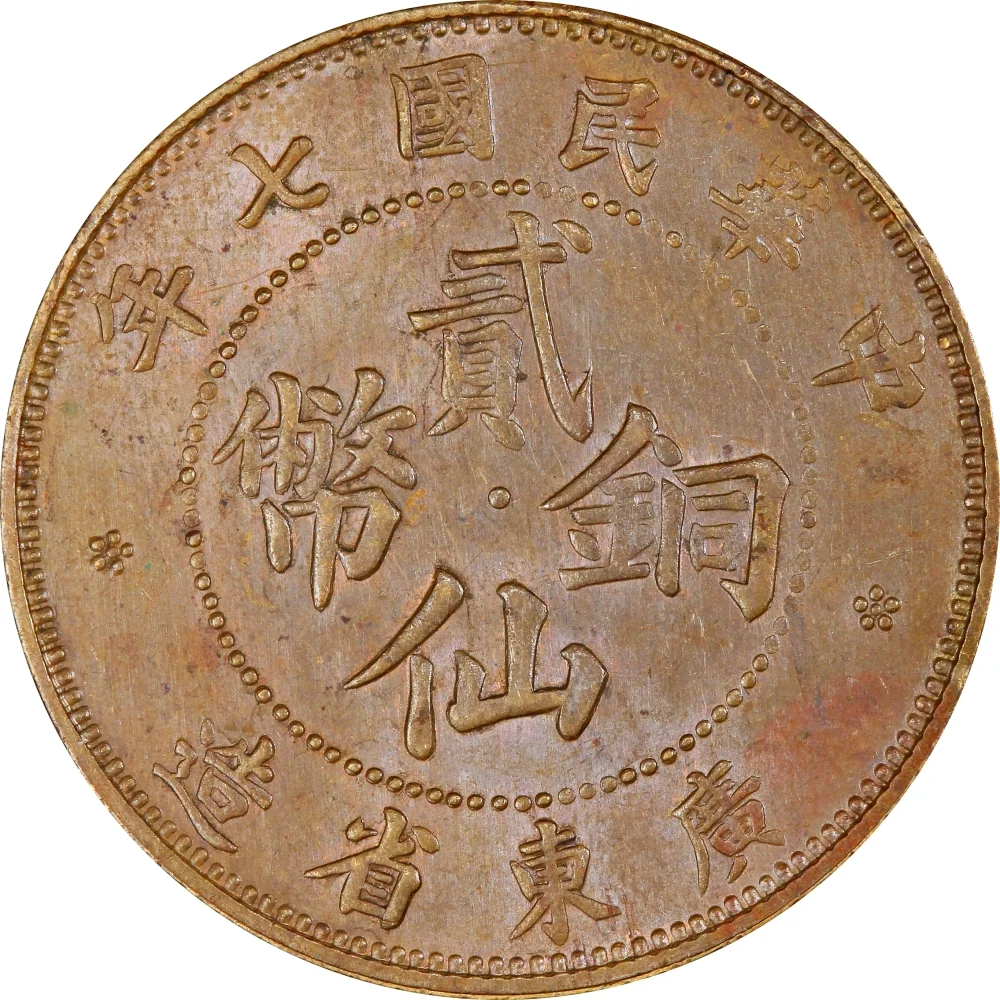
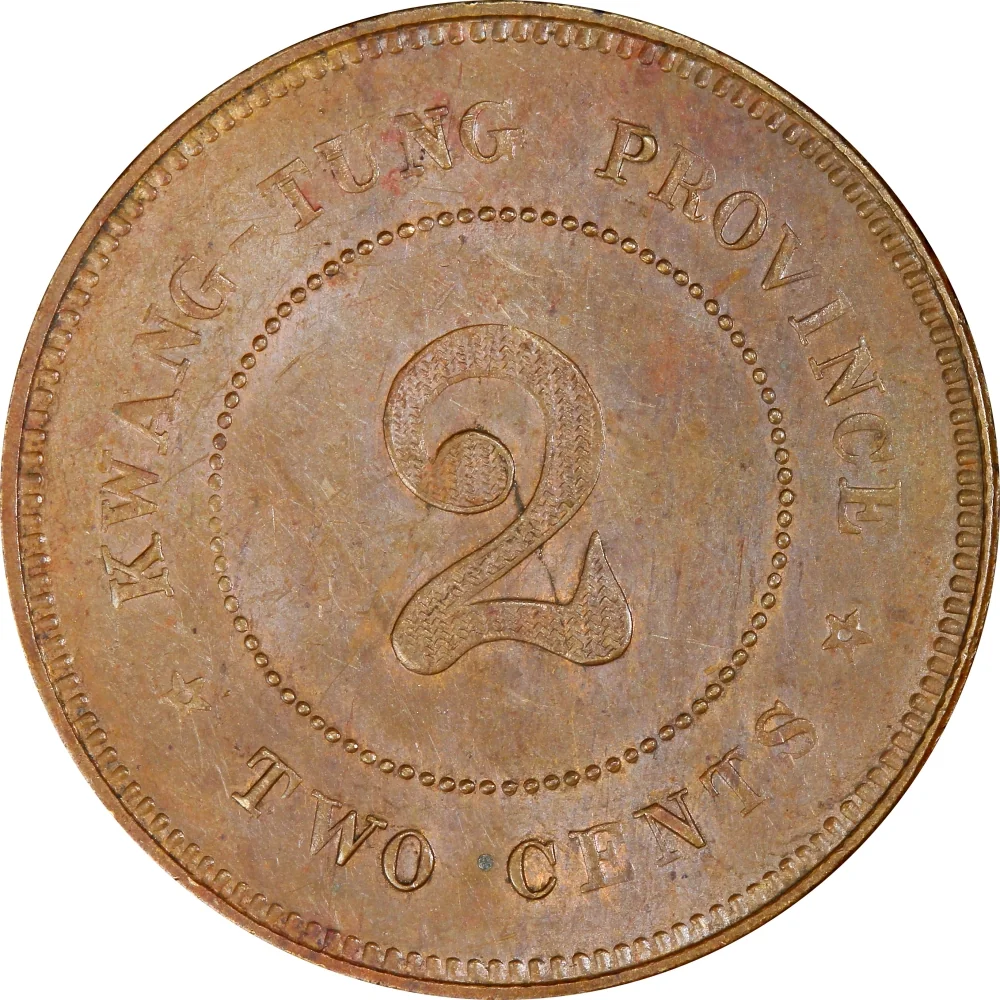
2 Fen – Kwangtung Province
China
Context
Year: 1918
Chinese republican Year: 7
Country: China 
Issuer: Kwangtung Province
Period:
(1912—1949)
Currency:
(1900—1949)
Subdivision: 2 Fen = 2 Cents
Demonetized: Yes
Material
References
Y: #Click to copy to clipboard418a
Numista: #36533
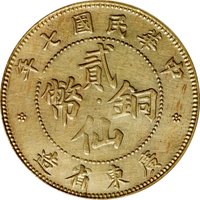
Obverse
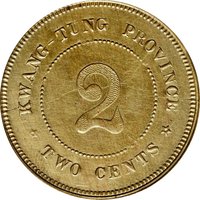
Reverse
Edge
Mintings
| Year | Mint Mark | Mintage | Quality | Collection |
|---|---|---|---|---|
| 1918 | — | — |
Historical background
In 1918, Kwangtung (Guangdong) Province was embroiled in a severe and chaotic currency crisis, a direct consequence of China's fragmented political landscape during the Warlord Era. The province was under the control of the Guangzhou Military Government, a southern regime opposed to the Beiyang government in Beijing, leading to a deliberate financial separation. This political divide resulted in the circulation of multiple, competing currencies. Silver dollars from various Chinese mints, foreign coins (like Mexican and French Indochinese piastres), and a flood of privately issued banknotes from local "native banks" and even military commanders all vied for acceptance, creating a bewildering and unstable monetary environment.
The most destabilizing factor was the massive over-issuance of unbacked paper currency. To fund military campaigns and administration, the Guangzhou authorities, led at times by Sun Yat-sen, printed enormous quantities of Guangdong Provincial Bank notes. These notes rapidly depreciated as public confidence evaporated, leading to severe inflation. The situation was exacerbated by "military scrip" forcibly issued by local garrison commanders to requisition supplies, which often became worthless once their troops moved on. This proliferation of dubious paper money caused merchants to hoard solid silver, further driving its premium and accelerating the devaluation of notes in everyday commerce.
This monetary anarchy had devastating effects on the provincial economy. Trade was hampered as merchants struggled to assess the value of different notes, and frequent discounting led to heavy losses. The suffering fell most heavily on the common people, including peasants and urban workers, who saw their wages and savings eroded by inflation. The currency crisis of 1918 was therefore not merely a financial issue but a critical symptom of the collapse of central authority, illustrating how warlord politics directly undermined economic stability and daily life in Guangdong.
The most destabilizing factor was the massive over-issuance of unbacked paper currency. To fund military campaigns and administration, the Guangzhou authorities, led at times by Sun Yat-sen, printed enormous quantities of Guangdong Provincial Bank notes. These notes rapidly depreciated as public confidence evaporated, leading to severe inflation. The situation was exacerbated by "military scrip" forcibly issued by local garrison commanders to requisition supplies, which often became worthless once their troops moved on. This proliferation of dubious paper money caused merchants to hoard solid silver, further driving its premium and accelerating the devaluation of notes in everyday commerce.
This monetary anarchy had devastating effects on the provincial economy. Trade was hampered as merchants struggled to assess the value of different notes, and frequent discounting led to heavy losses. The suffering fell most heavily on the common people, including peasants and urban workers, who saw their wages and savings eroded by inflation. The currency crisis of 1918 was therefore not merely a financial issue but a critical symptom of the collapse of central authority, illustrating how warlord politics directly undermined economic stability and daily life in Guangdong.
💎 Extremely Rare