

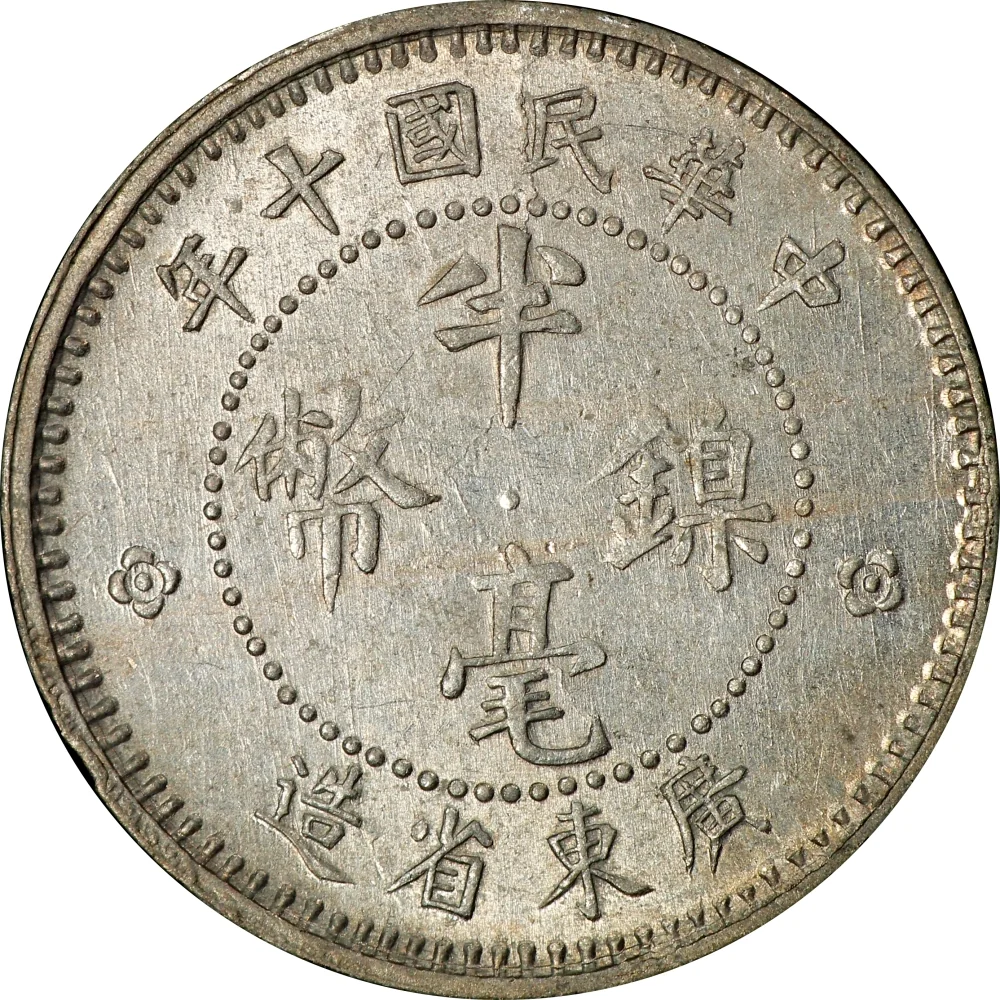
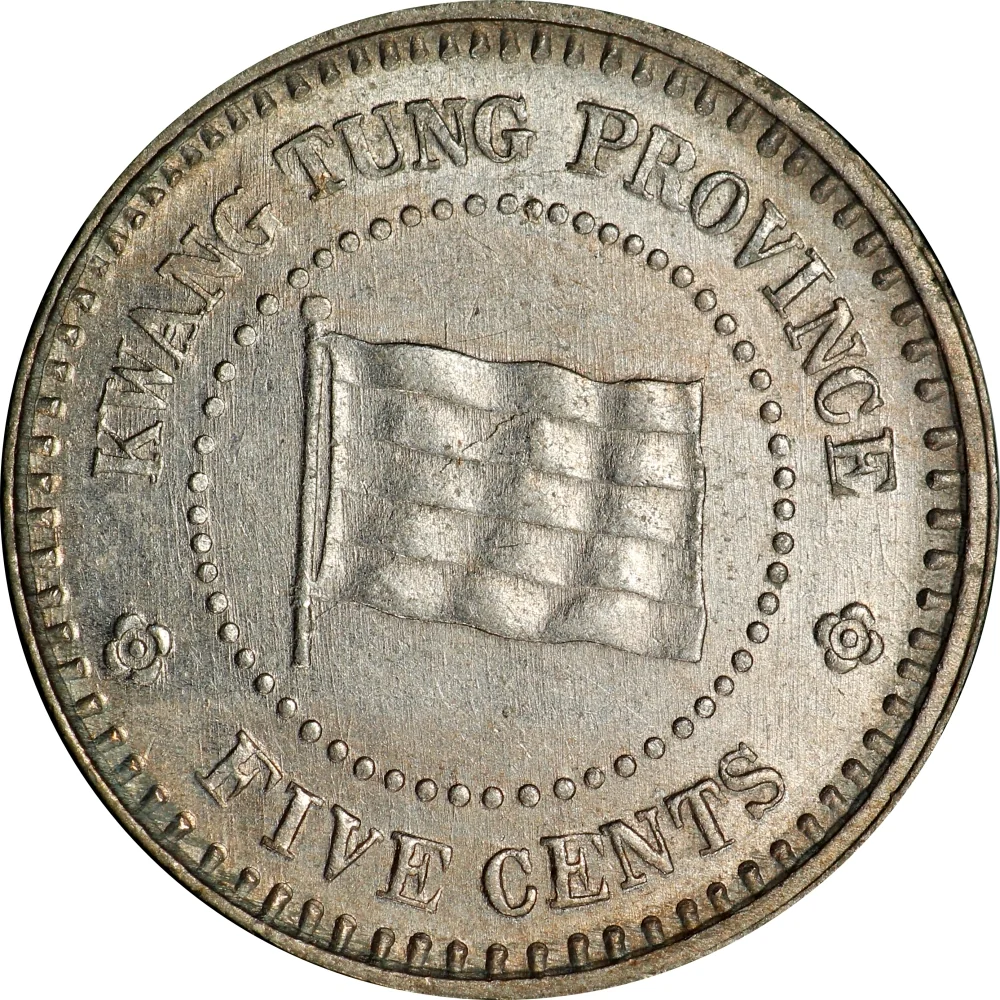
½ Jiao – Kwangtung Province
China
Context
Year: 1921
Chinese republican Year: 10
Country: China 
Issuer: Kwangtung Province
Period:
(1912—1949)
Currency:
(1900—1949)
Subdivision: ½ Jiao = 5 Cents
Demonetized: Yes
Total mintage: 666,000
Material
Diameter: 16 mm
Weight: 2.7 g
Thickness: 1.8 mm
Shape: Round
Composition: Copper-nickel
Technique: Milled
Alignment: Medal alignment
flip
References
Y: #Click to copy to clipboard421
Numista: #36529
Obverse
Reverse
Description:
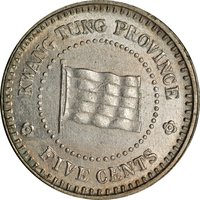
Flag encircled by English text.
Inscription:
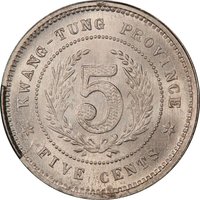
KWANG TUNG PROVINCE
FIVE CENTS
FIVE CENTS
Script: Latin
Edge
Plain
Mintings
| Year | Mint Mark | Mintage | Quality | Collection |
|---|---|---|---|---|
| 1921 | — | 666,000 |
Historical background
In 1921, Kwangtung (Guangdong) Province was a chaotic monetary landscape, emblematic of the wider political fragmentation of early Republican China. The province was under the nominal control of Sun Yat-sen's Nationalist government based in Canton (Guangzhou), but its authority was contested by local warlords, foreign concessions, and competing military factions. This political disunity was directly reflected in the currency system, which was a complex and unstable mixture of traditional, modern, and foreign instruments. The primary circulating medium included silver dollars (notably Mexican "Eagle" dollars and various Chinese provincial "dragon" dollars), silver sycee (bulk silver by weight), and a vast array of privately issued banknotes from both modern Chinese banks and traditional native banks (qianzhuang).
The most significant and destabilizing factor was the proliferation of paper money. To finance military campaigns and administration, both the provincial government and local military commanders issued their own, often unbacked, banknotes. The most notorious was the "Canton Currency," issued by the Provincial Bank of Kwangtung. These notes were issued in excessive volumes to cover fiscal shortfalls, leading to severe depreciation and widespread public distrust. Merchants and the public often preferred older, more reliable silver coins or even foreign currency, leading to a dual-system where goods had separate silver and paper prices, with the paper currency trading at a steep and fluctuating discount.
This monetary chaos severely hampered trade and daily life, creating a burden on the peasantry and merchant classes. The instability discouraged investment and facilitated speculation, while inflation eroded living standards. The situation in Kwangtung was a microcosm of China's broader crisis: the lack of a strong central authority prevented the establishment of a unified, trusted currency. Resolving the currency mess was understood to be inextricably linked to the larger project of provincial and national reunification, a goal that would continue to elude the region for years to come.
The most significant and destabilizing factor was the proliferation of paper money. To finance military campaigns and administration, both the provincial government and local military commanders issued their own, often unbacked, banknotes. The most notorious was the "Canton Currency," issued by the Provincial Bank of Kwangtung. These notes were issued in excessive volumes to cover fiscal shortfalls, leading to severe depreciation and widespread public distrust. Merchants and the public often preferred older, more reliable silver coins or even foreign currency, leading to a dual-system where goods had separate silver and paper prices, with the paper currency trading at a steep and fluctuating discount.
This monetary chaos severely hampered trade and daily life, creating a burden on the peasantry and merchant classes. The instability discouraged investment and facilitated speculation, while inflation eroded living standards. The situation in Kwangtung was a microcosm of China's broader crisis: the lack of a strong central authority prevented the establishment of a unified, trusted currency. Resolving the currency mess was understood to be inextricably linked to the larger project of provincial and national reunification, a goal that would continue to elude the region for years to come.
💎 Extremely Rare