

½ Jiao – Kwangtung Province
China
Context
Year: 1923
Chinese republican Year: 12
Country: China 
Issuer: Kwangtung Province
Period:
(1912—1949)
Currency:
(1900—1949)
Subdivision: ½ Jiao = 5 Cents
Demonetized: Yes
Total mintage: 480,000
Material
Diameter: 19 mm
Weight: 2.6 g
Shape: Round
Composition: Copper-nickel
Technique: Milled
Alignment: Medal alignment
flip
References
Y: #Click to copy to clipboard420a
Numista: #315191
Obverse
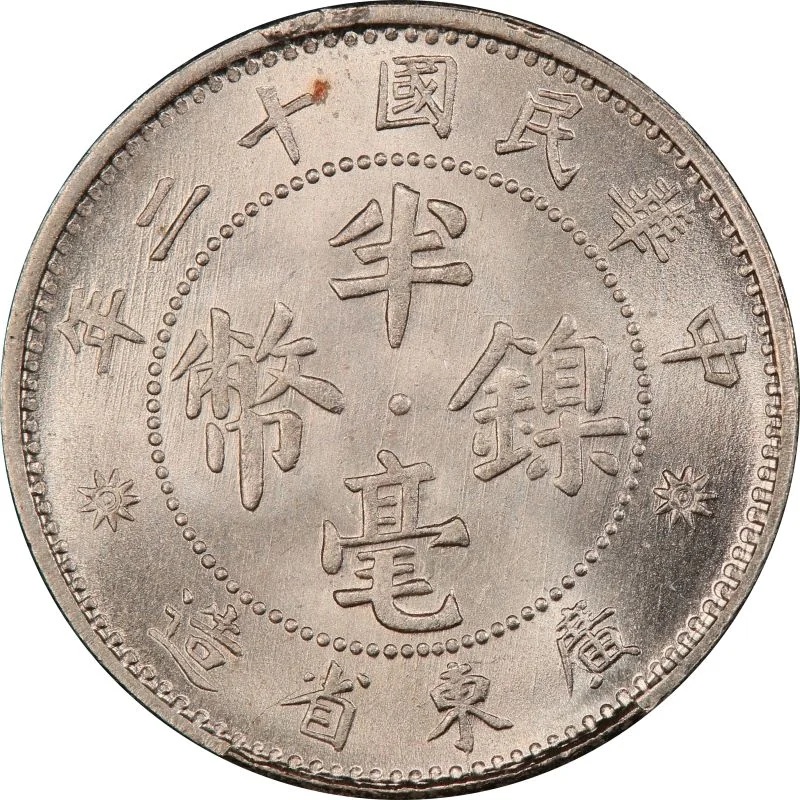
Description:
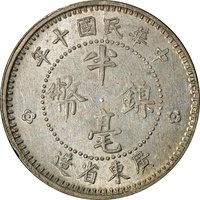
Four ideograms read vertically, right to left, encircled by more characters.
Inscription:
年二十國民華中
半
幣鎳
毫
造省東廣
半
幣鎳
毫
造省東廣
Translation:
Twenty Year of the Republic of China
Half
Nickel Coin
Mace
Made in Guangdong Province
Half
Nickel Coin
Mace
Made in Guangdong Province
Scripts: Chinese (traditional, regular script)
Language: Chinese
Reverse
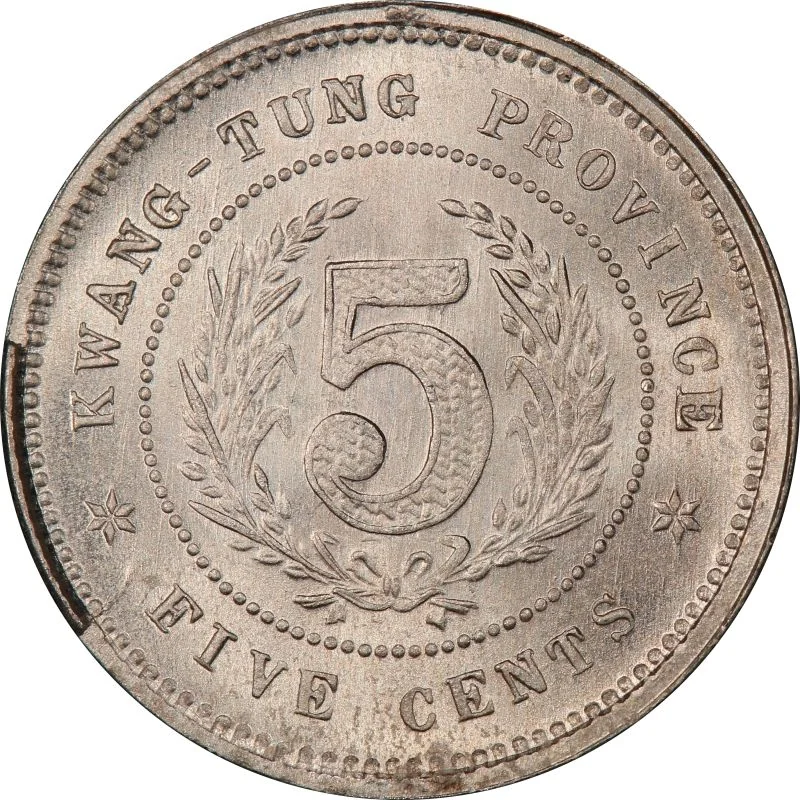
Description:
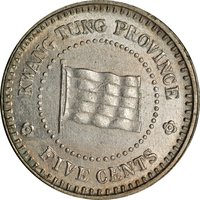
Value within wreath, English legend around.
Inscription:
KWANG-TUNG PROVINCE
5
FIVE CENTS
5
FIVE CENTS
Script: Latin
Edge
Plain
Mintings
| Year | Mint Mark | Mintage | Quality | Collection |
|---|---|---|---|---|
| 1923 | — | 480,000 |
Historical background
In 1923, Kwangtung (Guangdong) Province was the epicenter of China's revolutionary struggle, serving as the base for Sun Yat-sen's Kuomintang (KMT) government in Canton. This political instability directly fueled a severe and chaotic currency situation. The province was flooded with a bewildering variety of competing notes issued by multiple entities: the official Provincial Bank of Kwangtung, numerous private "native banks," and even military commanders occupying different districts who printed money to fund their forces. This led to a catastrophic loss of public confidence, as the value and redeemability of any given note were entirely dependent on the solvency and reach of the issuing authority.
The core of the crisis was the massive over-issue and depreciation of the Guangdong Provincial Bank notes, known as Dayang or "Guangdong dollars." Forced to print currency to finance the KMT's military campaigns and administrative costs, the Canton government saw the value of its own paper money plummet. By mid-1923, these notes were trading at a steep discount to silver dollars (yuan), causing rampant inflation and crippling the local economy. Merchants and the public increasingly hoarded silver coinage, rejecting paper, which only accelerated the downward spiral.
This monetary fragmentation and collapse was a direct reflection of the fractured political landscape. With warlords like Chen Jiongming controlling parts of the province and the KMT's hold on Canton itself being precarious, no single authority could impose a unified, trusted currency. The situation created immense hardship for the populace, disrupted trade, and starkly illustrated the fundamental challenge for Sun Yat-sen's government: to establish genuine political and fiscal control over its own base of power before it could hope to unify the nation.
The core of the crisis was the massive over-issue and depreciation of the Guangdong Provincial Bank notes, known as Dayang or "Guangdong dollars." Forced to print currency to finance the KMT's military campaigns and administrative costs, the Canton government saw the value of its own paper money plummet. By mid-1923, these notes were trading at a steep discount to silver dollars (yuan), causing rampant inflation and crippling the local economy. Merchants and the public increasingly hoarded silver coinage, rejecting paper, which only accelerated the downward spiral.
This monetary fragmentation and collapse was a direct reflection of the fractured political landscape. With warlords like Chen Jiongming controlling parts of the province and the KMT's hold on Canton itself being precarious, no single authority could impose a unified, trusted currency. The situation created immense hardship for the populace, disrupted trade, and starkly illustrated the fundamental challenge for Sun Yat-sen's government: to establish genuine political and fiscal control over its own base of power before it could hope to unify the nation.
⭐ Somewhat Rare