

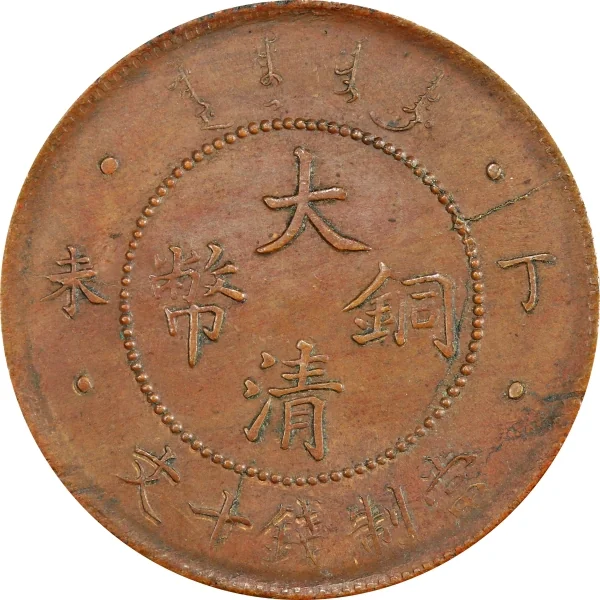
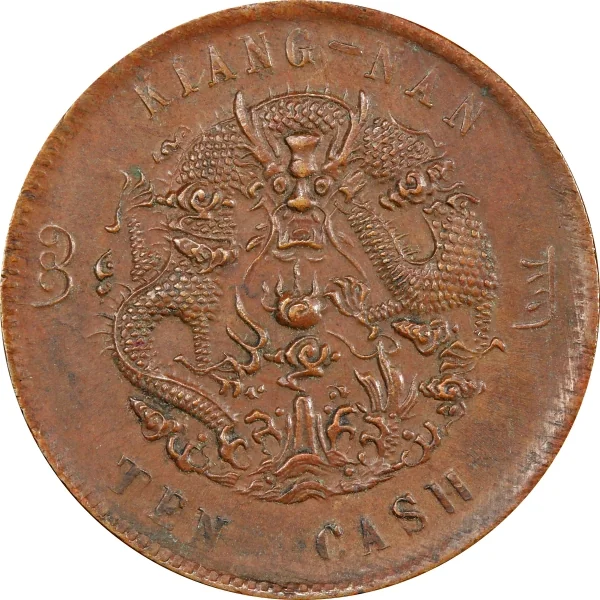
10 Cash – Kiangnan Province
China
Context
Year: 1907
Country: China 
Issuer: Kiangnan Province
Ruler: Guangxu
Currency:
(1898—1949)
Demonetized: Yes
Material
References
Y: #Click to copy to clipboardE140
Numista: #296989
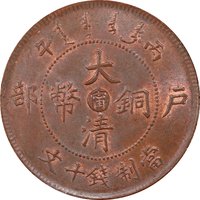
Obverse
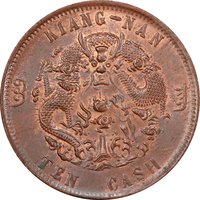
Reverse
Edge
Plain
Categories
| Mythology> Fantastic animal |
| Geography> Mountain |
Mintings
| Year | Mint Mark | Mintage | Quality | Collection |
|---|---|---|---|---|
| 1907 | — | — |
Historical background
In 1907, Kiangnan Province (centered on Shanghai and encompassing parts of modern Jiangsu and Anhui) was the epicenter of a complex and chaotic monetary system, a microcosm of the late Qing Dynasty's financial disintegration. The province did not operate with a single, unified currency but was instead flooded with a bewildering variety of mediums of exchange. These included imperial silver sycee (measured in taels), foreign-minted silver dollars (most notably the Mexican "Eagle" dollar), various copper cash coins (both Qing-issued and older issues), and a growing volume of private banknotes issued by native banks (qianzhuang) and modern commercial banks. The lack of a standard unit and fixed exchange rates between these forms created daily confusion and opportunity for arbitrage, hampering commerce.
This monetary fragmentation was exacerbated by the province's unique position as the heart of foreign trade and concession territories. The International Settlement in Shanghai effectively operated on a silver dollar standard, led by the Mexican dollar, while the Qing government still officially accounted in taels—a unit of weight, not a coin. Furthermore, the central government's attempts at reform, such as authorising provincial mints to produce new silver and copper coins, often backfired. Provincial mints, including the major one in Nanjing, frequently debased their copper coinage to raise revenue, leading to inflation, public distrust, and a disconnect between the face value and intrinsic metal value of the coins.
Consequently, the currency situation in 1907 Kiangnan was one of transition and tension. It was a battleground between traditional and modern, domestic and foreign, and central and local interests. The chaos provided a powerful argument for reformers and revolutionaries alike who saw monetary unification as essential for national sovereignty and economic strength. This environment set the stage for more aggressive centralised reforms attempted in the dynasty's final years, though true stabilisation would remain elusive until well after the 1911 Revolution.
This monetary fragmentation was exacerbated by the province's unique position as the heart of foreign trade and concession territories. The International Settlement in Shanghai effectively operated on a silver dollar standard, led by the Mexican dollar, while the Qing government still officially accounted in taels—a unit of weight, not a coin. Furthermore, the central government's attempts at reform, such as authorising provincial mints to produce new silver and copper coins, often backfired. Provincial mints, including the major one in Nanjing, frequently debased their copper coinage to raise revenue, leading to inflation, public distrust, and a disconnect between the face value and intrinsic metal value of the coins.
Consequently, the currency situation in 1907 Kiangnan was one of transition and tension. It was a battleground between traditional and modern, domestic and foreign, and central and local interests. The chaos provided a powerful argument for reformers and revolutionaries alike who saw monetary unification as essential for national sovereignty and economic strength. This environment set the stage for more aggressive centralised reforms attempted in the dynasty's final years, though true stabilisation would remain elusive until well after the 1911 Revolution.
✨ Legendary