

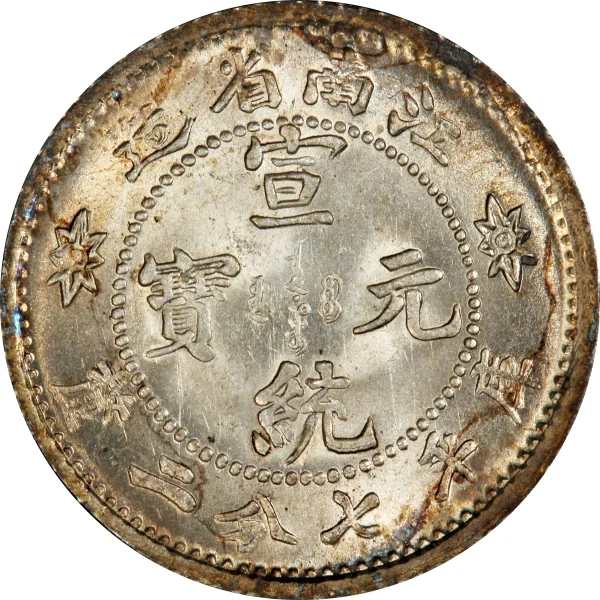
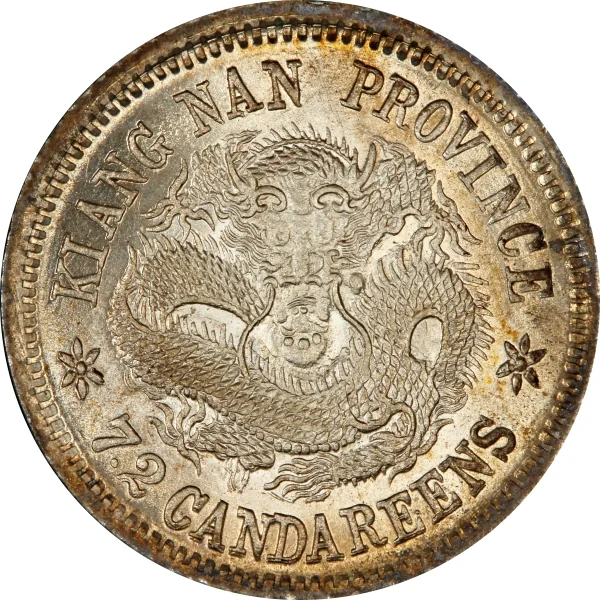
10 Fen – Kiangnan Province
China
Context
Years: 1911–1916
Country: China 
Issuer: Kiangnan Province
Ruler: Xuantong
Currency:
(1898—1949)
Demonetized: Yes
Total mintage: 820,000
Material
References
Y: #Click to copy to clipboard146
Numista: #42187
Value
Bullion value: $6.03
Obverse
Description:
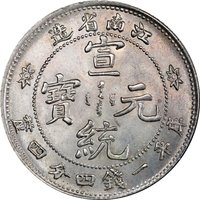
Chinese ideograms read vertically, right to left, with Manchu text in the center, all encircled by more Chinese characters.
Inscription:
造省南江
宣
ᠪᠠᡩᠠᡵᠠᠩᡤᠠ
寶 ᠶᡠᠸᠠᠨ ᠪᠣᠣ 元
ᡩᠣᡵᠣ
統
釐二分七平庫
宣
ᠪᠠᡩᠠᡵᠠᠩᡤᠠ
寶 ᠶᡠᠸᠠᠨ ᠪᠣᠣ 元
ᡩᠣᡵᠣ
統
釐二分七平庫
Translation:
Made at the Southern Jiang Provincial Mint
Xuan
Badarangga
Yuan Bao
Coin
Tong
Standard Treasury Weight of 2 Mace and 7 Candareens
Xuan
Badarangga
Yuan Bao
Coin
Tong
Standard Treasury Weight of 2 Mace and 7 Candareens
Reverse
Description:
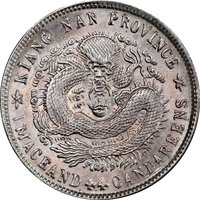
Dragon encircling a pearl, surrounded by English text.
Inscription:
KIANG NAN PROVINCE
7.2 CANDAREENS
7.2 CANDAREENS
Edge
Reeded.
Categories
| Mythology> Fantastic animal |
Mintings
| Year | Mint Mark | Mintage | Quality | Collection |
|---|---|---|---|---|
| — | — | 820,000 |
Historical background
In 1911, Kiangnan Province (centered on Shanghai and encompassing parts of modern Jiangsu and Anhui) was the commercial and financial heart of late Qing China, and its currency situation was one of extreme complexity and instability. The monetary system was a chaotic mix of traditional silver sycee (measured in taels), foreign-minted silver dollars (most notably the Mexican "Eagle" dollar), and a plethora of Chinese copper cash coins and banknotes. This "tiao-qian-liang" system created immense friction for trade, as daily transactions required constant conversion between copper, silver, and various note issues, all with fluctuating exchange rates. The province, and Shanghai in particular, was also the epicenter of modern Chinese banking, housing the headquarters of native qianzhuang and the newer yinhang, each issuing their own notes with varying degrees of credibility.
The political crisis of the 1911 Revolution, which erupted in Wuchang in October, acutely destabilized this already fragile system in Kiangnan. As revolutionary forces captured cities like Shanghai and Nanjing, public confidence in Qing government institutions evaporated. A severe run on banks and qianzhuang occurred, with depositors rushing to convert paper notes into silver, leading to widespread suspensions of payment and bankruptcies among traditional financial houses. The sudden collapse of credit paralyzed commerce, while both the retreating imperial authorities and the emerging revolutionary government faced fiscal crises, scrambling to secure silver reserves to fund their military efforts.
Consequently, the end of 1911 saw Kiangnan's monetary landscape in a state of disruptive transition. The Qing dynasty's currency authority had dissolved, but no unified system had taken its place. The vacuum was temporarily filled by foreign banks (like the Hongkong and Shanghai Banking Corporation), which saw their notes gain further circulation, and by emergency issues from local military governments and surviving Chinese banks. This period of fragmentation and hardship starkly highlighted the urgent need for a unified, modern currency system—a driving force that would lead the new Republic of China to later attempts at monetary centralization and reform.
The political crisis of the 1911 Revolution, which erupted in Wuchang in October, acutely destabilized this already fragile system in Kiangnan. As revolutionary forces captured cities like Shanghai and Nanjing, public confidence in Qing government institutions evaporated. A severe run on banks and qianzhuang occurred, with depositors rushing to convert paper notes into silver, leading to widespread suspensions of payment and bankruptcies among traditional financial houses. The sudden collapse of credit paralyzed commerce, while both the retreating imperial authorities and the emerging revolutionary government faced fiscal crises, scrambling to secure silver reserves to fund their military efforts.
Consequently, the end of 1911 saw Kiangnan's monetary landscape in a state of disruptive transition. The Qing dynasty's currency authority had dissolved, but no unified system had taken its place. The vacuum was temporarily filled by foreign banks (like the Hongkong and Shanghai Banking Corporation), which saw their notes gain further circulation, and by emergency issues from local military governments and surviving Chinese banks. This period of fragmentation and hardship starkly highlighted the urgent need for a unified, modern currency system—a driving force that would lead the new Republic of China to later attempts at monetary centralization and reform.
💎 Extremely Rare