

10 Cash – Kiangnan Province
China
Context
Year: 1906
Country: China 
Issuer: Kiangnan Province
Ruler: Guangxu
Currency:
(1898—1949)
Demonetized: Yes
Material
References
Y: #Click to copy to clipboard140.1-2
Numista: #296988
Obverse
Description:
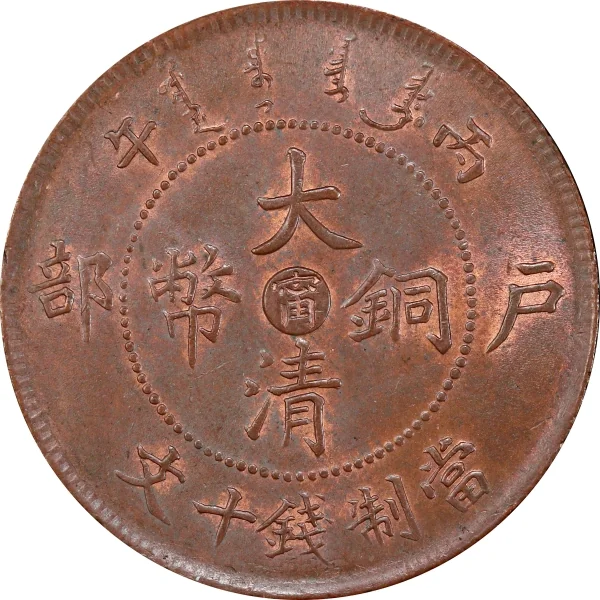
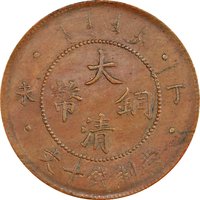
Four Chinese characters read vertically, right to left, with Manchu text above and additional characters around.
Inscription:
午 ᠪᠠᡩᠠᠷᠠᠩᡤᠠ ᡩᠣᠷᠣ ᡳ ᠠᠨᡳᠶᠠᡳ ᠸᡝᡳᠯᡝᡥᡝ 丙
部戶
大
幣銅
清
文十錢制當
部戶
大
幣銅
清
文十錢制當
Translation:
Wu Badarangga doro i aniyai weilehe Bing.
Bu Hu.
Da.
Bida tung.
Daiqing.
Wen shi qian zhi dang.
Bu Hu.
Da.
Bida tung.
Daiqing.
Wen shi qian zhi dang.
Reverse
Edge
Plain
Categories
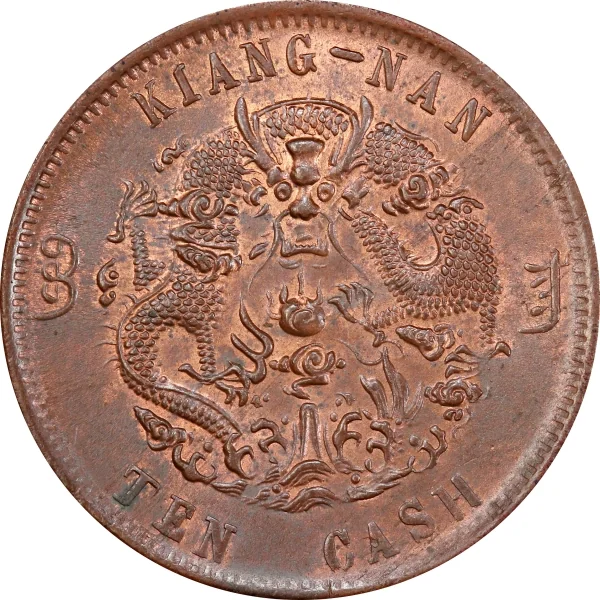
| Mythology> Fantastic animal |
| Geography> Mountain |
Mintings
| Year | Mint Mark | Mintage | Quality | Collection |
|---|---|---|---|---|
| 1906 | — | — |
Historical background
In 1906, Kiangnan Province (roughly corresponding to modern Jiangsu, Anhui, and the city of Shanghai) was a crucible of China's fraught monetary transition. The currency situation was characterized by a chaotic "multi-standard" system, a legacy of the late Qing dynasty's weakening central authority and growing foreign economic intrusion. The primary unit of account was the silver tael (liang), but there was no standard tael; instead, major commercial centers like Shanghai, Nanjing, and Suzhou each used their own slightly different tael weight and purity, known as the "Kuping" (treasury), "Caoping" (transport), and "Shanghai" tael. This necessitated complex exchange calculations for inter-city trade, creating inefficiency and opportunity for money-changers' profits.
Alongside silver by weight, a vast array of silver coins circulated. These included Mexican and other foreign trade dollars, various provincial dragon dollars minted in China with inconsistent silver content, and the new, uniform Imperial Dragon Dollar issued by the central government in an attempt to assert control. Simultaneously, a separate economy operated on copper cash (wen) for daily small transactions. However, the exchange rate between copper and silver was highly volatile, often inflating the cost of basic goods for the peasantry and urban poor. This "silver-copper crisis" was exacerbated by local shortages of copper coin and the debasement of copper issues by provincial mints.
This monetary fragmentation severely hampered commerce and state finance. Foreign banks, particularly in the International Settlement of Shanghai, held significant influence by issuing their own banknotes and managing much of the foreign exchange. The Qing government's efforts to create a national silver currency and standardize the tael were ongoing but met with resistance from provincial interests and ingrained commercial habits. Thus, in 1906, Kiangnan's economy operated amidst a jumble of metallic currencies, a symptom of the broader struggle between imperial consolidation, local autonomy, and foreign power in the years preceding the dynasty's collapse.
Alongside silver by weight, a vast array of silver coins circulated. These included Mexican and other foreign trade dollars, various provincial dragon dollars minted in China with inconsistent silver content, and the new, uniform Imperial Dragon Dollar issued by the central government in an attempt to assert control. Simultaneously, a separate economy operated on copper cash (wen) for daily small transactions. However, the exchange rate between copper and silver was highly volatile, often inflating the cost of basic goods for the peasantry and urban poor. This "silver-copper crisis" was exacerbated by local shortages of copper coin and the debasement of copper issues by provincial mints.
This monetary fragmentation severely hampered commerce and state finance. Foreign banks, particularly in the International Settlement of Shanghai, held significant influence by issuing their own banknotes and managing much of the foreign exchange. The Qing government's efforts to create a national silver currency and standardize the tael were ongoing but met with resistance from provincial interests and ingrained commercial habits. Thus, in 1906, Kiangnan's economy operated amidst a jumble of metallic currencies, a symptom of the broader struggle between imperial consolidation, local autonomy, and foreign power in the years preceding the dynasty's collapse.
⭐ Somewhat Rare