

20 Cash – Sinkiang Province
China
Context
Material
References
Y: #Click to copy to clipboardA41.1
Numista: #296087
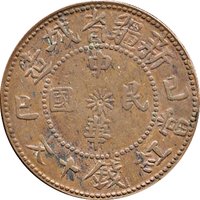
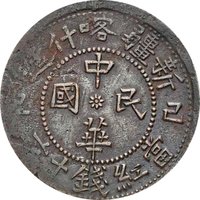
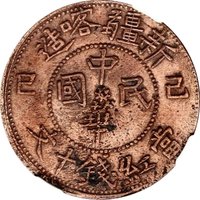
Obverse
Description:
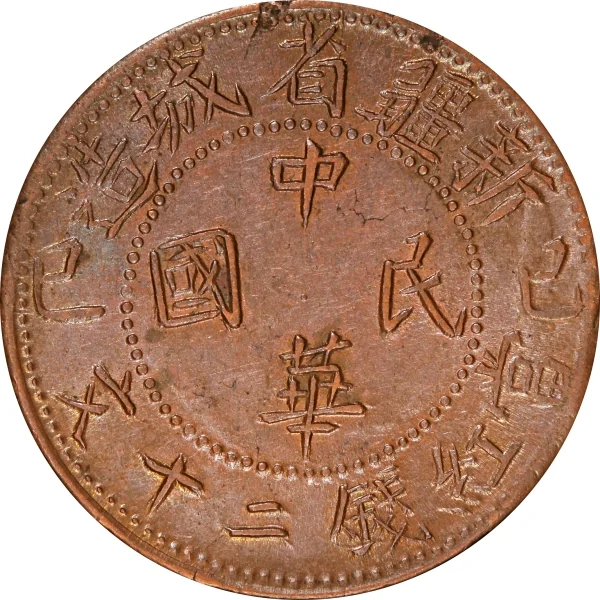
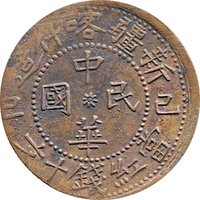
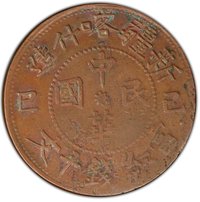
Four ideograms read vertically, right to left, encircled by more characters.
Inscription:
造城省疆新
巳己
中
國民
華
文十二錢紅當
巳己
中
國民
華
文十二錢紅當
Translation:
Made in the Central People's Government of China
The Republic of China
Wen Twelve Cash Coin
Red Equivalent
The Republic of China
Wen Twelve Cash Coin
Red Equivalent
Language: Chinese
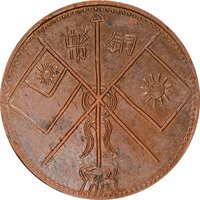
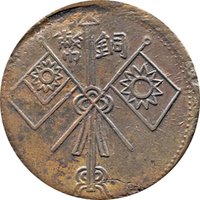
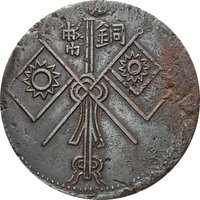
Reverse
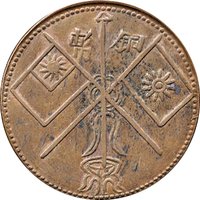
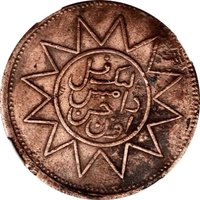
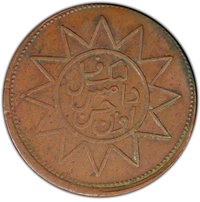
Description:
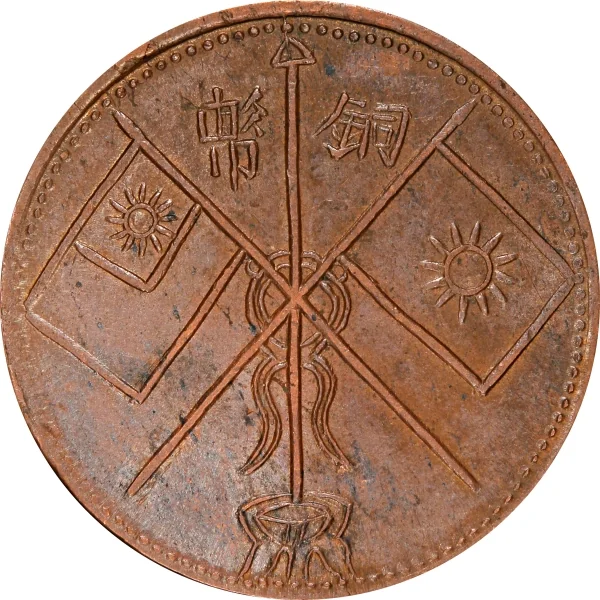
Crossed flags with central ribbon and bowl below, two Chinese characters above.
Inscription:
幣銅
Translation:
Copper coin
Language: Chinese
Edge
Mintings
| Year | Mint Mark | Mintage | Quality | Collection |
|---|---|---|---|---|
| 1929 | — | — | ||
| 1930 | — | — |
Historical background
In 1929, the currency situation in Sinkiang (Xinjiang) Province was characterized by extreme fragmentation and instability, a direct reflection of the region's political isolation and weak control from the nominal central government in Nanjing. The provincial warlord, Governor Jin Shuren, who had just taken power that year, presided over a financially distressed administration. To fund his regime and the ongoing military campaigns against regional rebellions, he resorted to the unchecked printing of paper currency, known as Xinjiang Provincial Bank Notes. This led to severe inflation and a rapid loss of public confidence, as the notes were not backed by sufficient silver reserves.
The monetary landscape was further complicated by the circulation of multiple older and competing forms of money. Alongside Jin's depreciating paper notes, physical silver—in the form of sycee (silver ingots) and coins from the late Qing Dynasty and the early Republic—remained a trusted but scarce medium for large transactions. In local bazaars, especially in southern oases, Chinese copper cash coins and even pul coins from the former Kashgaria kingdom still circulated for small-scale trade. Furthermore, along the trade routes with Soviet Central Asia, Russian Tsarist rubles and newer Soviet currency also had a significant presence, underscoring the region's economic gravitation towards the Soviet Union rather than China proper.
This chaotic multi-currency system created a burdensome economy for merchants and peasants alike, who had to navigate fluctuating exchange rates and the constant risk of holding devaluing paper. The reliance on Soviet currency also highlighted Jin Shuren’s growing political and financial dependence on the Soviet Union, which provided economic and military support in exchange for influence. Consequently, by the end of 1929, Sinkiang's currency was not a tool of unified sovereignty but a symptom of its fractured governance, economic dependency, and integration into the Soviet sphere of influence rather than a cohesive Chinese national economy.
The monetary landscape was further complicated by the circulation of multiple older and competing forms of money. Alongside Jin's depreciating paper notes, physical silver—in the form of sycee (silver ingots) and coins from the late Qing Dynasty and the early Republic—remained a trusted but scarce medium for large transactions. In local bazaars, especially in southern oases, Chinese copper cash coins and even pul coins from the former Kashgaria kingdom still circulated for small-scale trade. Furthermore, along the trade routes with Soviet Central Asia, Russian Tsarist rubles and newer Soviet currency also had a significant presence, underscoring the region's economic gravitation towards the Soviet Union rather than China proper.
This chaotic multi-currency system created a burdensome economy for merchants and peasants alike, who had to navigate fluctuating exchange rates and the constant risk of holding devaluing paper. The reliance on Soviet currency also highlighted Jin Shuren’s growing political and financial dependence on the Soviet Union, which provided economic and military support in exchange for influence. Consequently, by the end of 1929, Sinkiang's currency was not a tool of unified sovereignty but a symptom of its fractured governance, economic dependency, and integration into the Soviet sphere of influence rather than a cohesive Chinese national economy.
✨ Legendary