

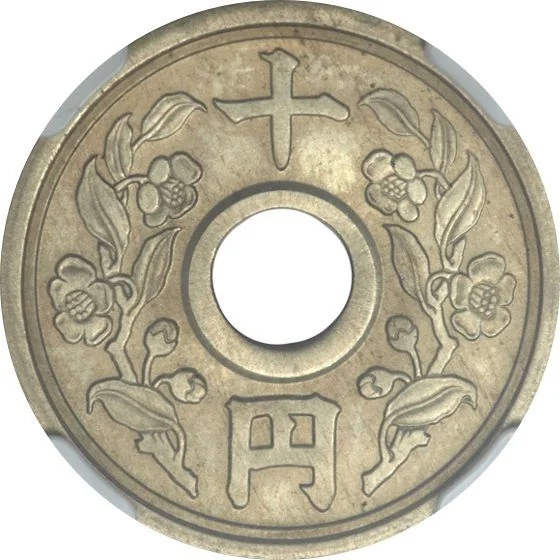
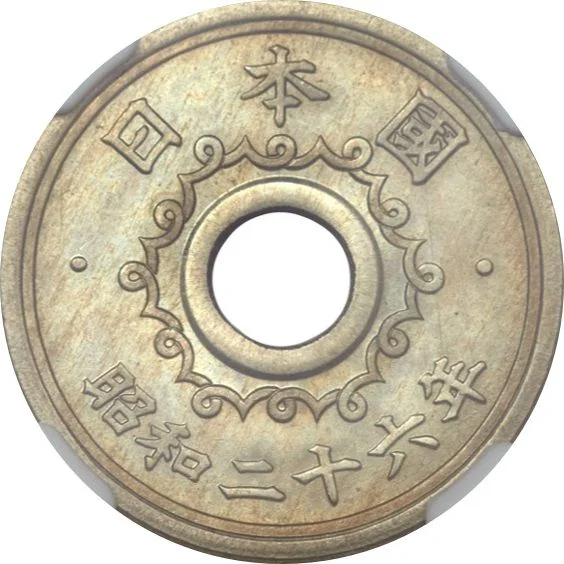
10 yen – Japan
Add to wishlist
Japan
Context
Material
Diameter: 20 mm
Weight: 2.79 g
Shape: Round with a round hole
Magnetic: No
Technique: Milled
Alignment: Medal alignment
flip
References
KM: #
Numista: #285819
Value
Exchange value: 10 JPY
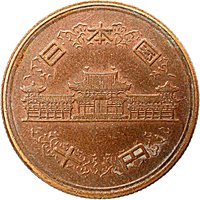
Obverse
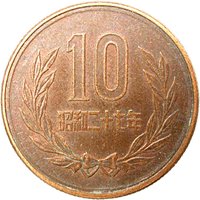
Reverse
Description:
Issuing authority top, date bottom.
Inscription:
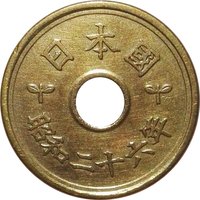
日本國
昭和二十六年
昭和二十六年
Translation:
Japan
Showa 26
Showa 26
Language: Japanese
Edge
Mintings
| Year | Mint Mark | Mintage | Quality | Collection |
|---|---|---|---|---|
| 1950 | — | 432,970,000 | ||
| 1951 | — | 313,430,000 |
Historical background
In 1950, Japan's currency situation was fundamentally shaped by the Allied Occupation and the early stages of post-war economic reconstruction. The yen, which had been devastated by wartime inflation and a collapsed economy, operated under a complex, multi-tiered exchange rate system established by the Supreme Commander for the Allied Powers (SCAP). A single official rate was set at 360 yen to the US dollar in April 1949 under the "Dodge Line" austerity plan, a pivotal move intended to stabilize the currency, curb inflation, and reintegrate Japan into the global economy. This fixed parity became a cornerstone of Japan's subsequent economic policy.
The domestic financial environment remained tightly controlled and fragile. While the Dodge Line successfully halted hyperinflation, it also triggered a severe recession known as the "Dodge Deflation." Credit was scarce, industrial production was only just recovering to pre-war levels, and the economy was heavily dependent on US procurement for the Korean War, which began in June 1950. This "special procurement" boom provided a critical injection of dollar reserves, bolstering the balance of payments and allowing Japan to support the fixed exchange rate without exhausting its nascent reserves.
Thus, the currency situation in 1950 was one of imposed stability atop a recovering but vulnerable economic base. The 360 yen/dollar peg provided a clear benchmark for trade and planning, but its maintenance relied on ongoing US economic support and strict domestic fiscal discipline. This framework laid the essential monetary foundation for the period of high-speed growth that would follow in the coming decades.
The domestic financial environment remained tightly controlled and fragile. While the Dodge Line successfully halted hyperinflation, it also triggered a severe recession known as the "Dodge Deflation." Credit was scarce, industrial production was only just recovering to pre-war levels, and the economy was heavily dependent on US procurement for the Korean War, which began in June 1950. This "special procurement" boom provided a critical injection of dollar reserves, bolstering the balance of payments and allowing Japan to support the fixed exchange rate without exhausting its nascent reserves.
Thus, the currency situation in 1950 was one of imposed stability atop a recovering but vulnerable economic base. The 360 yen/dollar peg provided a clear benchmark for trade and planning, but its maintenance relied on ongoing US economic support and strict domestic fiscal discipline. This framework laid the essential monetary foundation for the period of high-speed growth that would follow in the coming decades.
✨ Legendary