

5 Yen – Japan
Japan
Context
Material
Diameter: 22 mm
Weight: 3.75 g
Thickness: 1.5 mm
Shape: Round with a round hole
Composition: Brass
Magnetic: No
Technique: Milled
Alignment: Medal alignment
flip
References
Y: #Click to copy to clipboard72
Numista: #97765
Value
Exchange value: 5 JPY = $0.03
Obverse
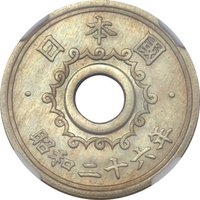
Description:
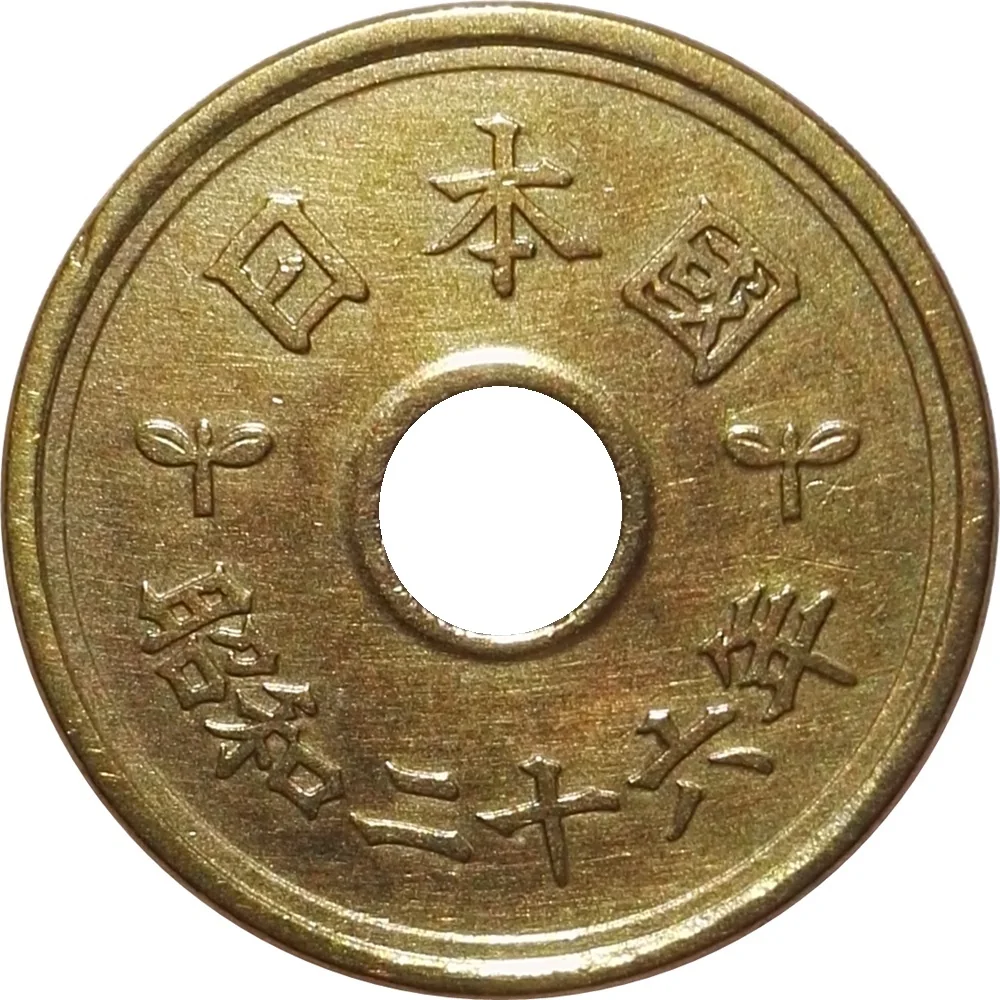
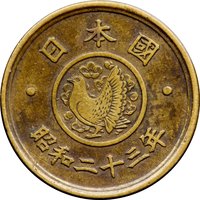
Center hole, seed leaf sides, authority above, date below.
Inscription:
日本國
昭和二十六年
昭和二十六年
Translation:
Japan
Showa 26
Showa 26
Language: Japanese
Reverse
Description:
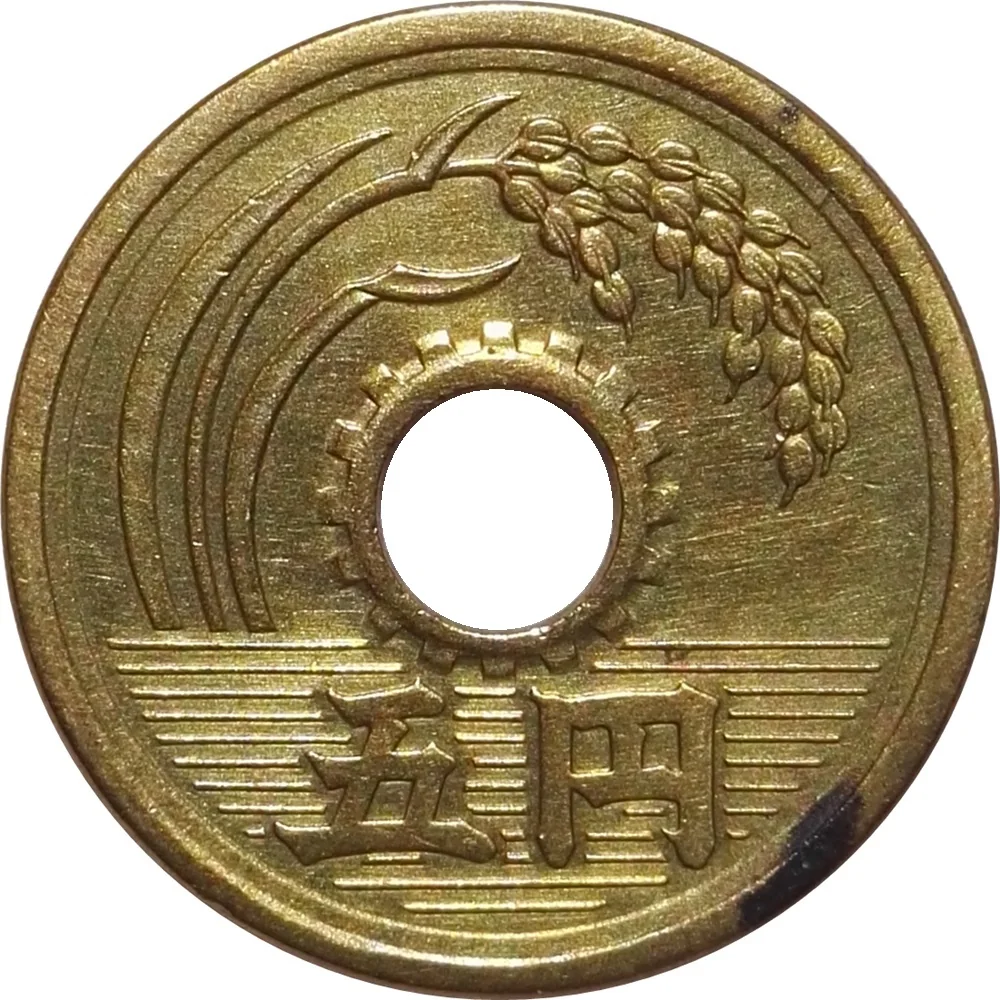
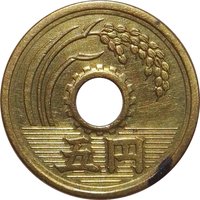
Rice stalk (agriculture), water (fisheries), and cog teeth (industry) encircle the central hole.
Inscription:
五円
Translation:
Five Yen
Language: Japanese
Edge
Plain
Mintings
| Year | Mint Mark | Mintage | Quality | Collection |
|---|---|---|---|---|
| 1949 | — | 111,896,000 | ||
| 1950 | — | 181,824,000 | ||
| 1951 | — | 197,980,000 | ||
| 1952 | — | 55,000,000 | ||
| 1953 | — | 45,000,000 | ||
| 1957 | — | 10,000,000 | ||
| 1958 | — | 50,000,000 |
Historical background
In 1949, Japan's currency situation was defined by the transformative Dodge Line, a stringent austerity and stabilization plan implemented under the guidance of American economist Joseph Dodge. Arriving in February 1949, Dodge confronted a postwar economy plagued by rampant inflation, a complex multi-tiered exchange rate system, and heavy subsidies that masked industrial inefficiencies. The core of the crisis was a "hidden domestic inflation" where the official exchange rate was 360 yen to the US dollar, but the real cost of imports, when accounting for government price supports and subsidies, was estimated to be as high as 600-900 yen to the dollar, creating a massive fiscal drain.
The Dodge Line abruptly ended this unstable regime by mandating a single, fixed exchange rate of 360 yen to the US dollar, a rate that would remain pivotal for 22 years. This was enforced alongside a balanced national budget, the cessation of reconstruction financing from the government's "Reconstruction Finance Bank," and the elimination of most subsidies and price controls. The goal was to shock the economy into stability by linking the yen firmly to the dollar, forcing Japanese industries to become internationally competitive without government crutches and halting the inflationary spiral caused by excessive currency issuance.
The immediate impact was severe deflation and a sharp recession, known as the "Dodge Line Depression," which caused widespread business failures and unemployment. However, by 1950, these harsh measures had successfully stabilized the currency, crushed inflation, and created the disciplined financial foundation for recovery. The fixed 360 yen rate provided a predictable environment for trade, which, when combined with the procurement boom of the Korean War that began in June 1950, ignited the export-led growth that would characterize Japan's economic miracle in the decades to follow. Thus, 1949 marked the painful but critical pivot from a chaotic, controlled economy to one integrated into the Bretton Woods system and poised for rapid expansion.
The Dodge Line abruptly ended this unstable regime by mandating a single, fixed exchange rate of 360 yen to the US dollar, a rate that would remain pivotal for 22 years. This was enforced alongside a balanced national budget, the cessation of reconstruction financing from the government's "Reconstruction Finance Bank," and the elimination of most subsidies and price controls. The goal was to shock the economy into stability by linking the yen firmly to the dollar, forcing Japanese industries to become internationally competitive without government crutches and halting the inflationary spiral caused by excessive currency issuance.
The immediate impact was severe deflation and a sharp recession, known as the "Dodge Line Depression," which caused widespread business failures and unemployment. However, by 1950, these harsh measures had successfully stabilized the currency, crushed inflation, and created the disciplined financial foundation for recovery. The fixed 360 yen rate provided a predictable environment for trade, which, when combined with the procurement boom of the Korean War that began in June 1950, ignited the export-led growth that would characterize Japan's economic miracle in the decades to follow. Thus, 1949 marked the painful but critical pivot from a chaotic, controlled economy to one integrated into the Bretton Woods system and poised for rapid expansion.
🌱 Very Common