

5 sen – Japan
Add to wishlist
Japan
Context
Year: 1945
Japanese - Shōwa era Year:: 20
Issuer: Japan
Ruler: Shōwa
Currency:
(since 1871)
Demonetized: Yes
Material
References
Numista: #284335
Value
Exchange value: 0.05 JPY
Obverse
Description:
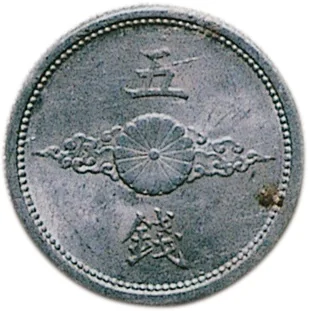
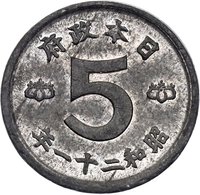
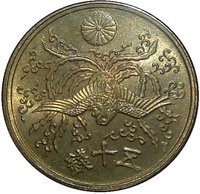
Value above and below, divided by the Imperial Chrysanthemum Seal within clouds.
Inscription:
五
錢
錢
Translation:
Five Cash
Language: Classical Chinese
Reverse
Description:
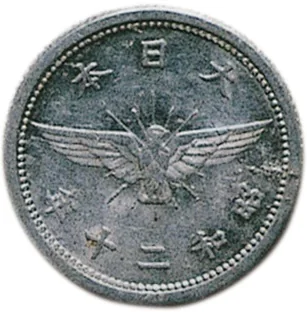
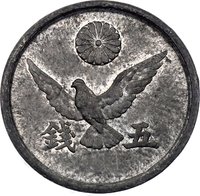
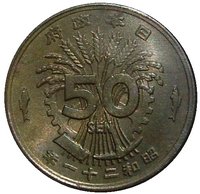
Golden kite (Japanese military symbol) with authoritative spread wings above the date.
Inscription:
本日大
年 十 二 和 昭
年 十 二 和 昭
Translation:
Showa 12th Year
Language: Japanese
Edge
Mintings
| Year | Mint Mark | Mintage | Quality | Collection |
|---|---|---|---|---|
| 1945 | — | — |
Historical background
In August 1945, Japan emerged from World War II in a state of profound economic and physical devastation. The nation's industrial capacity was crippled, its cities lay in ruins from Allied bombing, and its financial system was on the brink of collapse. The currency situation was chaotic and inflationary. To finance the war effort, the government had printed vast quantities of yen, leading to a massive increase in the money supply without corresponding economic output. This created severe suppressed inflation, where prices were officially controlled but a rampant black market flourished, with goods trading for many times their official prices. The yen's value had plummeted, public confidence in the currency was shattered, and the economy was reduced to a barter system for basic necessities.
The Allied Occupation, under the Supreme Commander for the Allied Powers (SCAP), immediately moved to stabilize the financial system as a prerequisite for reconstruction. A critical early measure was the issuance of new "B Yen" military scrip for use by occupation personnel, which circulated alongside the old "A Yen" to prevent the direct dollarization of the economy. More fundamentally, in February 1946, SCAP implemented the "New Yen Currency Conversion." This was a drastic, one-time monetary reform where old yen notes were declared invalid and citizens were forced to exchange them for new currency at a limited rate. Accounts were frozen, and large withdrawals were prohibited. The goal was to flush out hoarded cash, destroy the black market's capital, and gain control over the money supply.
While the conversion was socially harsh and economically disruptive, it succeeded in its primary objective of halting hyperinflation and restoring a degree of monetary control. It provided a stable, if austere, foundation for the subsequent series of reforms known as the "Dodge Line" in 1949, which imposed a balanced budget and a single exchange rate (360 yen to the dollar). These painful but necessary measures effectively ended the postwar currency crisis, eliminated the dual-price system, and laid the groundwork for the financial stability that would underpin Japan's period of rapid economic growth in the decades that followed.
The Allied Occupation, under the Supreme Commander for the Allied Powers (SCAP), immediately moved to stabilize the financial system as a prerequisite for reconstruction. A critical early measure was the issuance of new "B Yen" military scrip for use by occupation personnel, which circulated alongside the old "A Yen" to prevent the direct dollarization of the economy. More fundamentally, in February 1946, SCAP implemented the "New Yen Currency Conversion." This was a drastic, one-time monetary reform where old yen notes were declared invalid and citizens were forced to exchange them for new currency at a limited rate. Accounts were frozen, and large withdrawals were prohibited. The goal was to flush out hoarded cash, destroy the black market's capital, and gain control over the money supply.
While the conversion was socially harsh and economically disruptive, it succeeded in its primary objective of halting hyperinflation and restoring a degree of monetary control. It provided a stable, if austere, foundation for the subsequent series of reforms known as the "Dodge Line" in 1949, which imposed a balanced budget and a single exchange rate (360 yen to the dollar). These painful but necessary measures effectively ended the postwar currency crisis, eliminated the dual-price system, and laid the groundwork for the financial stability that would underpin Japan's period of rapid economic growth in the decades that followed.
✨ Legendary