

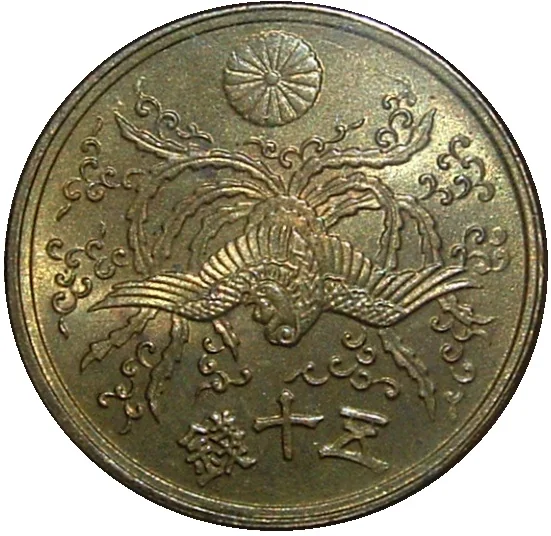
Obverse
Description:
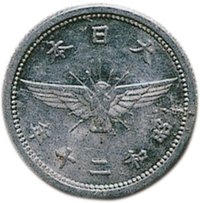
Phoenix in flight, chrysanthemum above, value below.
Inscription:
錢十五
Translation:
Fifteen coins.
Language: Chinese
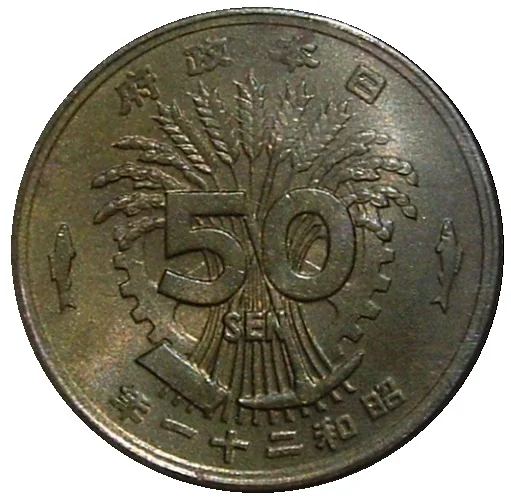
Reverse
Description:
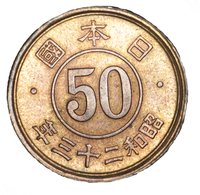
Cog, tools, grain, and fish.
Inscription:
府政本日
50
SEN
年一十二和昭
50
SEN
年一十二和昭
Translation:
Government of Japan
50
SEN
Showa 12 Year
50
SEN
Showa 12 Year
Language: Japanese
Edge
Reeded
Categories
| Plants> Flower |
| Symbols> Coat of Arms |
| Animal> Fish |
| Animal> Bird |
| Mythology> Fantastic animal |
Mintings
| Year | Mint Mark | Mintage | Quality | Collection |
|---|---|---|---|---|
| 1946 | — | 268,161,000 | ||
| 1947 | — | — |
Historical background
In the immediate aftermath of World War II, Japan's currency situation was one of catastrophic hyperinflation and monetary chaos. The economy was shattered, industrial production had collapsed, and the government, under the Allied Occupation led by SCAP (Supreme Commander for the Allied Powers), had financed the war effort through massive borrowing from the Bank of Japan. This resulted in a vast oversupply of banknotes—currency in circulation had increased nearly fifteen-fold since 1937—chasing a severe shortage of goods, leading to rampant inflation and a thriving black market where prices were often many times the official rates. The existing yen was essentially worthless, undermining all attempts at economic stabilization and recovery.
To break this cycle and wipe out the inflationary overhang, the government implemented the "New Yen" conversion in February 1946, a drastic monetary reform orchestrated by Finance Minister Tanzan Ishibashi with SCAP approval. The core measure was the freezing of all old banknotes; individuals were permitted to exchange only a small, strictly limited amount into new currency, with the rest of their assets forced into frozen bank accounts. This was accompanied by a capital levy on war-profiteering and a punitive wealth tax aimed at redistributing resources and nullifying the wartime financial legacy. The goal was to abruptly reduce the money supply, restore trust in the currency, and crush the inflationary psychology.
The short-term result was severe deflationary shock and liquidity crisis, causing widespread hardship as people struggled to access their own funds for daily necessities. While it succeeded in temporarily curbing inflation and eliminating the mountain of wartime currency, the reform was only a prelude to deeper structural changes. True stabilization came later, with the comprehensive "Dodge Line" austerity measures of 1949, which balanced the budget, ended subsidies, and fixed the exchange rate at 360 yen to the US dollar. The 1946 currency conversion thus stands as a painful but necessary surgical strike that laid the technical groundwork for Japan's post-war economic rebirth, forcibly resetting the monetary system upon which the subsequent "economic miracle" would be built.
To break this cycle and wipe out the inflationary overhang, the government implemented the "New Yen" conversion in February 1946, a drastic monetary reform orchestrated by Finance Minister Tanzan Ishibashi with SCAP approval. The core measure was the freezing of all old banknotes; individuals were permitted to exchange only a small, strictly limited amount into new currency, with the rest of their assets forced into frozen bank accounts. This was accompanied by a capital levy on war-profiteering and a punitive wealth tax aimed at redistributing resources and nullifying the wartime financial legacy. The goal was to abruptly reduce the money supply, restore trust in the currency, and crush the inflationary psychology.
The short-term result was severe deflationary shock and liquidity crisis, causing widespread hardship as people struggled to access their own funds for daily necessities. While it succeeded in temporarily curbing inflation and eliminating the mountain of wartime currency, the reform was only a prelude to deeper structural changes. True stabilization came later, with the comprehensive "Dodge Line" austerity measures of 1949, which balanced the budget, ended subsidies, and fixed the exchange rate at 360 yen to the US dollar. The 1946 currency conversion thus stands as a painful but necessary surgical strike that laid the technical groundwork for Japan's post-war economic rebirth, forcibly resetting the monetary system upon which the subsequent "economic miracle" would be built.
🌱 Common