

1 tael – Kirin Province
Add to wishlist
China
Context
Year: 1884
Chinese - Guangxu era Year:: 10
Country: China
Issuer: Kirin Province
Ruler: Guangxu
Currency:
(1882—1886)
Demonetized: Yes
Total mintage: 198
Material
References
Y: #
Numista: #274773
Value
Bullion value: $88.51
Obverse
Description:
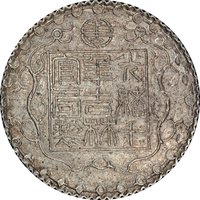
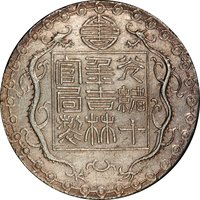
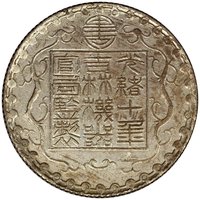
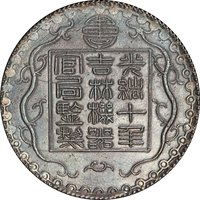
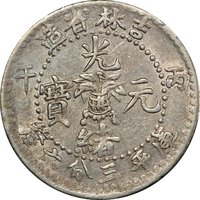
Three vertical columns of four ideograms, flanked by two dragons, with a charm above.
Inscription:
官吉光
局林緒
監機十
製器年
局林緒
監機十
製器年
Translation:
Supervised by the Official Bureau,
Manufactured Machinery in the Tenth Year
of the Ji Guang Era.
Manufactured Machinery in the Tenth Year
of the Ji Guang Era.
Language: Classical Chinese
Reverse
Edge
Reeded.
Categories
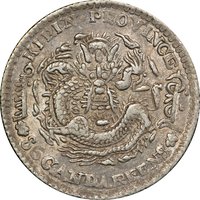
| Mythology> Fantastic animal |
Mintings
| Year | Mint Mark | Mintage | Quality | Collection |
|---|---|---|---|---|
| 1884 | — | 198 |
Historical background
In 1884, Kirin Province (Jilin) in Northeast China existed within a complex monetary ecosystem typical of the late Qing Dynasty, characterized by a lack of unified national currency. The primary medium of exchange was the silver tael, a unit of weight rather than a coin, leading to inefficiency and fraud as merchants and officials used varying local standards, such as the Kirin tael. Alongside this, a flood of copper-alloy cash coins (with square holes) circulated for daily small transactions, but their quality and value fluctuated wildly from mint to mint, and chronic shortages of copper led to widespread private casting of debased coins, further eroding public trust.
Crucially, the region was also experiencing a massive influx of foreign silver dollars, most notably Mexican Silver Dollars (also called "Eagle Dollars"), which entered via coastal trade and were highly trusted for their consistent weight and purity. Japanese and Russian trade silver also began to penetrate the region. Simultaneously, to finance military modernization and government expenses, provincial authorities and local merchants issued a plethora of private banknotes (qianpiao), convertible to silver or copper in theory. However, these notes were often over-issued by unstable institutions, leading to frequent defaults and severe inflationary risks that disrupted commerce.
This chaotic "multiple currency system" created significant obstacles to governance and economic development in Kirin. The provincial government struggled to collect taxes in a standardized form and faced constant revenue shortfalls. The situation reflected the weakening central authority of the Qing state and the growing influence of foreign economic power in the frontier regions. It was within this unstable monetary environment that provincial officials would soon attempt reforms, including the establishment of the Jilin Machine Bureau to mint standardized provincial silver and copper coins, aiming to assert sovereignty, simplify trade, and stabilize the local economy—a challenging task amidst dynastic decline.
Crucially, the region was also experiencing a massive influx of foreign silver dollars, most notably Mexican Silver Dollars (also called "Eagle Dollars"), which entered via coastal trade and were highly trusted for their consistent weight and purity. Japanese and Russian trade silver also began to penetrate the region. Simultaneously, to finance military modernization and government expenses, provincial authorities and local merchants issued a plethora of private banknotes (qianpiao), convertible to silver or copper in theory. However, these notes were often over-issued by unstable institutions, leading to frequent defaults and severe inflationary risks that disrupted commerce.
This chaotic "multiple currency system" created significant obstacles to governance and economic development in Kirin. The provincial government struggled to collect taxes in a standardized form and faced constant revenue shortfalls. The situation reflected the weakening central authority of the Qing state and the growing influence of foreign economic power in the frontier regions. It was within this unstable monetary environment that provincial officials would soon attempt reforms, including the establishment of the Jilin Machine Bureau to mint standardized provincial silver and copper coins, aiming to assert sovereignty, simplify trade, and stabilize the local economy—a challenging task amidst dynastic decline.

✨ Legendary