

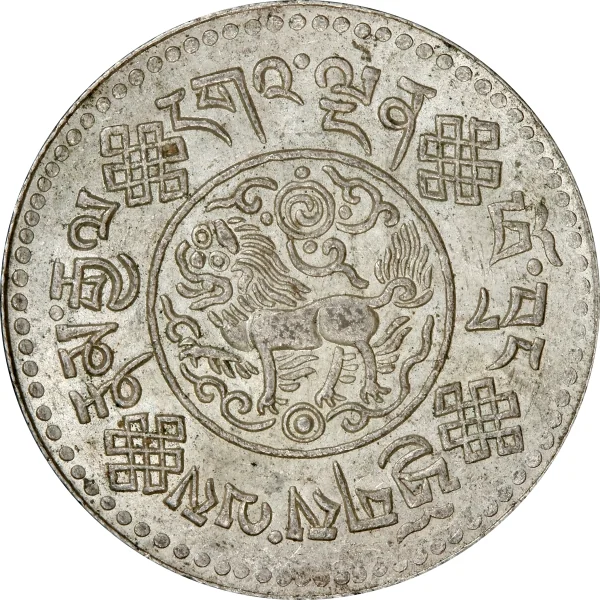
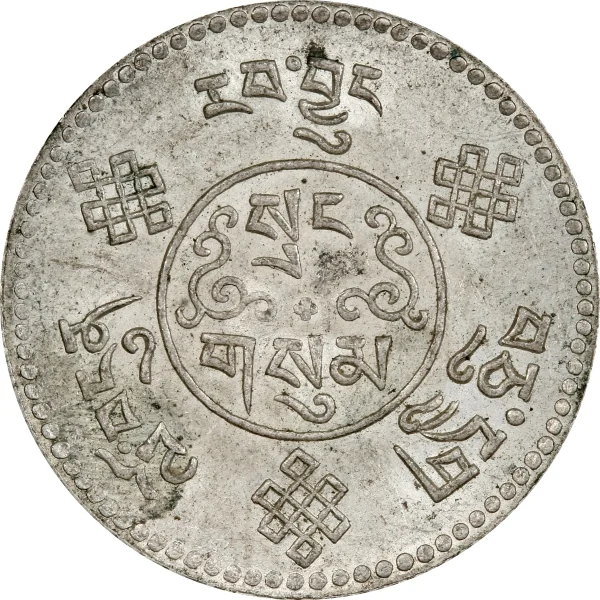
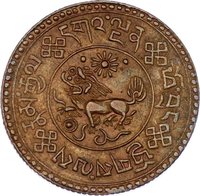
Obverse
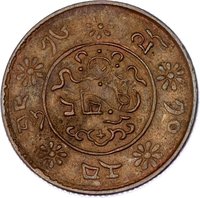
Reverse
Edge
Reeded.
Mints
| Name | Mark |
|---|---|
| Tapchi Electric Machine Factory | — |
Mintings
| Year | Mint Mark | Mintage | Quality | Collection |
|---|---|---|---|---|
| 1933 | — | — | ||
| 1934 | — | — |
Historical background
In 1933, Tibet operated under a complex and fragmented monetary system, reflecting its contested political status. While nominally a part of the Republic of China, the Tibetan government in Lhasa exercised de facto autonomy and issued its own currency. The primary unit was the Tibetan srang, a silver coin first minted in 1909, which circulated alongside smaller denominations like the skar and sho. However, the money supply was inconsistent, leading to periodic shortages and reliance on older Nepalese-minted Mohars and even Chinese silver yuan, which remained in circulation, particularly in eastern regions.
This multi-currency environment created significant economic instability. The value and acceptance of coins depended heavily on their silver content and the authority behind them, leading to confusion in trade. Furthermore, the Tibetan government lacked a central banking system and the technical capacity for sophisticated minting, making its currency vulnerable to counterfeiting and wear. The economy was still largely based on barter, especially in rural areas, with currency used mainly for larger transactions and taxes.
The monetary situation was intrinsically tied to geopolitics. The continued circulation of Chinese currency represented Beijing's persistent claim over the region, while the minting of Tibetan coins was a key symbol of Lhasa's self-rule. British India also exerted economic influence through trade routes, though the Indian rupee did not dominate internally. Thus, the currency landscape of 1933 Tibet was not merely an economic issue but a tangible reflection of the territory's precarious position between powerful neighbors and its struggle to maintain a separate economic identity.
This multi-currency environment created significant economic instability. The value and acceptance of coins depended heavily on their silver content and the authority behind them, leading to confusion in trade. Furthermore, the Tibetan government lacked a central banking system and the technical capacity for sophisticated minting, making its currency vulnerable to counterfeiting and wear. The economy was still largely based on barter, especially in rural areas, with currency used mainly for larger transactions and taxes.
The monetary situation was intrinsically tied to geopolitics. The continued circulation of Chinese currency represented Beijing's persistent claim over the region, while the minting of Tibetan coins was a key symbol of Lhasa's self-rule. British India also exerted economic influence through trade routes, though the Indian rupee did not dominate internally. Thus, the currency landscape of 1933 Tibet was not merely an economic issue but a tangible reflection of the territory's precarious position between powerful neighbors and its struggle to maintain a separate economic identity.
💎 Very Rare