

1000 Yen (Local Autonomy Law) – Japan
Non-circulating coins
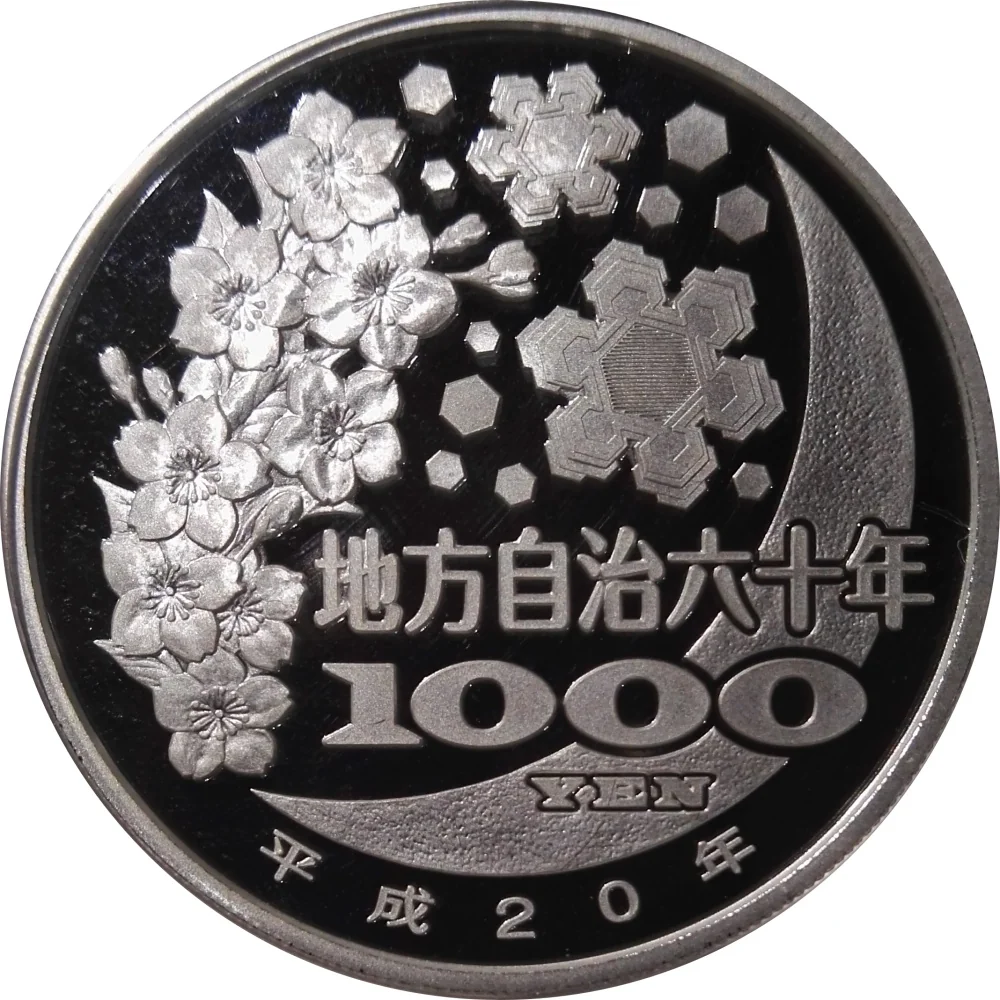
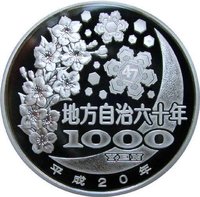
Commemoration: 60th anniversary of Local Autonomy Law
Japan
Context
Year: 2008
Japanese - Heisei era Year: 20
Issuer: Japan 
Ruler: Heisei
Currency:
(since 1871)
Total mintage: 100,000
Material
Diameter: 40 mm
Weight: 31.1 g
Silver weight: 31.07 g
Thickness: 3.5 mm
Shape: Round
Composition: 99.9% Silver
Standard: Silver ounce
Magnetic: No
Alignment: Medal alignment
flip
References
Y: #Click to copy to clipboard146
Numista: #19550
Value
Exchange value: 1000 JPY = $6.41
Bullion value: $89.57
Inflation-adjusted value: 1139.07 JPY
Obverse
Description:
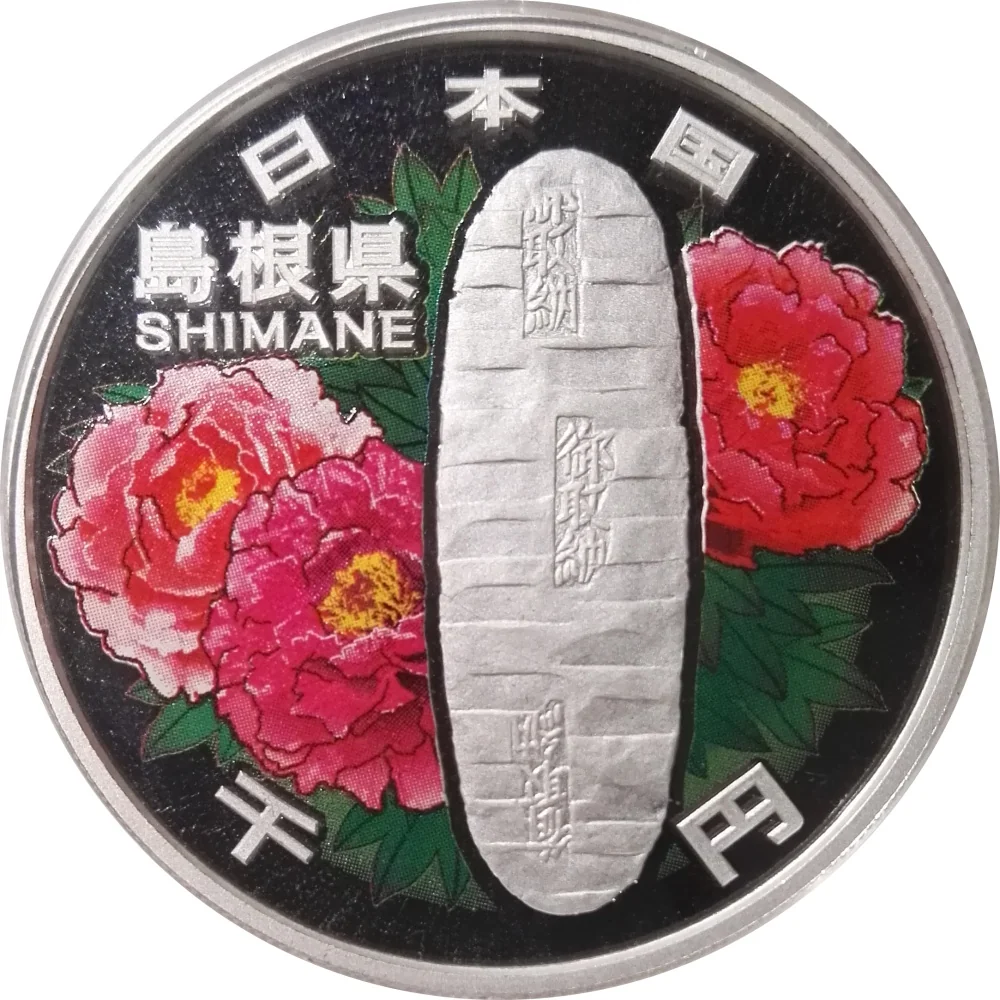
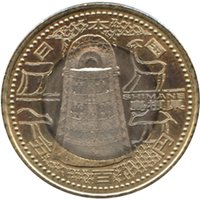
Otoriosame-Chogin silver coins from the Iwami Ginzan Silver Mine, with Shimane's prefectural flower, the peony. Colorized.
Inscription:
日 本 国
島根県
SHIMANE
御
取
納
(x3)
千 円
島根県
SHIMANE
御
取
納
(x3)
千 円
Translation:
JAPAN
Shimane Prefecture
SHIMANE
Imperial
Receipt
Payment
(x3)
One Thousand Yen
Shimane Prefecture
SHIMANE
Imperial
Receipt
Payment
(x3)
One Thousand Yen
Language: Japanese
Reverse
Edge
Slanted reeding right
Mints
| Name | Mark |
|---|---|
| Japan Mint | — |
Mintings
| Year | Mint Mark | Mintage | Quality | Collection |
|---|---|---|---|---|
| 2008 | — | 100,000 | Proof |
Historical background
In 2008, Japan's currency situation was dominated by the paradoxical strength of the yen amidst global financial turmoil. As the U.S. subprime mortgage crisis escalated into a full-blown global financial panic, investors worldwide engaged in a massive unwinding of the "carry trade." For years, they had borrowed cheap yen at Japan's near-zero interest rates to invest in higher-yielding assets abroad. The crisis triggered a rush to repay these loans, sparking a surge in demand for yen and causing it to appreciate sharply. This rapid strengthening was problematic for Japan's export-dependent economy, as a stronger yen made its cars and electronics more expensive overseas, squeezing corporate profits at a critical time.
Domestically, Japan was still grappling with the lingering effects of its "Lost Decade," characterized by deflation and stagnant growth. The Bank of Japan (BOJ) had maintained an ultra-loose monetary policy for years, with the benchmark interest rate at a low 0.5% for most of 2008 before being cut to 0.3% in October and then to 0.1% in December. Despite this, deflationary pressures persisted. The global financial shock from the Lehman Brothers collapse in September 2008 severely hit Japanese exports and industrial production, plunging the economy into a severe recession by year's end. The strong yen exacerbated this downturn, creating a complex challenge for policymakers who were simultaneously fighting a domestic recession and unwanted currency appreciation.
The government and the BOJ responded with limited tools. Verbal intervention to talk down the yen had little effect against the powerful market forces of risk aversion and deleveraging. While other central banks slashed rates aggressively, the BOJ had little room to cut further from its already near-zero floor. This period highlighted Japan's vulnerability to external shocks and the limitations of its monetary policy in a global liquidity crisis. The yen's role as a "safe-haven" asset in 2008, while a testament to Japan's financial stability, ultimately acted as an economic headwind, setting the stage for more direct intervention debates and prolonged deflation battles in the years that followed.
Domestically, Japan was still grappling with the lingering effects of its "Lost Decade," characterized by deflation and stagnant growth. The Bank of Japan (BOJ) had maintained an ultra-loose monetary policy for years, with the benchmark interest rate at a low 0.5% for most of 2008 before being cut to 0.3% in October and then to 0.1% in December. Despite this, deflationary pressures persisted. The global financial shock from the Lehman Brothers collapse in September 2008 severely hit Japanese exports and industrial production, plunging the economy into a severe recession by year's end. The strong yen exacerbated this downturn, creating a complex challenge for policymakers who were simultaneously fighting a domestic recession and unwanted currency appreciation.
The government and the BOJ responded with limited tools. Verbal intervention to talk down the yen had little effect against the powerful market forces of risk aversion and deleveraging. While other central banks slashed rates aggressively, the BOJ had little room to cut further from its already near-zero floor. This period highlighted Japan's vulnerability to external shocks and the limitations of its monetary policy in a global liquidity crisis. The yen's role as a "safe-haven" asset in 2008, while a testament to Japan's financial stability, ultimately acted as an economic headwind, setting the stage for more direct intervention debates and prolonged deflation battles in the years that followed.
💎 Very Rare