

1 chon – Korean Empire
Add to wishlist
Context
Years: 1905–1906
Country: Korea
Issuer: Korean Empire
Period:
(1897—1907)
Currency:
(1901—1910)
Demonetized: Yes
Total mintage: 11,800,000
Material
References
KM: #
Numista: #15831
Obverse
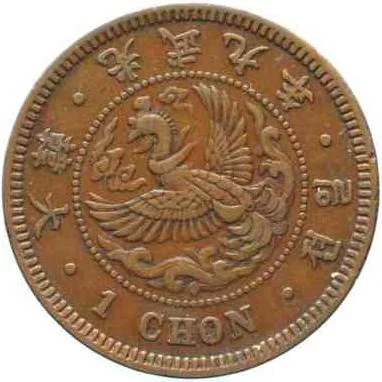
Description:
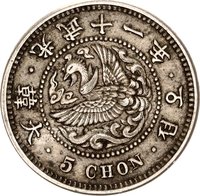
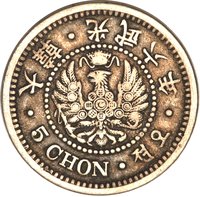
Imperial eagle left, date above, denomination below.
Inscription:
• 大韓 • 光武九年 • 일젼 • 1 CHON
Translation:
THE GREAT KOREA; KWANGMU, 9TH YEAR; ONE JEON; 1 CHON
Reverse
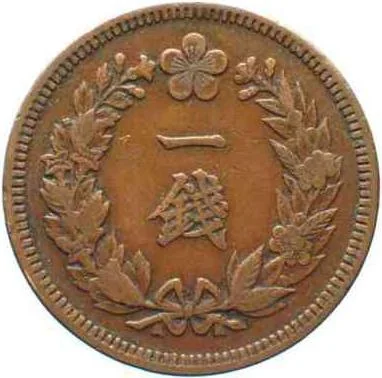
Description:
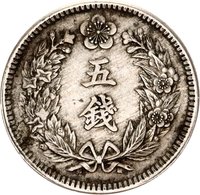
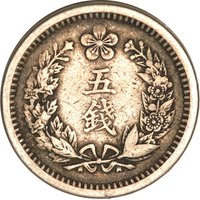
Denomination with wreath and plum flower (Imperial Seal of Korea).
Inscription:
一
錢
錢
Translation:
One coin.
Scripts: Chinese (traditional, regular script)
Language: Classical Chinese
Edge
Mintings
| Year | Mint Mark | Mintage | Quality | Collection |
|---|---|---|---|---|
| 1905 | — | 11,800,000 | ||
| 1906 | — | — |
Historical background
By 1905, the currency situation of the Korean Empire was one of profound instability and foreign domination, reflecting the nation's precarious political sovereignty. The traditional monetary system, based on copper mun coins and silver yang, was chaotic and debased, with widespread counterfeiting and regional variations hindering commerce. In an attempt to modernize, the government had introduced new currency, including the silver won in 1900, but these efforts were undermined by a severe lack of specie reserves and insufficient institutional control.
This financial vulnerability was aggressively exploited by imperial Japan, which was tightening its political grip following its victory in the Russo-Japanese War. Japanese banks, particularly the Dai-Ichi Bank, circulated vast quantities of Japanese yen notes within Korea, effectively making them a parallel currency. Furthermore, through the forced Japan-Korea Protocol of August 1905, the Korean government was compelled to appoint a Japanese financial advisor, Megata Tanetarō, who placed the Korean treasury under de facto Japanese management. His policies prioritized stabilizing the currency to benefit Japanese trade and strategic interests, not Korean economic sovereignty.
Consequently, by the end of 1905—the very year the Eulsa Treaty made Korea a Japanese protectorate—the Korean Empire had lost control over its monetary policy. The currency system was in a transitional but directed state, moving away from traditional forms and towards integration with the Japanese yen. This financial takeover was a critical component of Japan's colonial project, as controlling the money supply paved the way for full economic annexation, which would be formalized in 1910.
This financial vulnerability was aggressively exploited by imperial Japan, which was tightening its political grip following its victory in the Russo-Japanese War. Japanese banks, particularly the Dai-Ichi Bank, circulated vast quantities of Japanese yen notes within Korea, effectively making them a parallel currency. Furthermore, through the forced Japan-Korea Protocol of August 1905, the Korean government was compelled to appoint a Japanese financial advisor, Megata Tanetarō, who placed the Korean treasury under de facto Japanese management. His policies prioritized stabilizing the currency to benefit Japanese trade and strategic interests, not Korean economic sovereignty.
Consequently, by the end of 1905—the very year the Eulsa Treaty made Korea a Japanese protectorate—the Korean Empire had lost control over its monetary policy. The currency system was in a transitional but directed state, moving away from traditional forms and towards integration with the Japanese yen. This financial takeover was a critical component of Japan's colonial project, as controlling the money supply paved the way for full economic annexation, which would be formalized in 1910.
🌟 Limited