

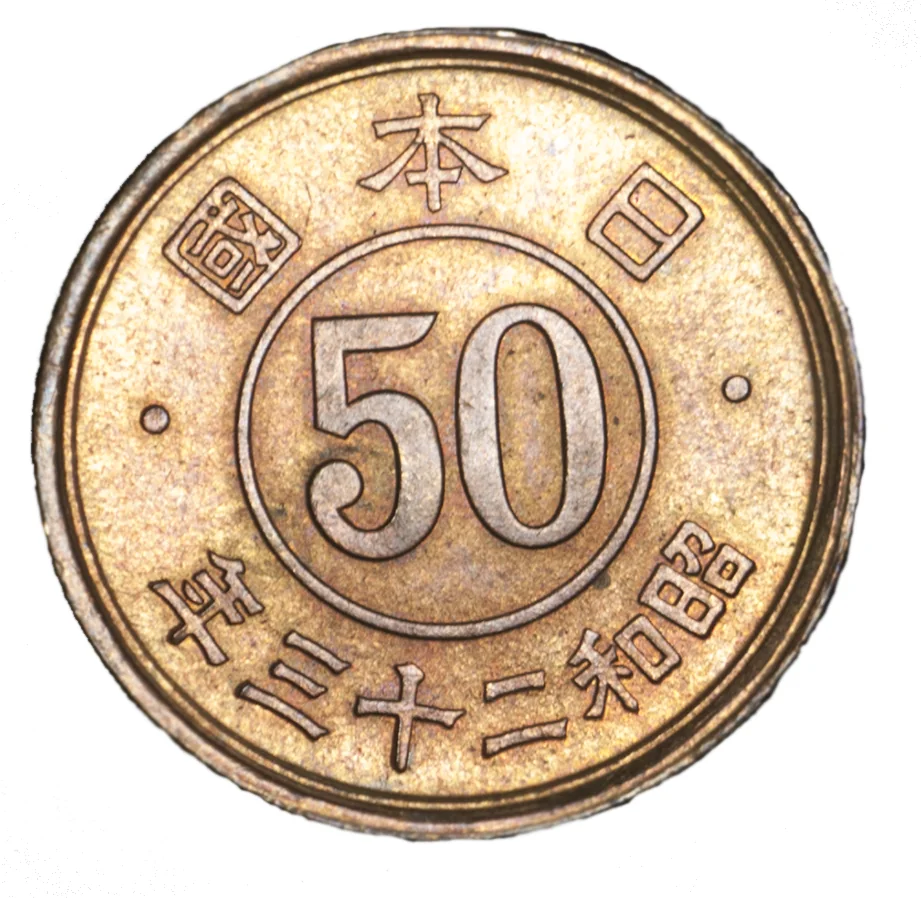
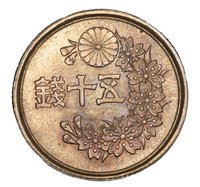
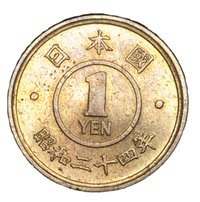
Obverse
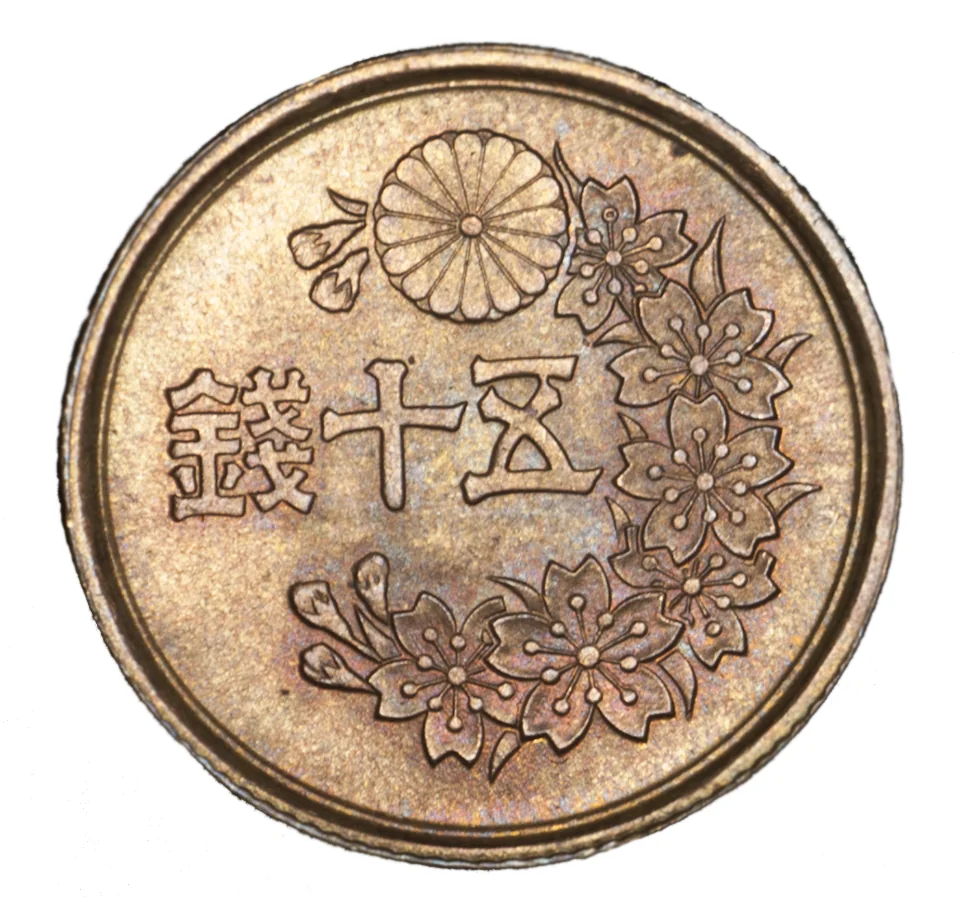
Reverse
Description:
Value and denomination left of cherry blossoms, chrysanthemum above.
Inscription:
錢十五
Translation:
Fifteen coins.
Language: Chinese
Edge
Reeded
Mintings
| Year | Mint Mark | Mintage | Quality | Collection |
|---|---|---|---|---|
| 1947 | — | 849,234,445 | ||
| 1948 | — | — |
Historical background
In 1947, Japan was in the throes of a severe economic crisis under Allied Occupation, grappling with the catastrophic aftermath of World War II. Hyperinflation was rampant, fueled by a massive expansion of the money supply to cover government deficits and reconstruction costs, while industrial production remained at a fraction of pre-war levels. The official currency, the yen, was nearly worthless on the black market, where most essential goods were traded, leading to a breakdown of the official economy and widespread poverty. The Occupation authorities, led by the United States, recognized that economic stabilization was a prerequisite for political recovery and the prevention of social unrest.
To combat this, the Occupation implemented the "Economic Stabilization Program" in 1947, a decisive and harsh austerity plan designed by American economist Joseph Dodge. Its centerpiece was the "New Yen Currency Conversion" of 1947, a dramatic monetary reform where old yen notes were declared invalid and citizens were forced to exchange them for a strictly limited amount of new currency. This sudden contraction of the money supply was intended to break inflationary expectations, eliminate hoarded wartime profits, and undermine the black market by rendering vast sums of old currency worthless.
The immediate effect was brutal but effective: inflation was abruptly halted, restoring some functionality to the currency. However, it also triggered a severe credit crunch, known as the "Dodge Line recession," which stifled business activity and caused significant short-term hardship. This painful stabilization in 7 set the stage for the more comprehensive "Dodge Line" reforms of 1949, which balanced the budget, fixed the exchange rate, and laid the foundation for Japan's subsequent period of rapid industrial growth and economic miracle. Thus, 1947 represents the pivotal, if painful, turning point from post-war chaos toward disciplined recovery.
To combat this, the Occupation implemented the "Economic Stabilization Program" in 1947, a decisive and harsh austerity plan designed by American economist Joseph Dodge. Its centerpiece was the "New Yen Currency Conversion" of 1947, a dramatic monetary reform where old yen notes were declared invalid and citizens were forced to exchange them for a strictly limited amount of new currency. This sudden contraction of the money supply was intended to break inflationary expectations, eliminate hoarded wartime profits, and undermine the black market by rendering vast sums of old currency worthless.
The immediate effect was brutal but effective: inflation was abruptly halted, restoring some functionality to the currency. However, it also triggered a severe credit crunch, known as the "Dodge Line recession," which stifled business activity and caused significant short-term hardship. This painful stabilization in 7 set the stage for the more comprehensive "Dodge Line" reforms of 1949, which balanced the budget, fixed the exchange rate, and laid the foundation for Japan's subsequent period of rapid industrial growth and economic miracle. Thus, 1947 represents the pivotal, if painful, turning point from post-war chaos toward disciplined recovery.
🌱 Very Common