

1 Yuan – Taiwan
Circulating commemorative coins
Commemoration: F.A.O.
China
Context
Year: 1969
Chinese republican Year: 58
Country: China 
Issuer: Taiwan 
Period:
(since 1949)
Currency:
(since 1949)
Total mintage: 10,000,000
Material
References
Y: #Click to copy to clipboard547
Numista: #9988
Value
Exchange value: 1 TWD
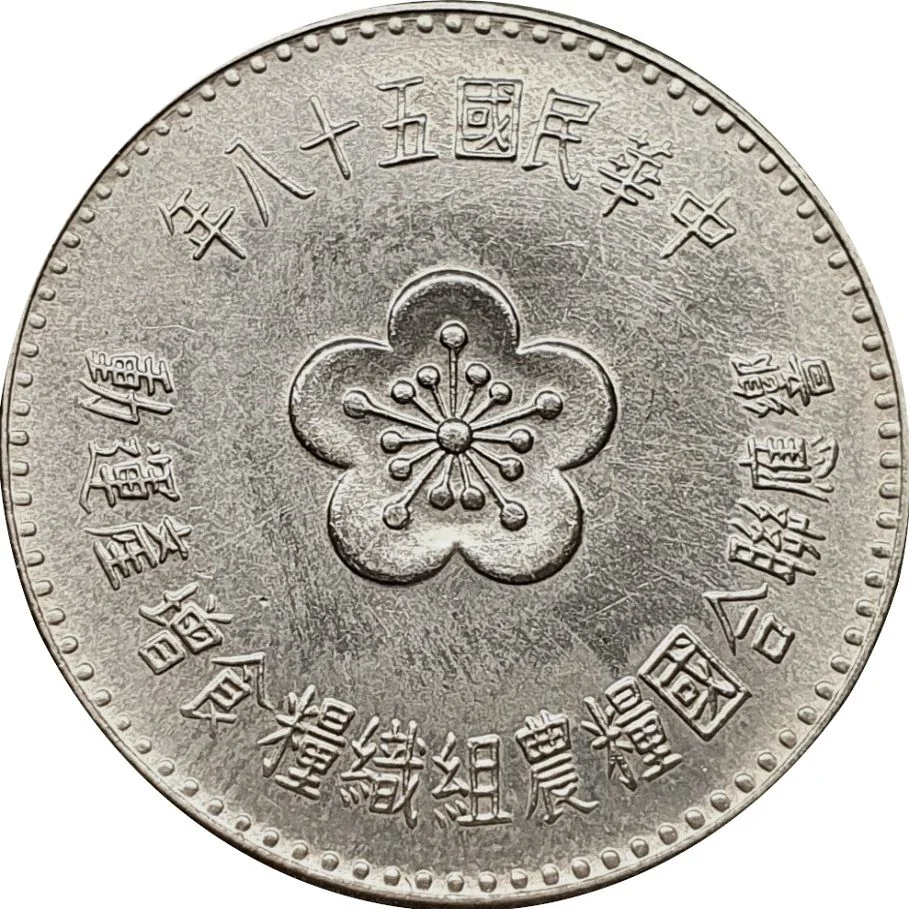
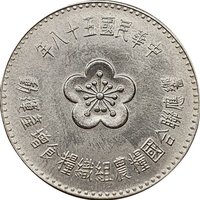
Obverse
Description:
Plum blossom (Prunus mume).
Inscription:
年八十五國民華中
動運産增食糧織組農糧國合聯應響
動運産增食糧織組農糧國合聯應響
Translation:
Eighty-fifth Year of the Republic of China.
Respond to the Movement for Increasing Production of Food and Textiles.
Organize the National Federation of Agricultural Cooperatives.
Respond to the Movement for Increasing Production of Food and Textiles.
Organize the National Federation of Agricultural Cooperatives.
Language: Chinese
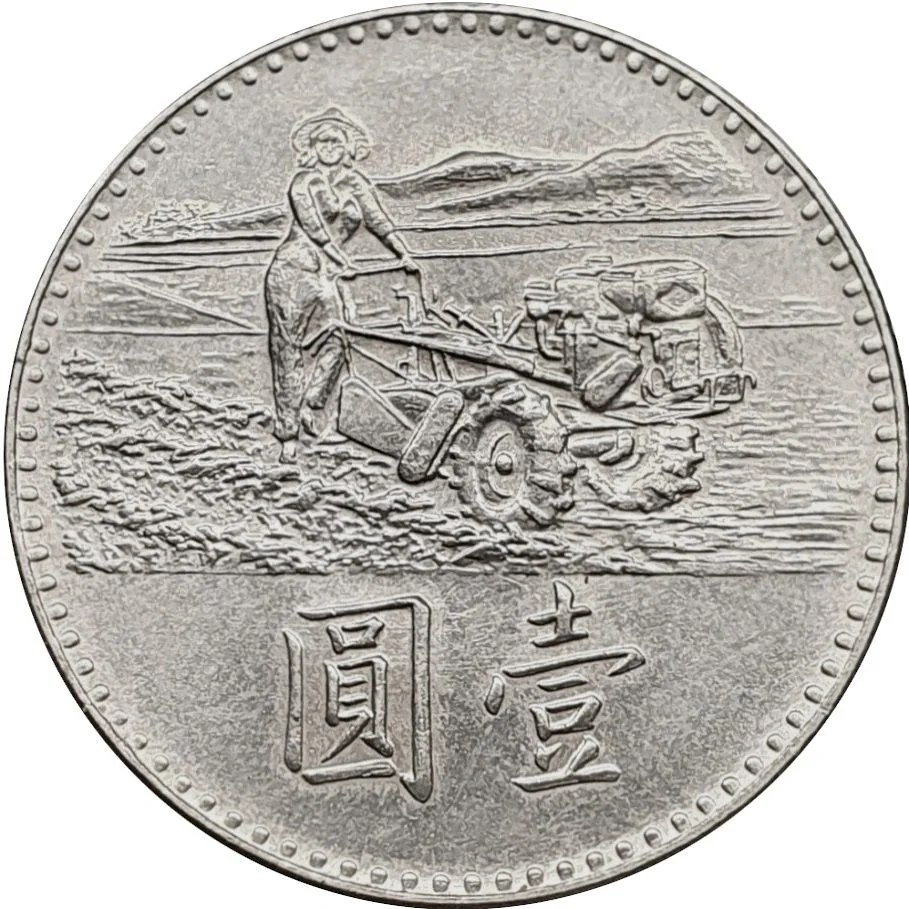
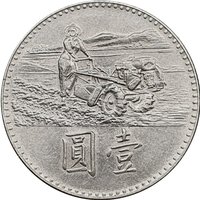
Reverse
Description:
Woman plowing field with hand tractor to right, denomination below.
Inscription:
圓壹
Translation:
One Yuan
Language: Classical Chinese
Edge
Milled
Categories
| Agriculture |
| Organization> FAO |
Mints
| Name | Mark |
|---|---|
| Central Mint of Taiwan | — |
Mintings
| Year | Mint Mark | Mintage | Quality | Collection |
|---|---|---|---|---|
| 1969 | — | 10,000,000 |
Historical background
In 1969, Taiwan's currency situation was characterized by stability and controlled growth under the guidance of the Central Bank of China, which had been re-established in Taipei in 1961. The New Taiwan Dollar (NTD), introduced in 1949 to end the hyperinflation of the old Taiwan Dollar, was firmly pegged to the US Dollar at a fixed rate of NT$40 to US$1. This peg, established in the early 1950s, provided a crucial anchor for trade and investment, fostering confidence both domestically and internationally during a period of rapid industrialization.
The island's economy was in the midst of its "economic miracle," transitioning from import substitution to export-oriented growth. The stable currency was a foundational pillar of this success, making Taiwanese exports like textiles and electronics competitively priced on the global market. Foreign exchange reserves were managed strictly, with a controlled foreign exchange system requiring most transactions to go through the central bank, ensuring the peg's defense and supporting strategic industrial policy.
There were no significant currency crises or devaluations in 1969 itself; the year represented a point of consolidation within a longer era of monetary stability that lasted until the early 1970s. However, underlying pressures were building due to Taiwan's consistent trade surpluses and the growing money supply from rapid economic expansion. These pressures would eventually lead to a modest revaluation to NT$38 to US$1 in 1973 and, following the Nixon Shock, a shift to a managed float later in the decade, ending the long-standing fixed rate.
The island's economy was in the midst of its "economic miracle," transitioning from import substitution to export-oriented growth. The stable currency was a foundational pillar of this success, making Taiwanese exports like textiles and electronics competitively priced on the global market. Foreign exchange reserves were managed strictly, with a controlled foreign exchange system requiring most transactions to go through the central bank, ensuring the peg's defense and supporting strategic industrial policy.
There were no significant currency crises or devaluations in 1969 itself; the year represented a point of consolidation within a longer era of monetary stability that lasted until the early 1970s. However, underlying pressures were building due to Taiwan's consistent trade surpluses and the growing money supply from rapid economic expansion. These pressures would eventually lead to a modest revaluation to NT$38 to US$1 in 1973 and, following the Nixon Shock, a shift to a managed float later in the decade, ending the long-standing fixed rate.
🌱 Common