

1 Yuan (Jiang Jieshi) – Taiwan
Circulating commemorative coins
Commemoration: 80th Anniversary of Jiang Jieshi
China
Context
Year: 1966
Chinese republican Year: 55
Country: China 
Issuer: Taiwan 
Period:
(since 1949)
Currency:
(since 1949)
Material
Diameter: 25 mm
Weight: 6 g
Thickness: 1.65 mm
Shape: Round
Composition: Copper-nickel
Technique: Milled
Alignment: Medal alignment
flip
References
Y: #Click to copy to clipboard543
Numista: #10245
Value
Exchange value: 1 TWD
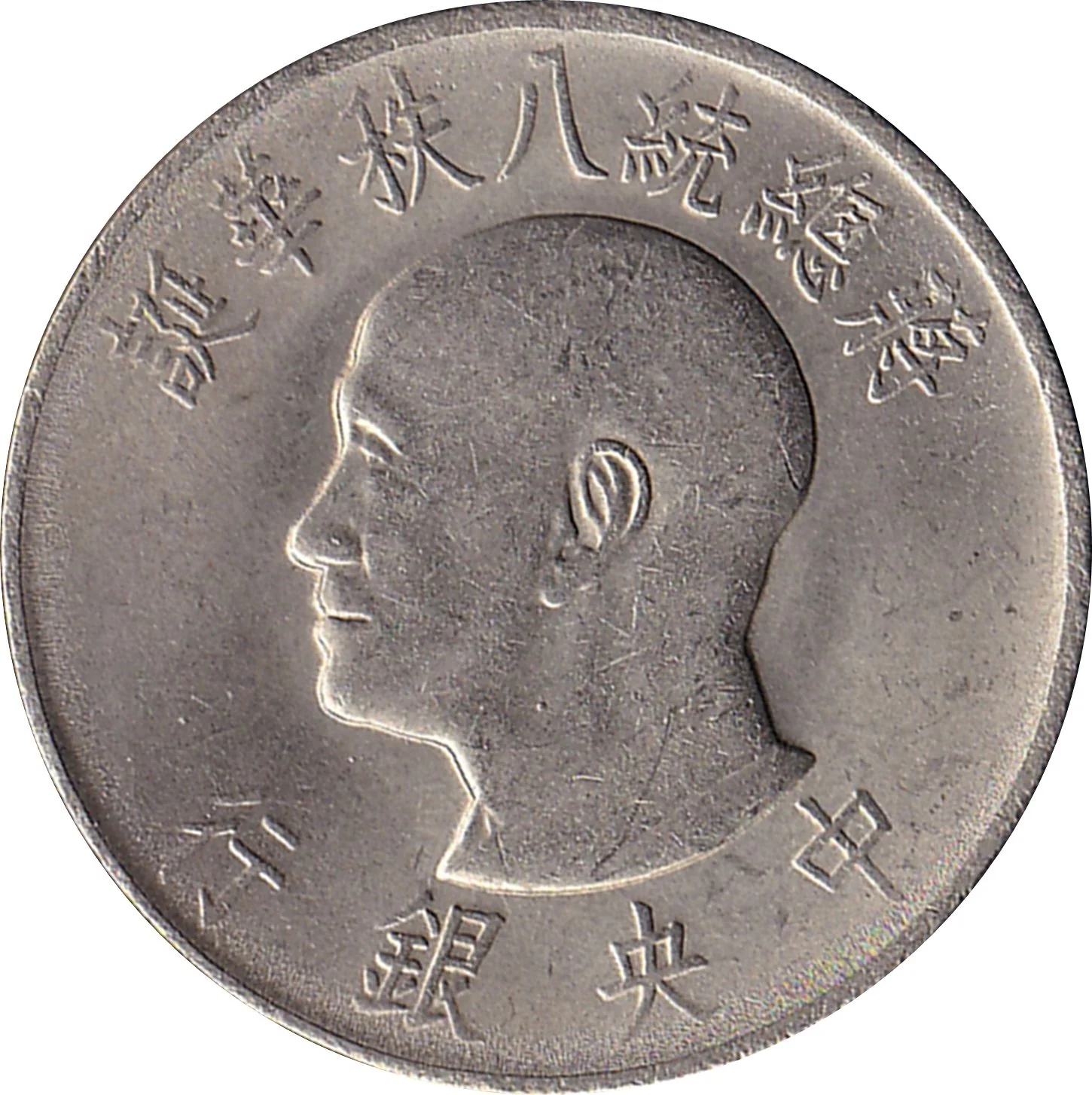
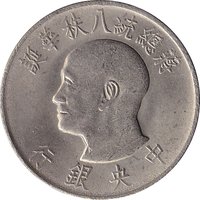
Obverse
Description:
Chiang Kai-shek bust facing left.
Inscription:
誕華秩八統總蔣
行銀央中
行銀央中
Translation:
Central Bank of China
Eighth Anniversary of the Founding of the Republic of China
Eighth Anniversary of the Founding of the Republic of China
Language: Chinese
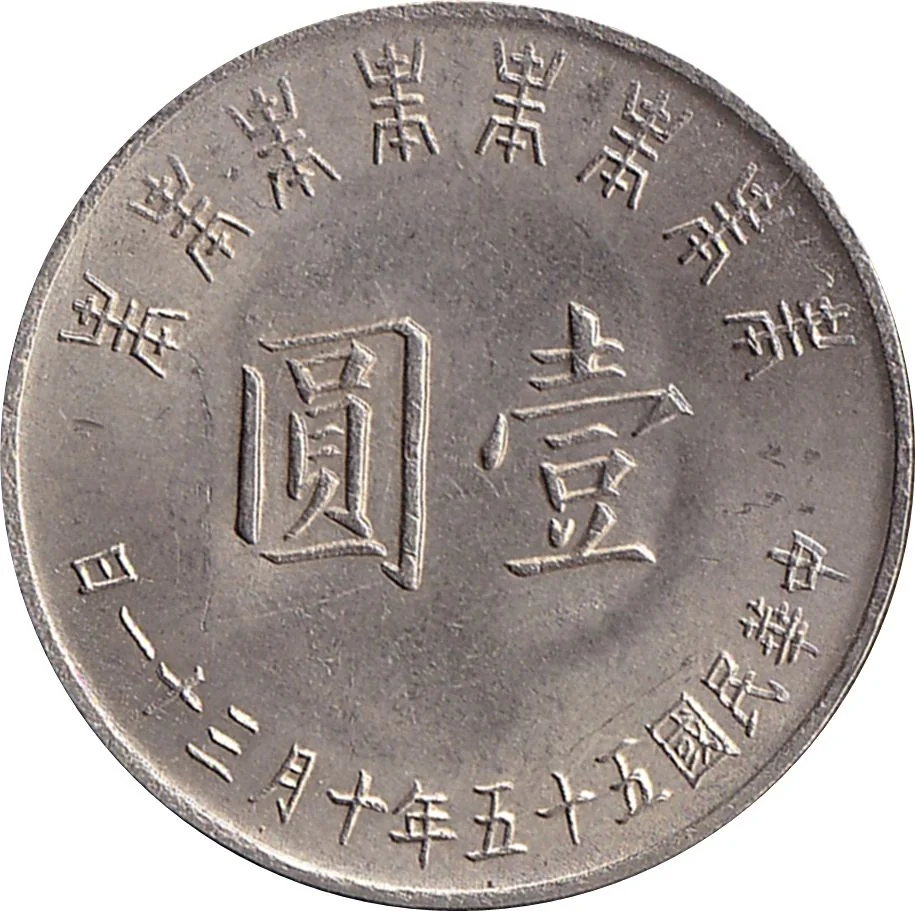
Reverse
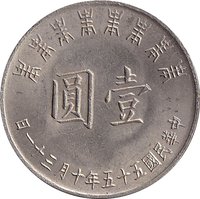
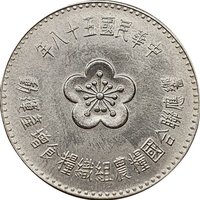
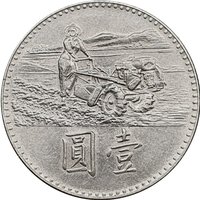
Description:
Denomination
Inscription:
圓壹
日一十三月十年五十五國民華中
日一十三月十年五十五國民華中
Translation:
Central Republic of China, Year 15, Month 10, Day 13, One Yuan
Language: Chinese
Edge
Milled
Categories
| Event> Birth anniversary |
Mintings
| Year | Mint Mark | Mintage | Quality | Collection |
|---|---|---|---|---|
| 1966 | — | — |
Historical background
In 1966, Taiwan's currency situation was characterized by a period of relative stability and controlled growth under the governance of the Republic of China (ROC). The New Taiwan Dollar (NTD), first issued in 1949 to replace the old Taiwan Dollar during a period of hyperinflation, had been successfully stabilized. This was largely due to a series of financial reforms and strict monetary policies implemented in the 1950s with U.S. aid and guidance, which had tamed inflation and established a credible central banking system under the Central Bank of China (re-established in Taipei in 1961).
The economy in 1966 was transitioning from import-substitution industrialization to export-oriented growth. The currency was maintained at a fixed exchange rate, pegged to the U.S. Dollar at a rate of NT$40 to US$1, a parity established in 1963 and which would remain for over a decade. This stable and somewhat undervalued peg was a deliberate policy to support the burgeoning export sector, making Taiwanese goods like textiles and electronics competitively priced on the global market and fueling the "Taiwan Economic Miracle."
Therefore, the currency landscape in 1966 was one of deliberate stability serving strategic economic development. The NTD was not freely convertible internationally, and capital controls were in place, reflecting the managed nature of the financial system. This environment of a fixed, stable exchange rate provided the predictable foundation necessary for the rapid industrial expansion and massive inflow of foreign investment that would define Taiwan's economic trajectory in the late 1960s and 1970s.
The economy in 1966 was transitioning from import-substitution industrialization to export-oriented growth. The currency was maintained at a fixed exchange rate, pegged to the U.S. Dollar at a rate of NT$40 to US$1, a parity established in 1963 and which would remain for over a decade. This stable and somewhat undervalued peg was a deliberate policy to support the burgeoning export sector, making Taiwanese goods like textiles and electronics competitively priced on the global market and fueling the "Taiwan Economic Miracle."
Therefore, the currency landscape in 1966 was one of deliberate stability serving strategic economic development. The NTD was not freely convertible internationally, and capital controls were in place, reflecting the managed nature of the financial system. This environment of a fixed, stable exchange rate provided the predictable foundation necessary for the rapid industrial expansion and massive inflow of foreign investment that would define Taiwan's economic trajectory in the late 1960s and 1970s.
🌱 Common