

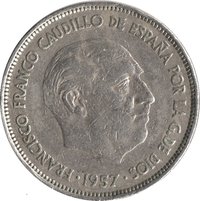
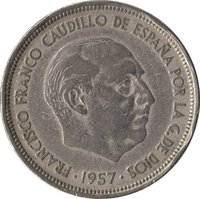
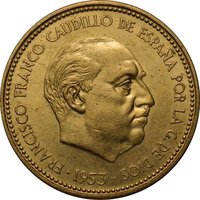
Obverse
Description:
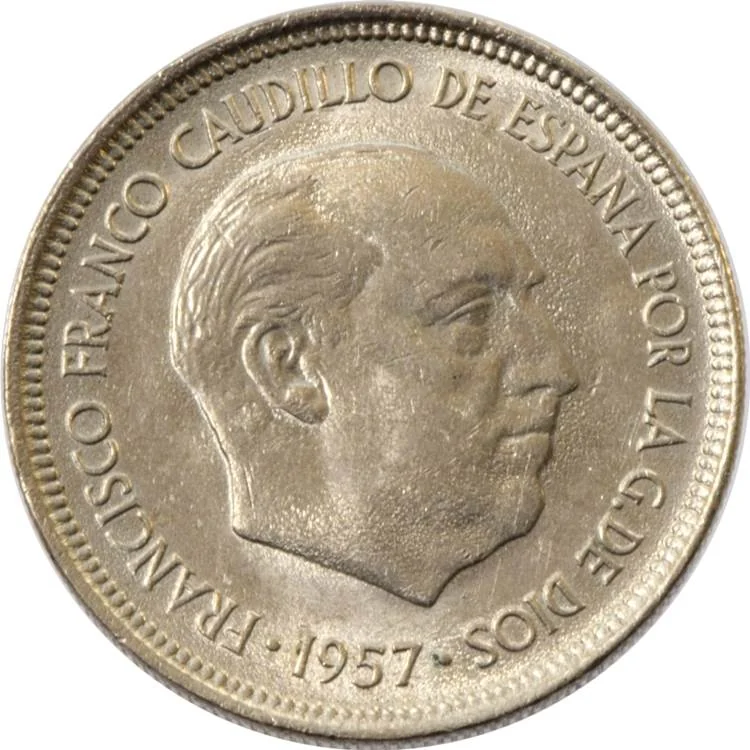
Franco facing right.
Inscription:
FRANCISCO FRANCO CAUDILLO DE ESPAÑA POR LA G.DE DIOS
· 1957 ·
· 1957 ·
Translation:
FRANCISCO FRANCO CAUDILLO OF SPAIN BY THE GRACE OF GOD
· 1957 ·
· 1957 ·
Script: Latin
Language: Spanish
Engraver: Manuel Marín Jimeno
Designer: Mariano Benlliure Gil
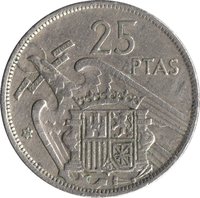
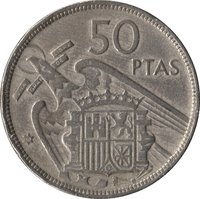
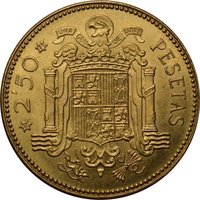
Reverse
Description:
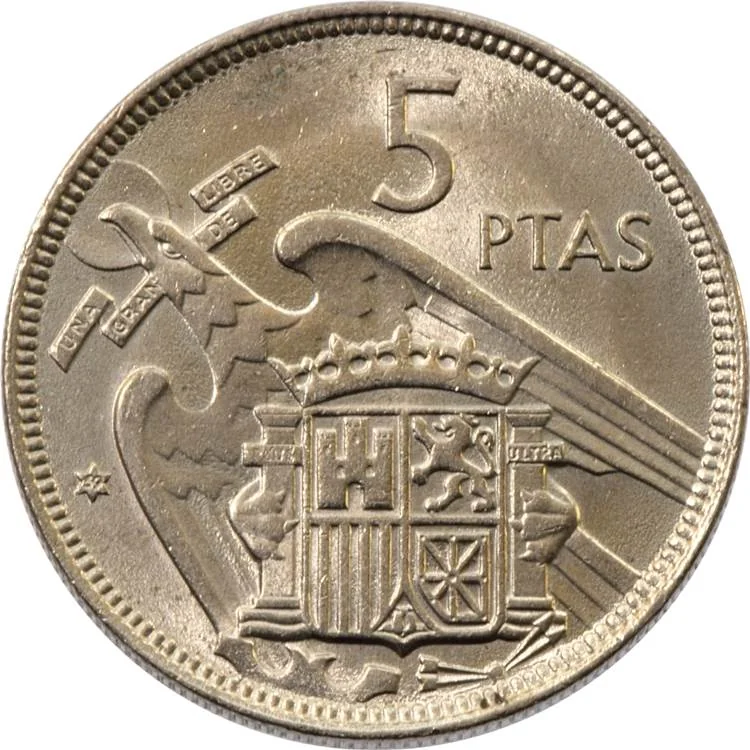
Coat of arms of Spain with the eagle of Saint John, a yoke, and arrows.
Inscription:
5 PTAS
UNA GRANDE LIBRE
PLUS ULTRA
🟌
UNA GRANDE LIBRE
PLUS ULTRA
🟌
Translation:
5 Pesetas
One Great Free
Further Beyond
One Great Free
Further Beyond
Script: Latin
Engraver: Teodoro Miciano Becerra
Edge
Reeded
Categories
| Person> Politician |
| Symbols> Coat of Arms |
| Animal> Bird> Eagle |
| Person> Military leader |
Mints
| Name | Mark |
|---|---|
| Royal Mint of Madrid | (🟌) |
| Royal Mint of Madrid | BA |
Mintings
| Year | Mint Mark | Mintage | Quality | Collection |
|---|---|---|---|---|
| 1958 | — | 43,000 | ||
| 1959 | — | 107,000,000 | ||
| 1960 | — | 26,000,000 | ||
| 1961 | — | 78,992,000 | ||
| 1962 | — | 40,963,000 | ||
| 1963 | 🟌 | — | ||
| 1963 | — | 50,000,000 | ||
| 1964 | — | 51,000,000 | ||
| 1965 | — | 25,000,000 | ||
| 1966 | — | 28,000,000 | ||
| 1967 | — | 30,000,000 | ||
| 1968 | — | 60,000,000 | ||
| 1969 | — | 40,000,000 | ||
| 1970 | — | — | ||
| 1971 | — | 77,000,000 | ||
| 1972 | — | 30,000 | Proof | |
| 1972 | — | 70,000,000 | ||
| 1973 | — | 25,000 | Proof | |
| 1973 | — | 78,000,000 | ||
| 1974 | — | 23,000 | Proof | |
| 1974 | — | 100,000,000 | ||
| 1975 | — | 75,000 | Proof | |
| 1975 | — | 139,047,000 |
Historical background
In 1958, Spain was in the midst of the Francoist dictatorship and was grappling with a profound economic crisis, largely a result of the regime's policy of autarky (self-sufficiency) that had isolated the country since the end of the Civil War in 1939. The national currency, the peseta, was severely overvalued at an official exchange rate fixed by the government, which bore little relation to its actual market value. This created a thriving black market for foreign currency, where the peseta traded at a fraction of its official rate, stifling legitimate foreign trade and investment and leading to rampant inflation, a large balance of payments deficit, and critically low foreign exchange reserves.
The situation reached a breaking point, forcing the regime to acknowledge that its autarkic model had failed. In 1957, a new cabinet with more technocratic ministers, often referred to as the "technocrats" linked to the Catholic group Opus Dei, was formed. Their primary task was to stabilize the economy, and currency reform was central to their plan. This culminated in the 1959 Stabilization Plan, a decisive shift in economic policy negotiated with international organizations like the OECD and the IMF.
While the formal devaluation and liberalization measures were implemented in July 1959, the groundwork was laid throughout 1958. The year was characterized by intense internal planning and external negotiation to secure the necessary foreign loans and approval for a drastic course correction. Therefore, the currency situation in 1958 is best understood as the final, critical phase of a monetary crisis that made a radical policy shift inevitable, setting the stage for the devaluation of the peseta, the partial convertibility of the currency, and the opening of the Spanish economy to foreign capital and trade the following year.
The situation reached a breaking point, forcing the regime to acknowledge that its autarkic model had failed. In 1957, a new cabinet with more technocratic ministers, often referred to as the "technocrats" linked to the Catholic group Opus Dei, was formed. Their primary task was to stabilize the economy, and currency reform was central to their plan. This culminated in the 1959 Stabilization Plan, a decisive shift in economic policy negotiated with international organizations like the OECD and the IMF.
While the formal devaluation and liberalization measures were implemented in July 1959, the groundwork was laid throughout 1958. The year was characterized by intense internal planning and external negotiation to secure the necessary foreign loans and approval for a drastic course correction. Therefore, the currency situation in 1958 is best understood as the final, critical phase of a monetary crisis that made a radical policy shift inevitable, setting the stage for the devaluation of the peseta, the partial convertibility of the currency, and the opening of the Spanish economy to foreign capital and trade the following year.
🌱 Very Common