

1 Ruble (Victory in the Great Patriotic War) – Soviet Union
Circulating commemorative coins
Commemoration: 30th Anniversary of Victory in the Great Patriotic War
Russia
Context
Years: 1975–1988
Year: 1975
Country: Russia 
Issuer: Soviet Union 
Period:
(1922—1991)
Currency:
(1961—1991)
Demonetization: 1991
Total mintage: 15,044,000
Material
Diameter: 31 mm
Weight: 12.8 g
Thickness: 2.3 mm
Shape: Round
Composition: Nickel brass
Magnetic: No
Technique: Milled
Alignment: Medal alignment
flip
References
Y: #Click to copy to clipboard142.1
Numista: #4592
Value
Exchange value: 1 SUR
Obverse
Description:
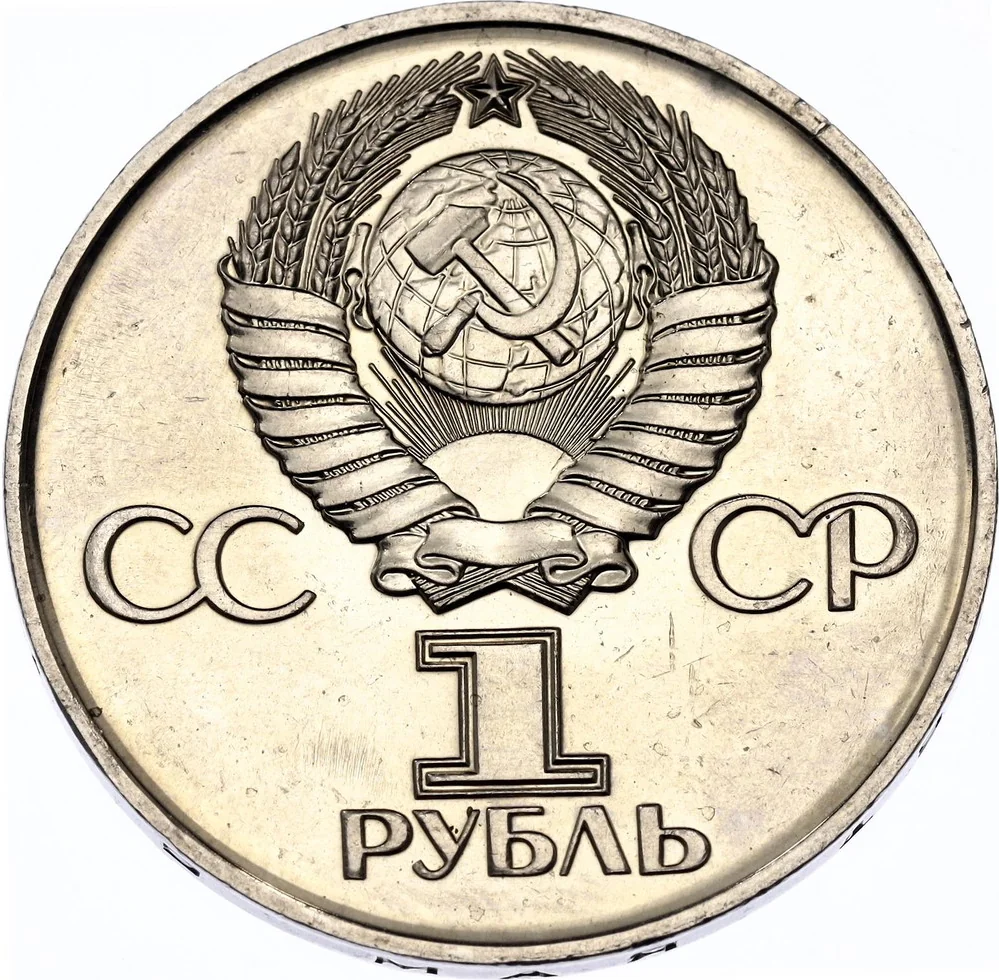
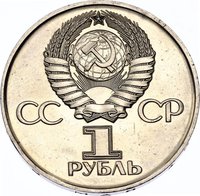
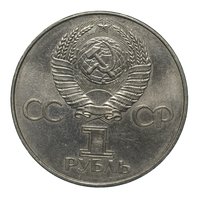
The Soviet Union's coat of arms; value.
Inscription:
СС СР
1
РУБЛЬ
1
РУБЛЬ
Translation:
ONE RUBLE USSR
Script: Cyrillic
Language: Russian
Engraver: V. Ermokov
Reverse
Description:
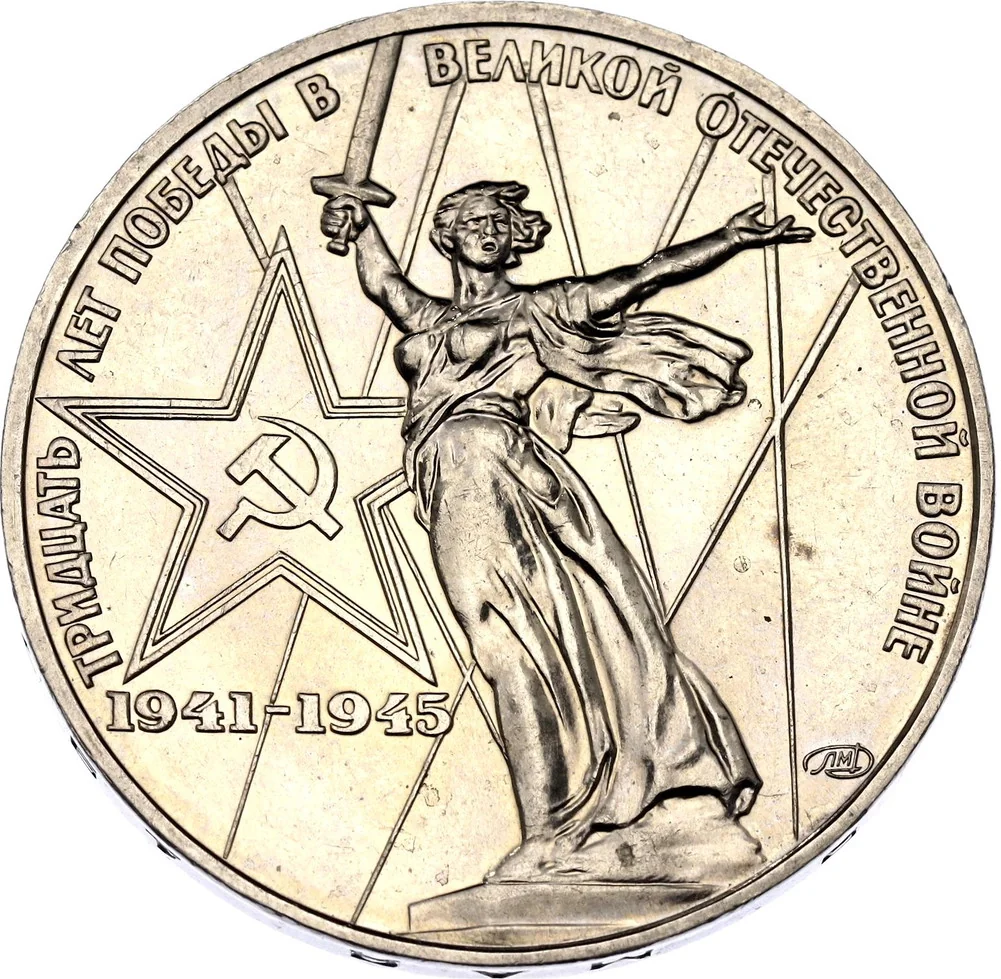
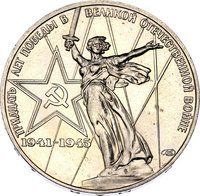
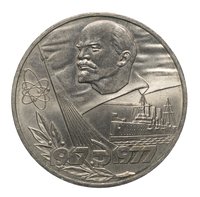
Volgograd monument with projectors displaying XXX for the victory anniversary.
Inscription:
ТРИДЦАТЬ ЛЕТ ПОБЕДЫ В ВЕЛИКОЙ ОТЕЧЕСТВЕННОЙ ВОЙНЕ
1941-1945
XXX
ЛМД
1941-1945
XXX
ЛМД
Translation:
THIRTY YEARS OF VICTORY IN THE GREAT PATRIOTIC WAR
1941-1945
XXX
LMD
1941-1945
XXX
LMD
Script: Cyrillic
Language: Russian
Engraver: J. Komschicov
Edge
Smooth with inscription
Legend:
ОДИН РУБЛЬ ⋆ 9 МАЯ 1975 ⋆
Translation:
ONE RUBLE * 9 MAY 1975 *
Language: Russian
Mints
| Name | Mark |
|---|---|
| Saint Petersburg | (ЛМД) |
Mintings
| Year | Mint Mark | Mintage | Quality | Collection |
|---|---|---|---|---|
| 1975 | ЛМД | 14,989,000 | ||
| 1975 | ЛМД | — | Proof | |
| 1975 | ЛМД | — | Prooflike | |
| 1988 | — | 55,000 | Proof |
Historical background
By 1975, the Soviet Union's currency situation was characterized by a stark duality between a stable, but largely meaningless, official ruble and a vibrant, repressed shadow economy. Officially, the State Bank (Gosbank) maintained strict control, with the ruble's exchange rate artificially set at 0.75 rubles to 1 US dollar—a figure disconnected from economic reality. This "wooden ruble" was non-convertible, meaning it could not be legally exchanged for foreign currency or taken out of the country, isolating the Soviet financial system from the global market. Internally, wages and prices for basic goods were centrally fixed, creating an illusion of stability and shielding the population from inflation, which was instead manifested as chronic shortages.
Beneath this controlled facade, a complex second economy operated, giving the ruble its true, variable value. Due to perennial deficits of quality goods and services, citizens routinely turned to the rynok (collective farm markets), the black market, or blat (personal connections) to obtain anything from meat and jeans to automobile parts. Here, effective prices were significantly higher than state prices. Furthermore, a special sector existed for privileged elites and foreigners, where goods were available for "certificate rubles" or hard currency in Beryozka stores, creating a two-tiered consumption society. The ruble's real purchasing power was thus highly situational, depending entirely on whether one was accessing the empty state system or the costly informal one.
This unstable equilibrium was under growing strain in the mid-1970s. While the Brezhnev era's "Era of Stagnation" saw little official economic reform, increased détente and foreign trade, partly financed by soaring oil exports following the 1973 crisis, brought more hard currency into state coffers. However, it also heightened the contradictions of a non-convertible currency in international dealings. The state relied on complex bilateral trade agreements and used an artificial "transferable ruble" for Comecon accounting, but the fundamental weakness of the monetary system was becoming more apparent. The currency situation of 1975, therefore, reflected the broader Soviet economic paradox: surface-level stability maintained by rigid controls, underpinned by growing inefficiencies and a thriving informal economy that increasingly defined daily life.
Beneath this controlled facade, a complex second economy operated, giving the ruble its true, variable value. Due to perennial deficits of quality goods and services, citizens routinely turned to the rynok (collective farm markets), the black market, or blat (personal connections) to obtain anything from meat and jeans to automobile parts. Here, effective prices were significantly higher than state prices. Furthermore, a special sector existed for privileged elites and foreigners, where goods were available for "certificate rubles" or hard currency in Beryozka stores, creating a two-tiered consumption society. The ruble's real purchasing power was thus highly situational, depending entirely on whether one was accessing the empty state system or the costly informal one.
This unstable equilibrium was under growing strain in the mid-1970s. While the Brezhnev era's "Era of Stagnation" saw little official economic reform, increased détente and foreign trade, partly financed by soaring oil exports following the 1973 crisis, brought more hard currency into state coffers. However, it also heightened the contradictions of a non-convertible currency in international dealings. The state relied on complex bilateral trade agreements and used an artificial "transferable ruble" for Comecon accounting, but the fundamental weakness of the monetary system was becoming more apparent. The currency situation of 1975, therefore, reflected the broader Soviet economic paradox: surface-level stability maintained by rigid controls, underpinned by growing inefficiencies and a thriving informal economy that increasingly defined daily life.
🌱 Very Common