

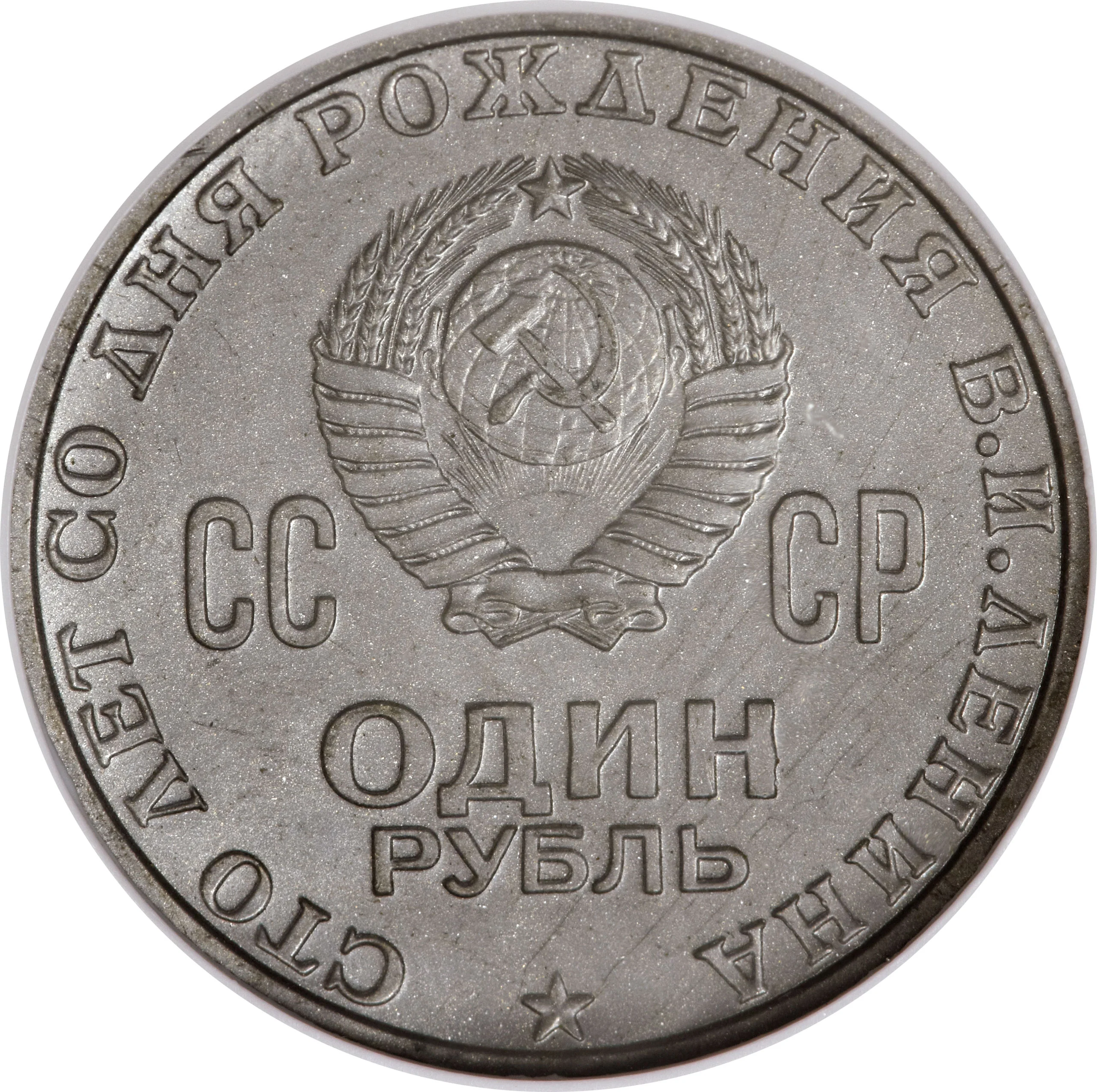
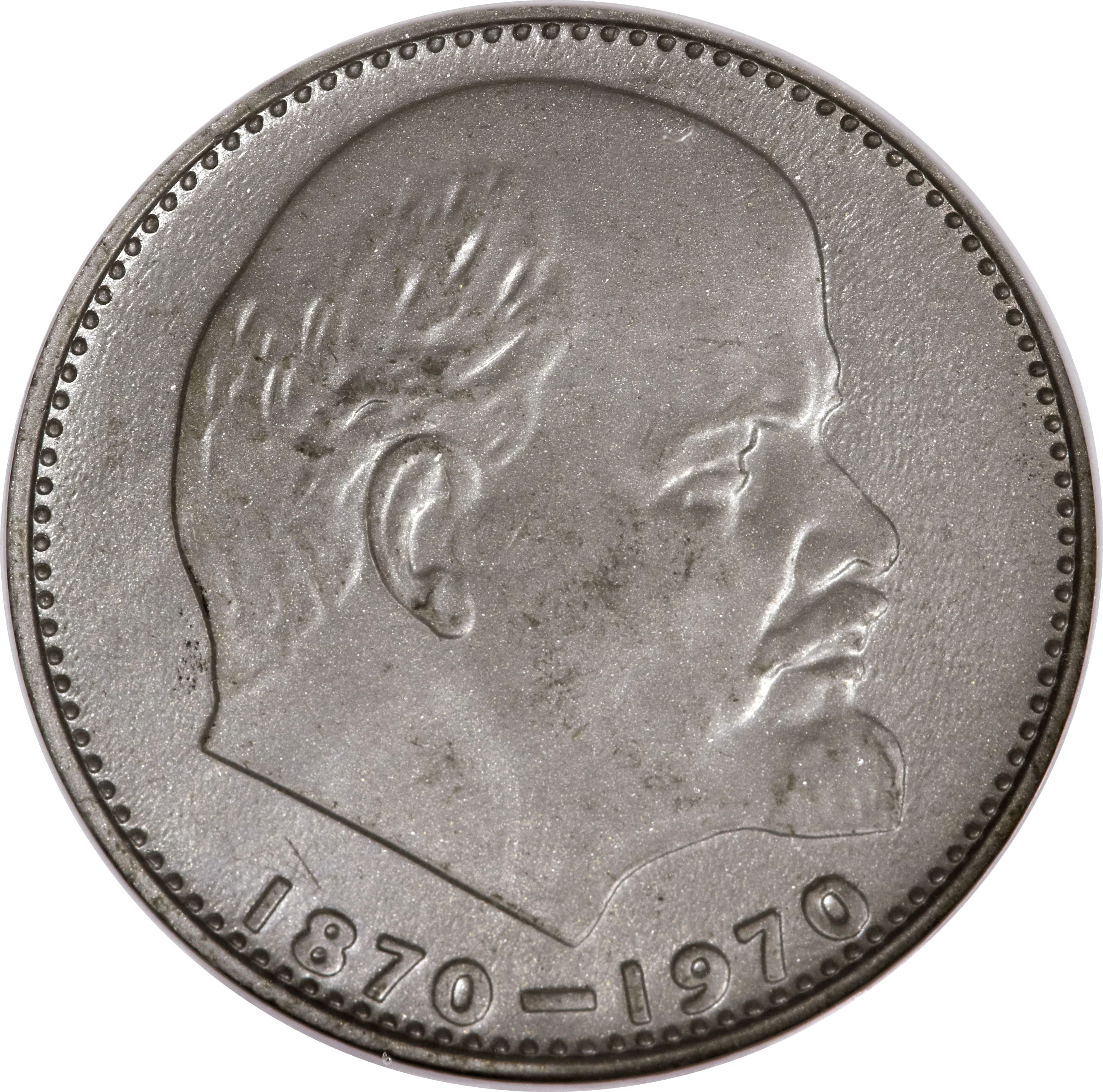
1 Ruble (Vladimir Lenin) – Soviet Union
Circulating commemorative coins
Commemoration: 100th Anniversary of the Birth of Vladimir Lenin
Russia
Context
Year: 1970
Country: Russia 
Issuer: Soviet Union 
Period:
(1922—1991)
Currency:
(1961—1991)
Demonetization: 1991
Total mintage: 100,003,250
Material
Diameter: 31 mm
Weight: 12.8 g
Thickness: 2.4 mm
Shape: Round
Composition: Nickel brass
Magnetic: No
Technique: Milled
Alignment: Medal alignment
flip
References
Y: #Click to copy to clipboard141
Numista: #4591
Value
Exchange value: 1 SUR
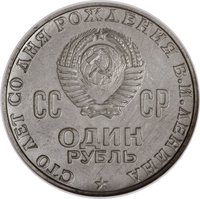
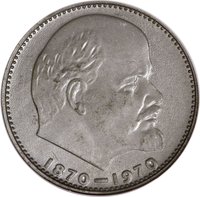
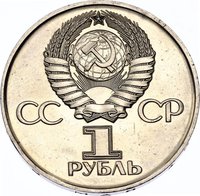
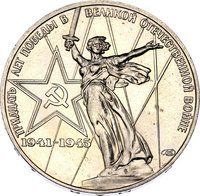
Obverse
Reverse
Edge
Pattern of stars and dots
Legend:
⋆ • ⋆ • ⋆ • ⋆ • ⋆ • ⋆ • ⋆ • ⋆ • ⋆ • ⋆ •
Categories
| Event> Birth anniversary |
| Person> Politician |
| Symbol> Hammer and sickle |
Mints
| Name | Mark |
|---|---|
| Saint Petersburg | — |
Mintings
| Year | Mint Mark | Mintage | Quality | Collection |
|---|---|---|---|---|
| 1970 | — | 99,889,000 | ||
| 1970 | — | 3,000 | Proof | |
| 1970 | — | 111,250 | Prooflike |
Historical background
In the 1970s, the Soviet Union operated under a complex and strictly controlled dual-currency system. The official state currency was the Soviet ruble (RUB), which was non-convertible, meaning it could not be legally exchanged for foreign currencies on international markets. Its value was set arbitrarily by the state, bearing little relation to its actual purchasing power or economic reality. This ruble was used for all domestic wages, savings, and transactions within the state-controlled economy, where prices for basic goods and services were heavily subsidized.
Alongside this domestic ruble existed a separate, parallel financial world centered on the "foreign trade ruble" and, more importantly, a special currency known as the chetyonok (четырёх, "four") or "certificate ruble." This was a surrogate currency used in the chain of foreign trade settlements. For international dealings, the USSR primarily utilized a fictional "transferable ruble" within the Council for Mutual Economic Assistance (COMECON) bloc. However, for hard currency earnings from trade with the West, the state maintained absolute monopoly control. Access to real foreign currencies like US dollars was restricted to the state bank and a tiny elite, while ordinary citizens faced severe criminal penalties for possessing them.
For the average Soviet citizen in the 1970s, this meant a life largely insulated from global finance but marked by chronic shortages and a growing awareness of currency inequality. While their ruble salaries provided for basic needs in an economy of queues and deficits, it was worthless for accessing high-quality imported goods or foreign travel. These luxuries were available only through special hard-currency stores (beryozka) or the black market, where dollars commanded a premium many times the official exchange rate. This disparity highlighted the growing contradictions between the USSR's stagnant planned economy and the consumer-driven West, fostering a underground economy and public cynicism about the official financial system.
Alongside this domestic ruble existed a separate, parallel financial world centered on the "foreign trade ruble" and, more importantly, a special currency known as the chetyonok (четырёх, "four") or "certificate ruble." This was a surrogate currency used in the chain of foreign trade settlements. For international dealings, the USSR primarily utilized a fictional "transferable ruble" within the Council for Mutual Economic Assistance (COMECON) bloc. However, for hard currency earnings from trade with the West, the state maintained absolute monopoly control. Access to real foreign currencies like US dollars was restricted to the state bank and a tiny elite, while ordinary citizens faced severe criminal penalties for possessing them.
For the average Soviet citizen in the 1970s, this meant a life largely insulated from global finance but marked by chronic shortages and a growing awareness of currency inequality. While their ruble salaries provided for basic needs in an economy of queues and deficits, it was worthless for accessing high-quality imported goods or foreign travel. These luxuries were available only through special hard-currency stores (beryozka) or the black market, where dollars commanded a premium many times the official exchange rate. This disparity highlighted the growing contradictions between the USSR's stagnant planned economy and the consumer-driven West, fostering a underground economy and public cynicism about the official financial system.
🌱 Very Common