

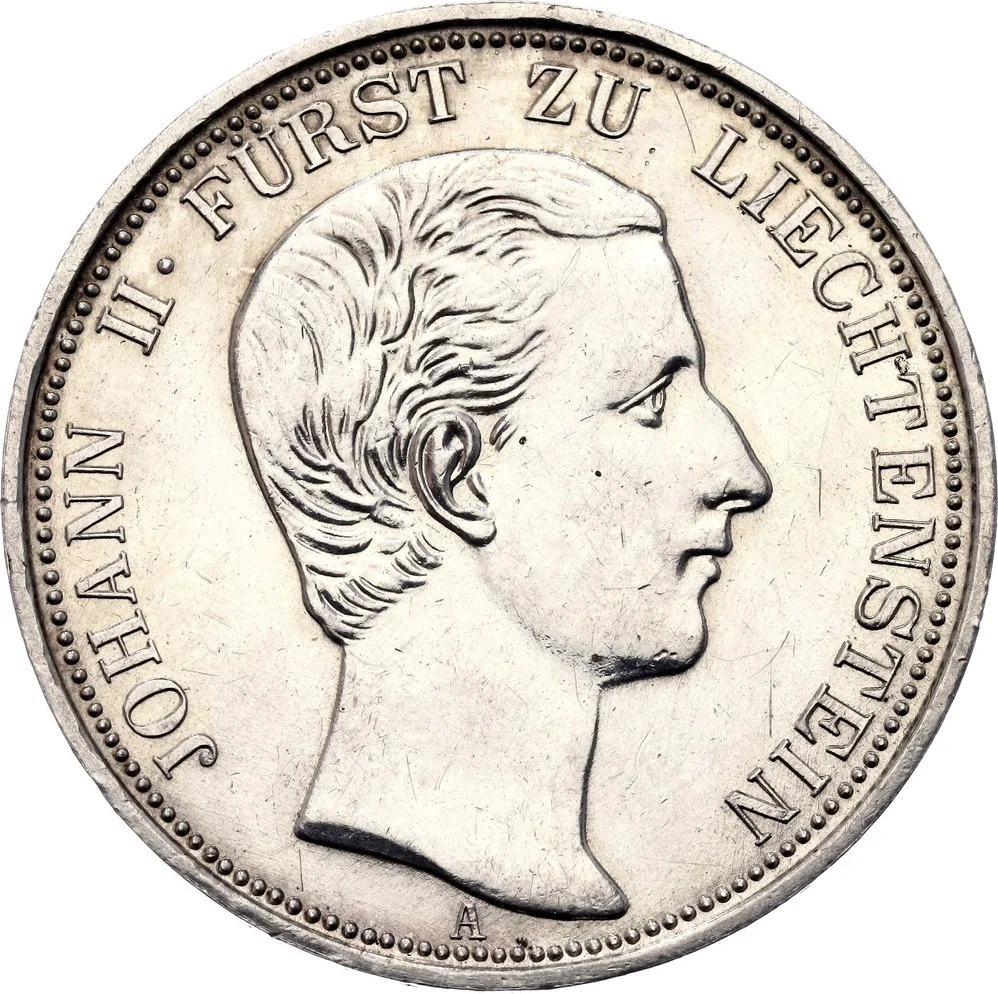
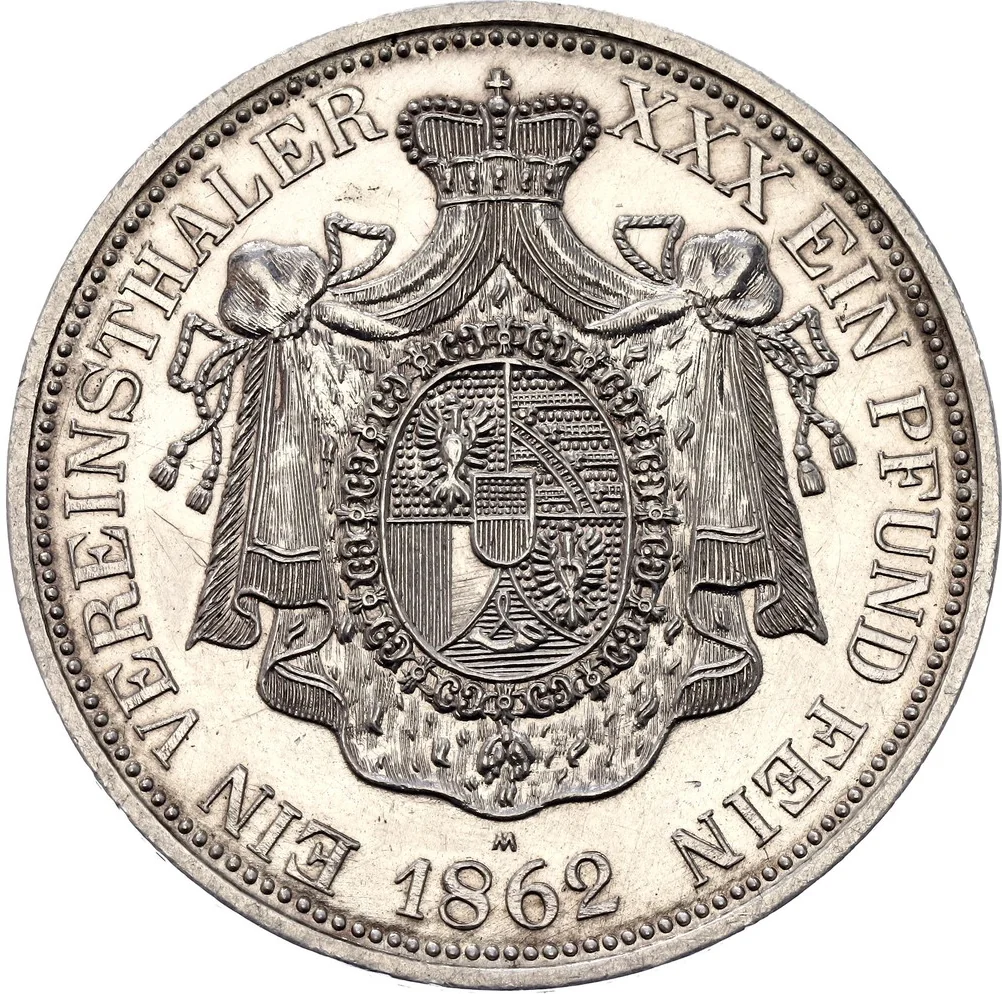
1 Vereinsthaler – Liechtenstein
Liechtenstein
Context
Years: 1862–1966
Year: 1862
Issuer: Liechtenstein 
Ruler: John II
Currency:
(1728—1868)
Subdivision: 1 Vereinsthaler = 1⁄30 Metric Pound
Demonetization: 1893
Total mintage: 1,920
Material
References
Y: #Click to copy to clipboard1
Numista: #23759
Value
Bullion value: $48.35
Obverse
Reverse
Edge
Categories
| Symbols> Coat of Arms |
| Person> Monarch |
Mints
| Name | Mark |
|---|---|
| Münze Österreich | A |
| Munich | A M |
Mintings
| Year | Mint Mark | Mintage | Quality | Collection |
|---|---|---|---|---|
| 1862 | A | 1,920 | ||
| 1966 | — | — |
Historical background
In 1862, Liechtenstein's currency situation was inherently complex and defined by its lack of a sovereign monetary system. The principality, deeply integrated into the Austrian economic sphere through the Customs Treaty of 1852, did not mint its own coins. Instead, the Austrian monetary system was legally dominant, with the Austrian Gulden (divided into 100 Kreuzer) serving as the official accounting unit and primary circulating currency. This practical and political reliance on Austria meant Liechtenstein's economy was directly subject to the monetary policies and stability of the Habsburg Empire.
However, the circulation was not exclusive. Due to Liechtenstein's location and trade ties, various foreign coins, particularly from the southern German states and Switzerland, also circulated freely within its borders. This created a de facto multi-currency environment where merchants and citizens had to navigate exchange rates between Austrian, German, and Swiss currencies. The Swiss Franc, which would later become paramount, was already gaining traction due to its perceived stability and the growing commercial links across the Rhine.
This period preceded a significant shift. The political upheavals of the 1860s, culminating in the Austro-Prussian War of 1866, would soon prompt Liechtenstein to re-evaluate its dependencies. The year 1862 thus represents the late phase of an uninterrupted Austrian monetary hegemony, a system that appeared stable on the surface but was poised for change as Liechtenstein began its gradual political and economic reorientation toward Switzerland, a process that would eventually lead to the adoption of the Swiss Franc in 1924.
However, the circulation was not exclusive. Due to Liechtenstein's location and trade ties, various foreign coins, particularly from the southern German states and Switzerland, also circulated freely within its borders. This created a de facto multi-currency environment where merchants and citizens had to navigate exchange rates between Austrian, German, and Swiss currencies. The Swiss Franc, which would later become paramount, was already gaining traction due to its perceived stability and the growing commercial links across the Rhine.
This period preceded a significant shift. The political upheavals of the 1860s, culminating in the Austro-Prussian War of 1866, would soon prompt Liechtenstein to re-evaluate its dependencies. The year 1862 thus represents the late phase of an uninterrupted Austrian monetary hegemony, a system that appeared stable on the surface but was poised for change as Liechtenstein began its gradual political and economic reorientation toward Switzerland, a process that would eventually lead to the adoption of the Swiss Franc in 1924.
💎 Very Rare