

1 Thaler – Liechtenstein
Liechtenstein
Context
Year: 1728
Issuer: Liechtenstein 
Ruler: Josef Johann Adam
Currency:
(1728—1868)
Demonetized: Yes
Total mintage: 810
Material
References
KM: #Click to copy to clipboard2
Numista: #92554
Value
Bullion value: $66.47
Obverse
Description:
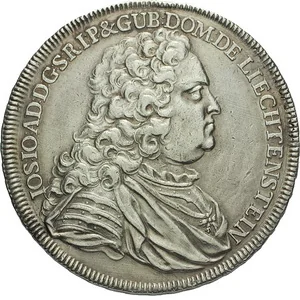
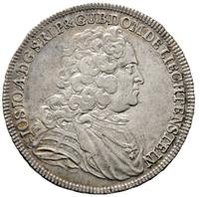
Josef Johann Adam right-facing bust, surrounded by lettering.
Inscription:
IOS·IO·AD·D·G·S·R·I·PR·& GUB·DOM·DE LIECHTENSTEIN·
Script: Latin
Reverse
Description:
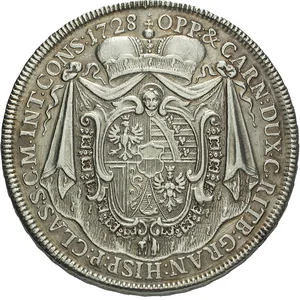
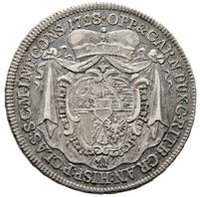
Crowned, mantled arms with chain. Lettering and date encircling.
Inscription:
OPP:& CARN:DUX·C·RITB:GRAN:HISP:P:CLAS:S·C·M·INT·CONS:1728
Script: Latin
Edge
Categories
| Symbols> Coat of Arms |
| Person> Monarch |
Mintings
| Year | Mint Mark | Mintage | Quality | Collection |
|---|---|---|---|---|
| 1728 | — | 810 |
Historical background
In 1728, the currency situation in the Principality of Liechtenstein was not one of sovereign monetary control but of complex dependence and regional circulation. The principality, having been formally established just two decades prior in 1719, lacked its own mint and was integrated into the sprawling economic and monetary networks of the Holy Roman Empire. Consequently, a multitude of foreign coins circulated within its borders, primarily from neighbouring Austrian territories, the Swiss Cantons, and various German states. This led to a chronic problem of monetary confusion, where coins of different weights, metallic purity, and face values had to be constantly evaluated and exchanged.
The legal framework for this circulation was largely dictated by the Imperial Coinage Ordinance (Reichsmünzordnung) of 1559, which was still nominally in effect but widely ignored. In practice, the most important currency for larger transactions and state finance was the Konventionstaler, a standard silver coin used across the southern German and Austrian lands. For everyday trade, however, people used a jumble of smaller silver and billon coins, such as Kreuzers and Batzen, many of which were debased. This fragmented system was inefficient and prone to exploitation, as bad money could drive out good, and merchants faced significant exchange risks.
Therefore, the year 1728 fell within a prolonged period of monetary instability for Liechtenstein. The reigning prince, Josef Johann Adam, was likely more preoccupied with the dire state of the princely finances—he would be forced to sell the county of Vaduz just a year later—than with implementing a comprehensive currency reform. The situation would persist until broader regional reforms, particularly those undertaken by the Austrian Empire in the latter half of the 18th century, provided a more stable monetary environment for the small, dependent principality.
The legal framework for this circulation was largely dictated by the Imperial Coinage Ordinance (Reichsmünzordnung) of 1559, which was still nominally in effect but widely ignored. In practice, the most important currency for larger transactions and state finance was the Konventionstaler, a standard silver coin used across the southern German and Austrian lands. For everyday trade, however, people used a jumble of smaller silver and billon coins, such as Kreuzers and Batzen, many of which were debased. This fragmented system was inefficient and prone to exploitation, as bad money could drive out good, and merchants faced significant exchange risks.
Therefore, the year 1728 fell within a prolonged period of monetary instability for Liechtenstein. The reigning prince, Josef Johann Adam, was likely more preoccupied with the dire state of the princely finances—he would be forced to sell the county of Vaduz just a year later—than with implementing a comprehensive currency reform. The situation would persist until broader regional reforms, particularly those undertaken by the Austrian Empire in the latter half of the 18th century, provided a more stable monetary environment for the small, dependent principality.
✨ Legendary