

10 qirsh – Egypt
Add to wishlist
Egypt
Context
Years: 1891–1908
Islamic (Hijri) Year:: 1293
Issuer: Egypt
Ruler: Abdul Hamid II
Currency:
(1834—1916)
Demonetized: Yes
Total mintage: 5,000
Material
References
KM: #
Numista: #17229
Value
Bullion value: $114.80
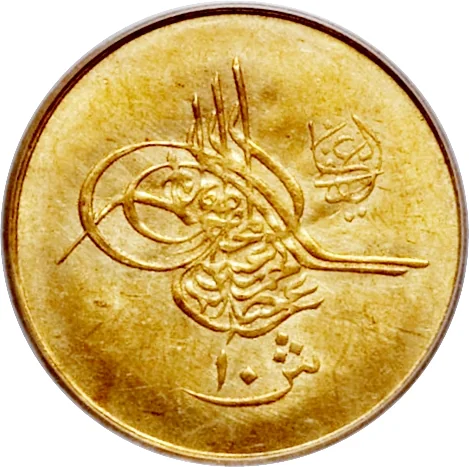
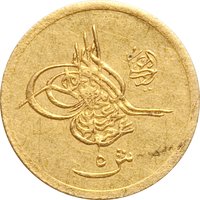
Obverse
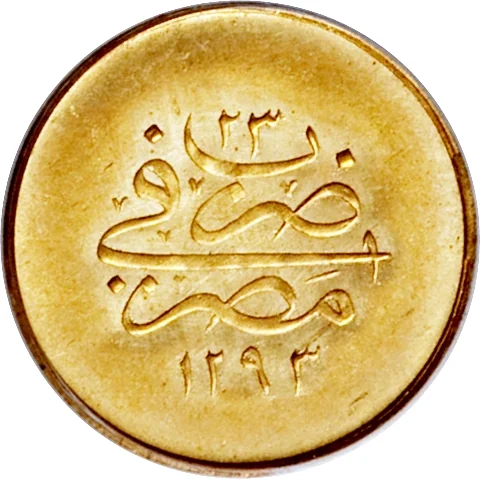
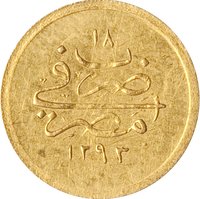
Reverse
Edge
Plain
Mintings
| Year | Mint Mark | Mintage | Quality | Collection |
|---|---|---|---|---|
| 1891 | — | — | ||
| 1892 | — | — | ||
| 1897 | — | — | ||
| 1908 | — | 5,000 |
Historical background
In 1891, Egypt's currency situation was defined by its complex position within the Ottoman Empire and under British financial control. Nominally an Ottoman province, Egypt issued its own currency, the Egyptian pound (ginēh), which was pegged to and equivalent to the British gold sovereign. This bimetallic system, however, was under strain. The official parity was maintained for gold, but the value of the widely circulating silver piastre coins fluctuated on the market, creating a disruptive divergence between the government's fixed exchange rate and the commercial rate. This instability caused significant confusion in everyday transactions and hindered commerce.
The root of this monetary disorder lay in the global decline of silver prices in the late 19th century. As Egypt was on a de facto gold standard through its peg to the British pound, but still minted and used vast quantities of silver token coinage, the falling intrinsic value of silver threatened the currency's stability. The government, advised by British officials who had assumed control of Egypt's finances after the 1882 occupation, was compelled to repeatedly reduce the silver content of the piastre to keep it in circulation at its mandated rate against the gold pound. This was a stopgap measure that eroded public confidence.
Consequently, 1891 was a year of decisive reform. Under the guidance of the British Agent and Consul-General, Lord Cromer, the Egyptian government passed the Currency Reform Law. This legislation effectively demonetized the old silver coins and introduced a new, lighter token silver currency, decisively subordinating it to the gold standard. The reform successfully stabilized the exchange rate, firmly anchoring the Egyptian economy to the British sterling system and facilitating foreign investment, but it also cemented British financial dominance over the country for decades to come.
The root of this monetary disorder lay in the global decline of silver prices in the late 19th century. As Egypt was on a de facto gold standard through its peg to the British pound, but still minted and used vast quantities of silver token coinage, the falling intrinsic value of silver threatened the currency's stability. The government, advised by British officials who had assumed control of Egypt's finances after the 1882 occupation, was compelled to repeatedly reduce the silver content of the piastre to keep it in circulation at its mandated rate against the gold pound. This was a stopgap measure that eroded public confidence.
Consequently, 1891 was a year of decisive reform. Under the guidance of the British Agent and Consul-General, Lord Cromer, the Egyptian government passed the Currency Reform Law. This legislation effectively demonetized the old silver coins and introduced a new, lighter token silver currency, decisively subordinating it to the gold standard. The reform successfully stabilized the exchange rate, firmly anchoring the Egyptian economy to the British sterling system and facilitating foreign investment, but it also cemented British financial dominance over the country for decades to come.
✨ Legendary