

1 Peseta – Spain
Spain
Context
Years: 1896–1902
Issuer: Spain 
Ruler: Alfonso XIII
Currency:
(1868—2001)
Demonetization: 20 February 1939
Total mintage: 35,133,000
Material
References
KM: #Click to copy to clipboard706
Numista: #6275
Value
Exchange value: 1 ESP
Bullion value: $11.95
Obverse
Description:
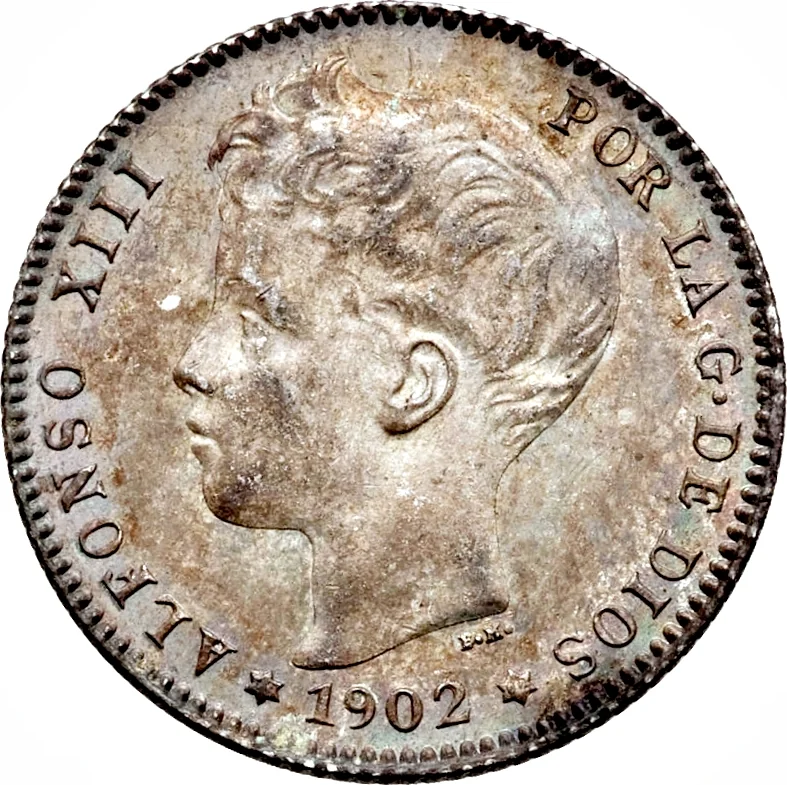
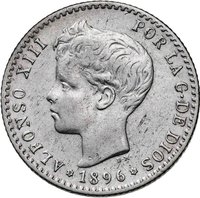
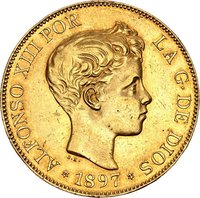
Child King Alfonso XIII facing left.
Inscription:
ALFONSO XIII POR LA G· DE DIOS
B· M·
🟌 1902 🟌
B· M·
🟌 1902 🟌
Translation:
ALFONSO XIII BY THE GRACE OF GOD
KING OF SPAIN
🟌 1902 🟌
KING OF SPAIN
🟌 1902 🟌
Script: Latin
Language: Spanish
Engraver: Bartolomé Maura Montaner
Reverse
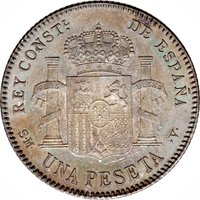
Description:
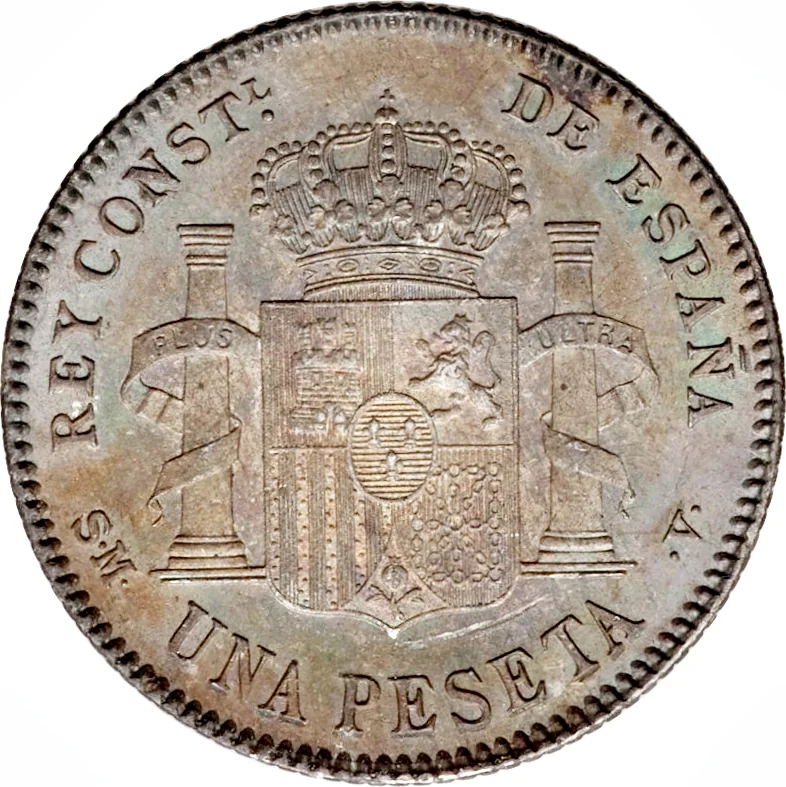
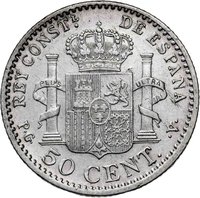
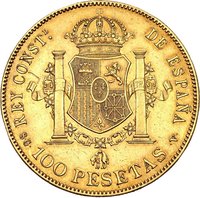
Spanish coat of arms with the Pillars of Hercules.
Inscription:
REY CONSTL. DE ESPAÑA
PLUS ULTRA
S·M· UNA PESETA ·V·
PLUS ULTRA
S·M· UNA PESETA ·V·
Translation:
KING CONSTITUTIONAL OF SPAIN
MORE BEYOND
H.M. ONE PESETA V.
MORE BEYOND
H.M. ONE PESETA V.
Script: Latin
Engraver: Bartolomé Maura Montaner
Edge
Reeded
Categories
| Person> Monarch |
| Symbols> Coat of Arms |
Mints
| Name | Mark |
|---|---|
| Royal Mint of Madrid | (🟌) |
Mintings
| Year | Mint Mark | Mintage | Quality | Collection |
|---|---|---|---|---|
| 1896 | 🟌 | 6,412,000 | ||
| 1899 | 🟌 | 7,472,000 | ||
| 1900 | 🟌 | 18,650,000 | ||
| 1901 | 🟌 | — | ||
| 1902 | 🟌 | 2,599,000 |
Historical background
In 1896, Spain's currency system was firmly embedded within the bimetallic standard of the Latin Monetary Union, though the nation was not an official signatory. The official legal tender was the peseta, introduced in 1868 to replace the complex array of regional currencies and unify the national economy. The system was theoretically bimetallic, with the peseta defined by law as equivalent to either 0.290322 grams of gold or 4.5 grams of silver. However, in practice, the global phenomenon of "the disappearance of silver" had pushed Spain onto a de facto gold standard. The market value of silver had fallen dramatically since the 1870s, making it profitable to export silver coins for their bullion value, which led to a chronic shortage of fractional silver coinage in daily circulation.
This scarcity of official silver coins created significant practical difficulties for commerce and wages, particularly for the working class. The gap was filled by a proliferation of private token coins issued by banks, corporations, and even municipal governments, as well as worn and clipped older coins. Furthermore, the state itself increasingly relied on issuing fiduciary money—paper banknotes not fully backed by gold—to finance chronic budget deficits, leading to a growing divergence between the official gold-based value of the peseta and its actual purchasing power. Public trust in paper money was low, and gold coins were hoarded, exacerbating the monetary confusion.
The currency situation of 1896 thus reflected Spain's broader economic and political struggles at the end of the 19th century. While legally aligned with European monetary systems, the reality was a fragmented and unstable circulation, symptomatic of the country's fiscal instability, industrial underdevelopment, and the financial burdens from colonial conflicts (most notably the ongoing Cuban War of Independence). This monetary environment hindered investment and economic modernization, contributing to a period of stagnation and setting the stage for the severe monetary crises that would follow in the coming decades.
This scarcity of official silver coins created significant practical difficulties for commerce and wages, particularly for the working class. The gap was filled by a proliferation of private token coins issued by banks, corporations, and even municipal governments, as well as worn and clipped older coins. Furthermore, the state itself increasingly relied on issuing fiduciary money—paper banknotes not fully backed by gold—to finance chronic budget deficits, leading to a growing divergence between the official gold-based value of the peseta and its actual purchasing power. Public trust in paper money was low, and gold coins were hoarded, exacerbating the monetary confusion.
The currency situation of 1896 thus reflected Spain's broader economic and political struggles at the end of the 19th century. While legally aligned with European monetary systems, the reality was a fragmented and unstable circulation, symptomatic of the country's fiscal instability, industrial underdevelopment, and the financial burdens from colonial conflicts (most notably the ongoing Cuban War of Independence). This monetary environment hindered investment and economic modernization, contributing to a period of stagnation and setting the stage for the severe monetary crises that would follow in the coming decades.
🌱 Very Common