

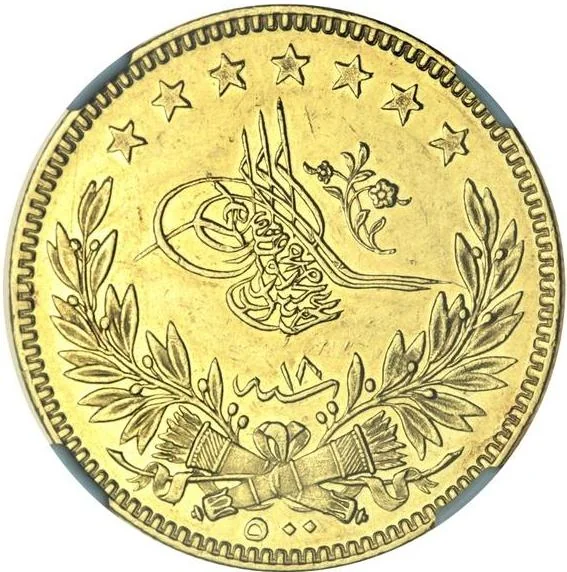
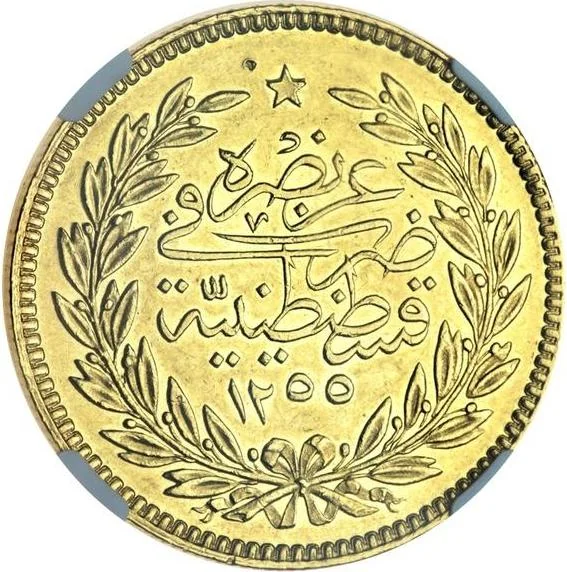
500 Kurush – Ottoman Empire
Turkey
Context
Years: 1856–1860
Islamic (Hijri) Year: 1255
Country: Turkey 
Issuer: Ottoman Empire
Ruler: Abdulmejid I
Currency:
(1844—1923)
Demonetized: Yes
Total mintage: 9,140
Material
References
KM: #Click to copy to clipboard681
Numista: #143199
Value
Bullion value: $5524.95
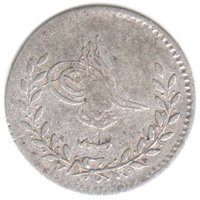
Obverse
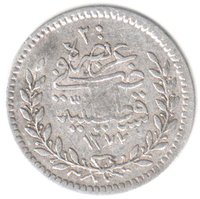
Reverse
Edge
Mintings
| Year | Mint Mark | Mintage | Quality | Collection |
|---|---|---|---|---|
| 1856 | — | 9,140 | ||
| 1858 | — | — | ||
| 1860 | — | — |
Historical background
By 1856, the Ottoman Empire's currency system was in a state of profound crisis and transition, a direct reflection of its broader fiscal and political struggles. The empire operated on a bimetallic standard, with the gold lira (or altın) and the silver kuruş as the primary units, alongside a vast array of debased copper mangır for small change. However, decades of budget deficits, costly military campaigns, and an inability to modernize its tax collection had forced the state to repeatedly debase the silver coinage. This resulted in a severe loss of public confidence, a wide and fluctuating exchange rate between gold and silver coins, and rampant counterfeiting. The situation was exacerbated by the widespread circulation of foreign currencies, like the British sovereign and French franc, which were often preferred for large transactions due to their stable value, undermining Ottoman monetary sovereignty.
The immediate backdrop to this year was the recently concluded Crimean War (1853-1856), which had pushed the Ottoman treasury to the brink of bankruptcy. To finance the war, the state had resorted to issuing kaime, an early form of paper money not backed by specie, which rapidly depreciated. The 1856 Imperial Reform Edict (Islahat Fermanı), proclaimed that February, promised sweeping modernization and equality for all subjects, partly to secure post-war support from European allies. Crucially, this political context included urgent financial clauses, as the empire sought its first major foreign loans from European markets. These loans, beginning with the landmark 1855 loan guaranteed by Britain and France, were conditional on fiscal reforms and tied the Ottoman economy more tightly to European capital, intensifying pressure to stabilize the currency.
Consequently, 1856 stands as a pivotal year marking the beginning of a concerted, though ultimately troubled, effort at monetary reform. Under the guidance of European advisors, the Ottoman government began serious planning to establish a central bank, which would materialize in 1863 as the Imperial Ottoman Bank (a British-French venture). The goal was to consolidate debt, regulate the money supply, and restore confidence. Thus, the currency situation was characterized by a chaotic legacy of debasement and paper money inflation, set against a new and coercive drive toward Western-style financial institutions, marking the start of the empire's deep and dependent integration into the global capitalist system.
The immediate backdrop to this year was the recently concluded Crimean War (1853-1856), which had pushed the Ottoman treasury to the brink of bankruptcy. To finance the war, the state had resorted to issuing kaime, an early form of paper money not backed by specie, which rapidly depreciated. The 1856 Imperial Reform Edict (Islahat Fermanı), proclaimed that February, promised sweeping modernization and equality for all subjects, partly to secure post-war support from European allies. Crucially, this political context included urgent financial clauses, as the empire sought its first major foreign loans from European markets. These loans, beginning with the landmark 1855 loan guaranteed by Britain and France, were conditional on fiscal reforms and tied the Ottoman economy more tightly to European capital, intensifying pressure to stabilize the currency.
Consequently, 1856 stands as a pivotal year marking the beginning of a concerted, though ultimately troubled, effort at monetary reform. Under the guidance of European advisors, the Ottoman government began serious planning to establish a central bank, which would materialize in 1863 as the Imperial Ottoman Bank (a British-French venture). The goal was to consolidate debt, regulate the money supply, and restore confidence. Thus, the currency situation was characterized by a chaotic legacy of debasement and paper money inflation, set against a new and coercive drive toward Western-style financial institutions, marking the start of the empire's deep and dependent integration into the global capitalist system.
✨ Legendary