

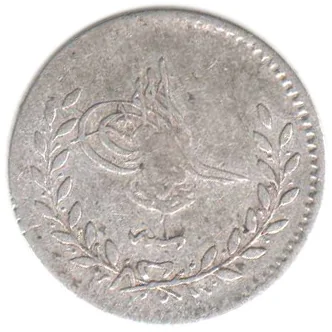
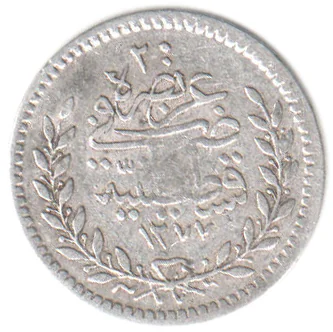
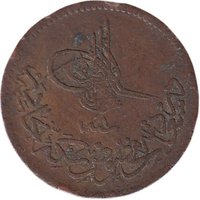
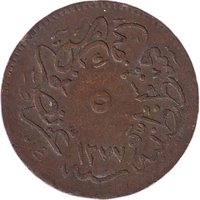
20 para – Ottoman Empire
Add to wishlist
Turkey
Context
Years: 1860–1867
Islamic (Hijri) Year:: 1277
Country: Turkey
Issuer: Ottoman Empire
Ruler: Abdülaziz
Currency:
(1844—1923)
Demonetized: Yes
Total mintage: 5,380,000
Material
References
KM: #
Numista: #27524
Value
Bullion value: $1.22
Reverse
Edge
Mints
| Name | Mark |
|---|---|
| Constantinople | — |
Mintings
| Year | Mint Mark | Mintage | Quality | Collection |
|---|---|---|---|---|
| 1860 | — | 930,000 | ||
| 1861 | — | 420,000 | ||
| 1862 | — | 850,000 | ||
| 1863 | — | 1,570,000 | ||
| 1865 | — | 740,000 | ||
| 1866 | — | 520,000 | ||
| 1867 | — | 350,000 |
Historical background
By 1860, the Ottoman Empire's currency system was in a state of profound disarray, a direct reflection of its broader fiscal and political crises. The empire operated on a bimetallic standard, but the primary unit, the kuruş (piastre), had been drastically debased over decades to finance budget deficits and military expenses. This resulted in a chaotic circulation of diverse coins: alongside devalued Ottoman issues, foreign gold coins like the British sovereign and French napoleon were widely used for large transactions, while a plethora of older Ottoman and even counterfeit coins circulated at fluctuating, unofficial values. The lack of uniform, trusted specie severely hampered both domestic commerce and international trade.
This monetary instability was exacerbated by the government's reliance on paper money, the kaime, first issued in the 1840s. Initially intended as short-term debt notes, the kaime became a permanent, unbacked fiat currency. By 1860, it was in severe depreciation, trading at a steep discount to the already weakened metallic kuruş. Public confidence in the paper money was low, and its value could vary significantly between Istanbul and the provinces, creating multiple, unstable exchange rates within the empire itself.
Recognizing that monetary reform was essential for modern statehood and economic survival, the Ottoman administration was actively planning a major overhaul. The Imperial Ottoman Bank, established in 1856 with British and French capital, was poised to become a state bank and play a central role. The reforms would culminate in 1863 with the Bank's rechartering and the introduction of a new gold-based currency, the Ottoman lira. Thus, 1860 represents a critical juncture—the low point of a decaying system, immediately preceding a concerted, though only partially successful, effort to impose monetary order and integrate the empire into the global gold standard.
This monetary instability was exacerbated by the government's reliance on paper money, the kaime, first issued in the 1840s. Initially intended as short-term debt notes, the kaime became a permanent, unbacked fiat currency. By 1860, it was in severe depreciation, trading at a steep discount to the already weakened metallic kuruş. Public confidence in the paper money was low, and its value could vary significantly between Istanbul and the provinces, creating multiple, unstable exchange rates within the empire itself.
Recognizing that monetary reform was essential for modern statehood and economic survival, the Ottoman administration was actively planning a major overhaul. The Imperial Ottoman Bank, established in 1856 with British and French capital, was poised to become a state bank and play a central role. The reforms would culminate in 1863 with the Bank's rechartering and the introduction of a new gold-based currency, the Ottoman lira. Thus, 1860 represents a critical juncture—the low point of a decaying system, immediately preceding a concerted, though only partially successful, effort to impose monetary order and integrate the empire into the global gold standard.
⭐ Rare