

2 zlotys – Poland
Add to wishlist
Circulating commemorative coins
Commemoration: Winged cavalryman - 17th Century
Series: History of the Polish Cavalry
Poland
Context
Material
Diameter: 27 mm
Weight: 8.15 g
Thickness: 2 mm
Shape: Round
Composition: Nordic gold
Magnetic: No
Technique: Milled
Alignment: Medal alignment
flip
References
Y: #
Numista: #9735
Value
Exchange value: 2 PLN
Inflation-adjusted value: 3.58 PLN
Obverse
Description:
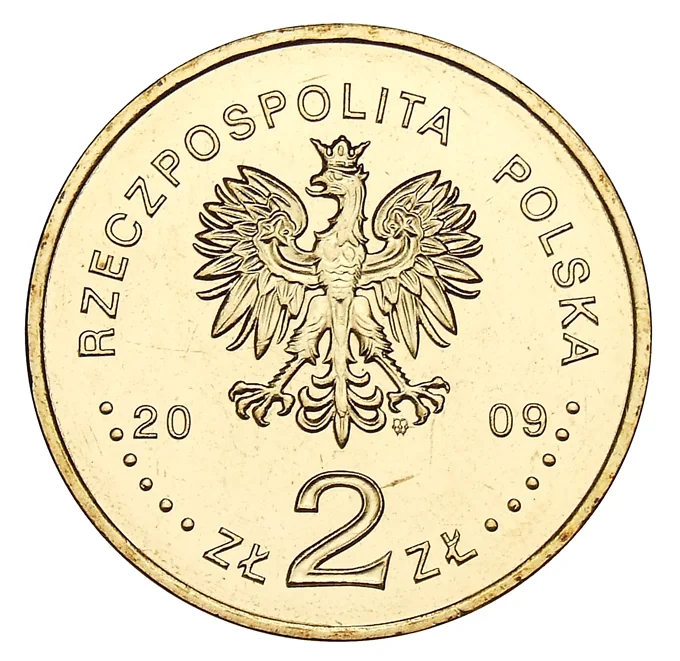
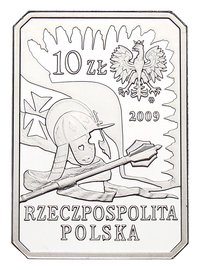
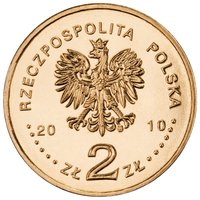
Eagle left divides date, value above.
Inscription:
RZECZPOSPOLITA POLSKA
2009
mw
ZŁ 2 ZŁ
2009
mw
ZŁ 2 ZŁ
Translation:
REPUBLIC OF POLAND
2009
mw
2 ZŁ 2 ZŁ
2009
mw
2 ZŁ 2 ZŁ
Script: Latin
Language: Polish
Designer: Ewa Tyc-Karpińska
Reverse
Description:
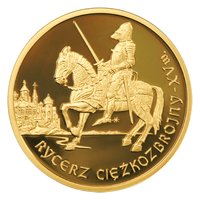
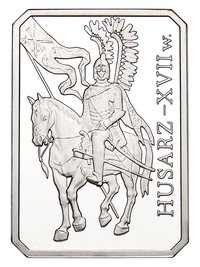
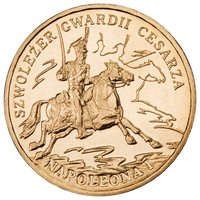
XVII Century Hussar on horseback.
Inscription:
HUSARZ - XVII w.
Script: Latin
Designer: Andrzej Nowakowski
Edge
Inscripted with "NBP" repeated in alternating orientation, separated by stars.
Legend:
NBP ★ NBP ★ NBP ★ NBP ★ NBP ★ NBP ★ NBP ★ NBP ★
Mints
| Name | Mark |
|---|---|
| Mint of Poland | (MW) |
Mintings
| Year | Mint Mark | Mintage | Quality | Collection |
|---|---|---|---|---|
| 2009 | MW | 1,400,000 |
Historical background
In 2009, Poland was an outlier in Central and Eastern Europe, being the only EU member state to avoid a technical recession during the global financial crisis. This relative resilience, however, unfolded against a complex and volatile currency situation centered on the Polish złoty (PLN). The złoty experienced significant depreciation pressure in the first half of the year, losing approximately 30% of its value against the euro from mid-2008 peaks. This was driven by a global "flight to safety," where investors retreated from emerging market assets, and by regional concerns over economic stability, which hit Central European currencies hard.
The currency's weakness presented a dual-edged sword for the Polish economy. On one hand, it boosted the competitiveness of Polish exports, which provided a crucial buffer as domestic demand softened. On the other hand, it posed serious risks: many Polish households and businesses had taken out mortgages and loans denominated in Swiss francs (CHF) or euros during earlier stable periods. The złoty's fall dramatically increased the local currency cost of servicing these foreign-denominated debts, threatening a wave of defaults and putting strain on the banking sector. The National Bank of Poland (NBP) responded with a series of interest rate cuts starting in November 2008 to stimulate the economy, a move that typically could further weaken the currency but was deemed necessary.
By the latter half of 2009, the situation began to stabilize. Improved global risk sentiment and Poland's comparatively strong economic fundamentals, including a flexible exchange rate regime that acted as a shock absorber, led to a gradual recovery of the złoty. The currency regained much of its lost ground, alleviating the pressure on foreign currency borrowers. This period underscored Poland's economic decoupling from its regional peers and set the stage for its subsequent nickname as a "green island" of growth, but it also left a lasting legacy of concern over the Swiss franc mortgage crisis, which would become a major political and financial issue in the following years.
The currency's weakness presented a dual-edged sword for the Polish economy. On one hand, it boosted the competitiveness of Polish exports, which provided a crucial buffer as domestic demand softened. On the other hand, it posed serious risks: many Polish households and businesses had taken out mortgages and loans denominated in Swiss francs (CHF) or euros during earlier stable periods. The złoty's fall dramatically increased the local currency cost of servicing these foreign-denominated debts, threatening a wave of defaults and putting strain on the banking sector. The National Bank of Poland (NBP) responded with a series of interest rate cuts starting in November 2008 to stimulate the economy, a move that typically could further weaken the currency but was deemed necessary.
By the latter half of 2009, the situation began to stabilize. Improved global risk sentiment and Poland's comparatively strong economic fundamentals, including a flexible exchange rate regime that acted as a shock absorber, led to a gradual recovery of the złoty. The currency regained much of its lost ground, alleviating the pressure on foreign currency borrowers. This period underscored Poland's economic decoupling from its regional peers and set the stage for its subsequent nickname as a "green island" of growth, but it also left a lasting legacy of concern over the Swiss franc mortgage crisis, which would become a major political and financial issue in the following years.
Series: History of the Polish Cavalry

🌱 Common