

24 Skilling – Norway
Norway
Context
Years: 1823–1824
Issuer: Norway 
Ruler: Charles III John
Currency:
(1816—1875)
Demonetized: Yes
Total mintage: 132,400
Material
References
KM: #Click to copy to clipboard296
Numista: #97346
Value
Bullion value: $14.25
Obverse
Description:
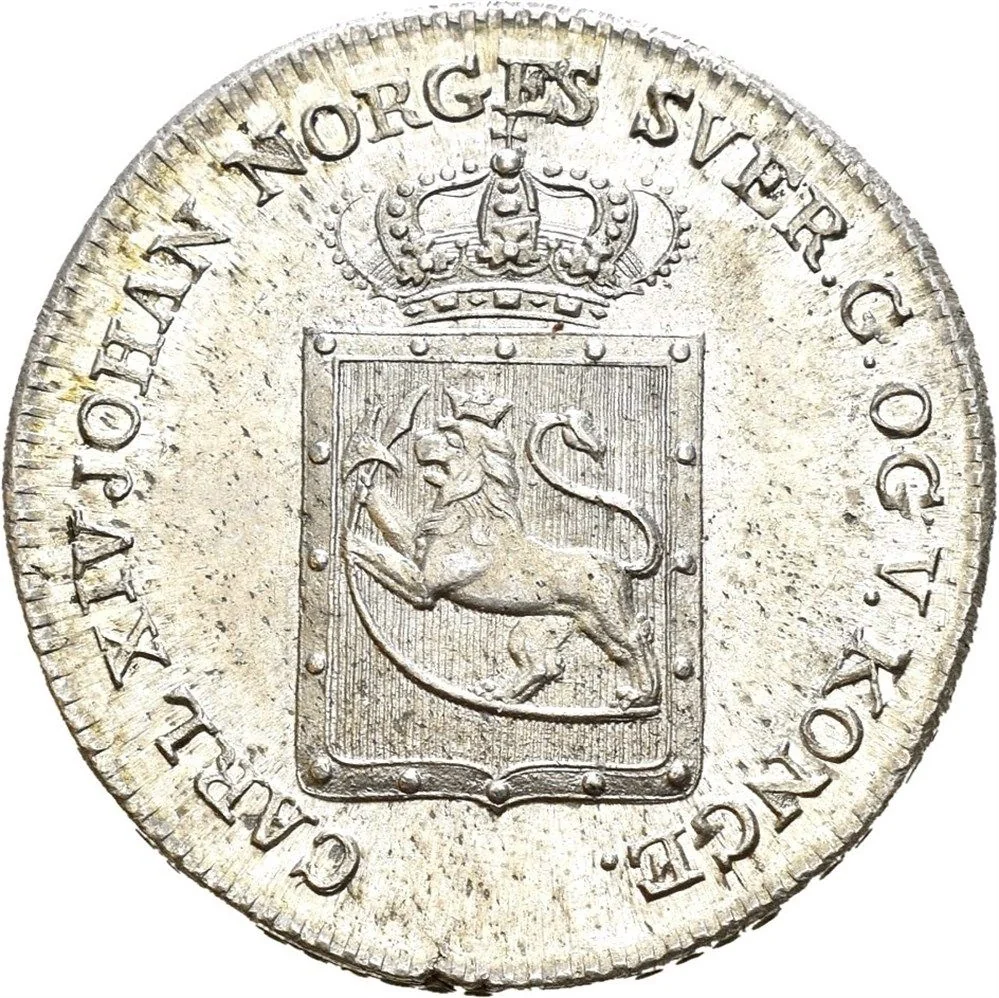
Crowned rectangular shield with beaded border and rim. Inside, a crowned Norwegian lion faces left, holding a halberd against a vertically lined background, surrounded by an inscription.
Inscription:
CARL XIV JOHAN NORGES SVER. G. OG V. KONGE.
Translation:
CARL XIV JOHAN NORWAY'S SWEDEN'S GOTH AND WEND KING.
Script: Latin
Reverse
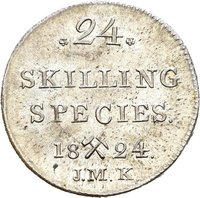
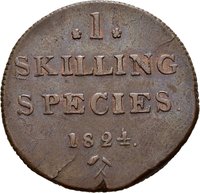
Description:
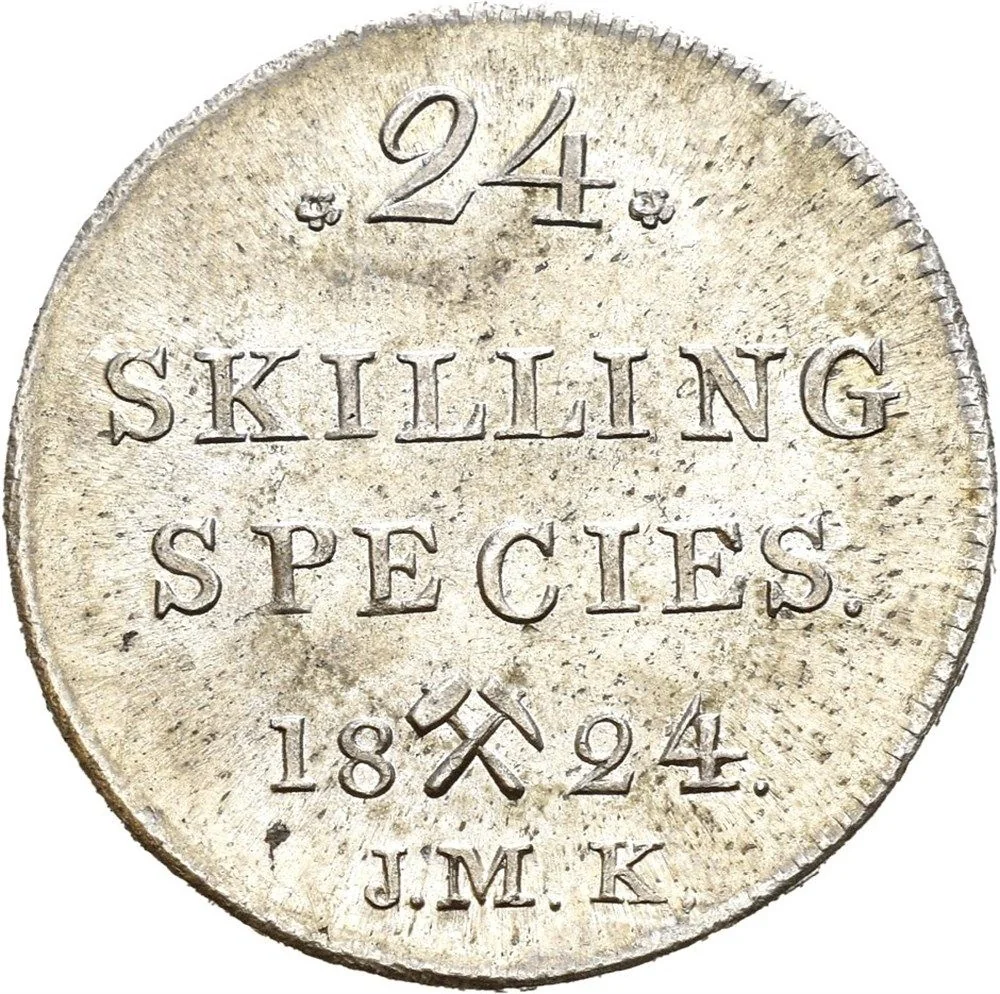
Value and date on four lines.
Date divided by mintmark.
Mintmaster's initials below.
Beaded rim.
Date divided by mintmark.
Mintmaster's initials below.
Beaded rim.
Inscription:
🏵24🏵
SKILLING
SPECIES.
18 ⚒ 24.
J. M. K.
SKILLING
SPECIES.
18 ⚒ 24.
J. M. K.
Script: Latin
Edge
Mints
| Name | Mark |
|---|---|
| Norwegian Mint | — |
Mintings
| Year | Mint Mark | Mintage | Quality | Collection |
|---|---|---|---|---|
| 1823 | — | 124,600 | ||
| 1824 | — | 7,800 |
Historical background
In 1823, Norway found itself in a complex monetary situation, a direct legacy of its recent union with Sweden (established in 1814) and the preceding Napoleonic Wars. Following the state bankruptcy of Denmark-Norway in 1813, the Rigsbank in Copenhagen issued a new paper currency, the riksbankdaler, intended for both kingdoms. However, this currency was not backed by silver and rapidly depreciated, leading to a severe loss of public confidence and widespread economic instability. By 1816, the newly independent Norwegian state sought to establish its own financial sovereignty by founding Norges Bank and introducing a new currency unit, the speciedaler, which was defined as a silver standard coin.
Despite the 1816 reform, the period up to 1823 was one of transition and difficulty. Norges Bank also issued paper money (banknotes), and a critical divergence emerged between the value of the silver speciedaler coin and the paper bankdaler notes, which were not fully convertible. This created a dual-currency system where goods had two prices—one in silver and a higher one in paper—causing confusion and hampering trade. The paper money continued to circulate at a significant discount to silver, reflecting persistent public skepticism and the state's limited silver reserves.
The year 1823 therefore marked a pivotal moment of resolution. Under the leadership of Finance Minister Jonas Collett, the Norwegian parliament (Stortinget) passed the Monetary Regulation of 1823. This law mandated the gradual withdrawal of the old depreciated paper notes and firmly established the silver speciedaler as the sole legal standard. Crucially, it restored full convertibility, ensuring banknotes could be redeemed for silver coin on demand. This successful move to a secure, unified silver standard ended the monetary chaos, laid the foundation for Norway’s modern financial system, and ushered in a period of greater economic stability and growth.
Despite the 1816 reform, the period up to 1823 was one of transition and difficulty. Norges Bank also issued paper money (banknotes), and a critical divergence emerged between the value of the silver speciedaler coin and the paper bankdaler notes, which were not fully convertible. This created a dual-currency system where goods had two prices—one in silver and a higher one in paper—causing confusion and hampering trade. The paper money continued to circulate at a significant discount to silver, reflecting persistent public skepticism and the state's limited silver reserves.
The year 1823 therefore marked a pivotal moment of resolution. Under the leadership of Finance Minister Jonas Collett, the Norwegian parliament (Stortinget) passed the Monetary Regulation of 1823. This law mandated the gradual withdrawal of the old depreciated paper notes and firmly established the silver speciedaler as the sole legal standard. Crucially, it restored full convertibility, ensuring banknotes could be redeemed for silver coin on demand. This successful move to a secure, unified silver standard ended the monetary chaos, laid the foundation for Norway’s modern financial system, and ushered in a period of greater economic stability and growth.
✨ Legendary