

2 skilling – Norway
Add to wishlist
Norway
Context
Years: 1822–1834
Issuer: Norway
Ruler: Charles III John
Currency:
(1816—1875)
Demonetized: Yes
Total mintage: 4,425,200
Material
References
KM: #
Numista: #38563
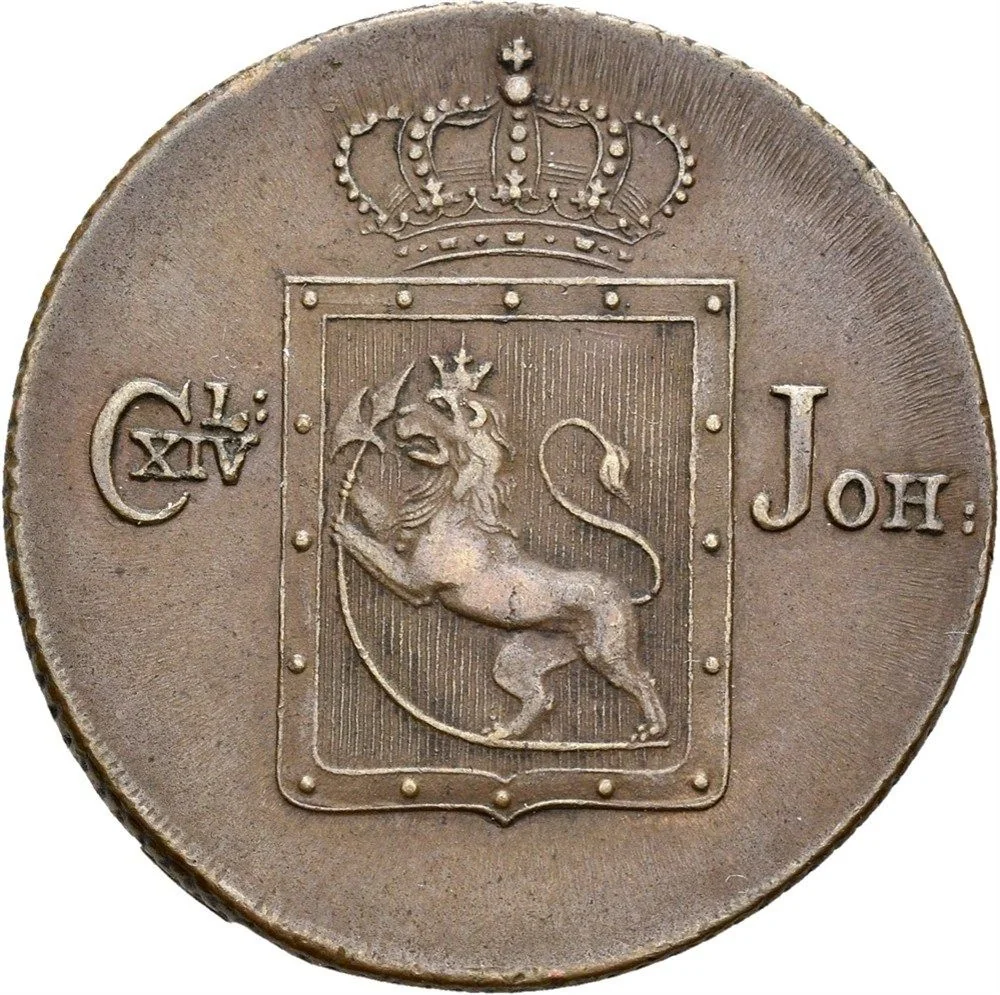
Obverse
Description:
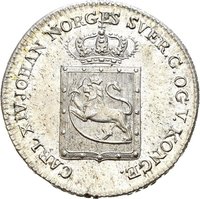
Crowned rectangular shield with beaded border, containing a crowned Norwegian lion facing left and holding a halberd on a vertically lined field. Inscription divided by shield. Milled rim.
Inscription:
CL: XIV | JOH:
Translation:
By the Grace of God, John, King of England, France, and Lord of Ireland.
Script: Latin
Language: Latin
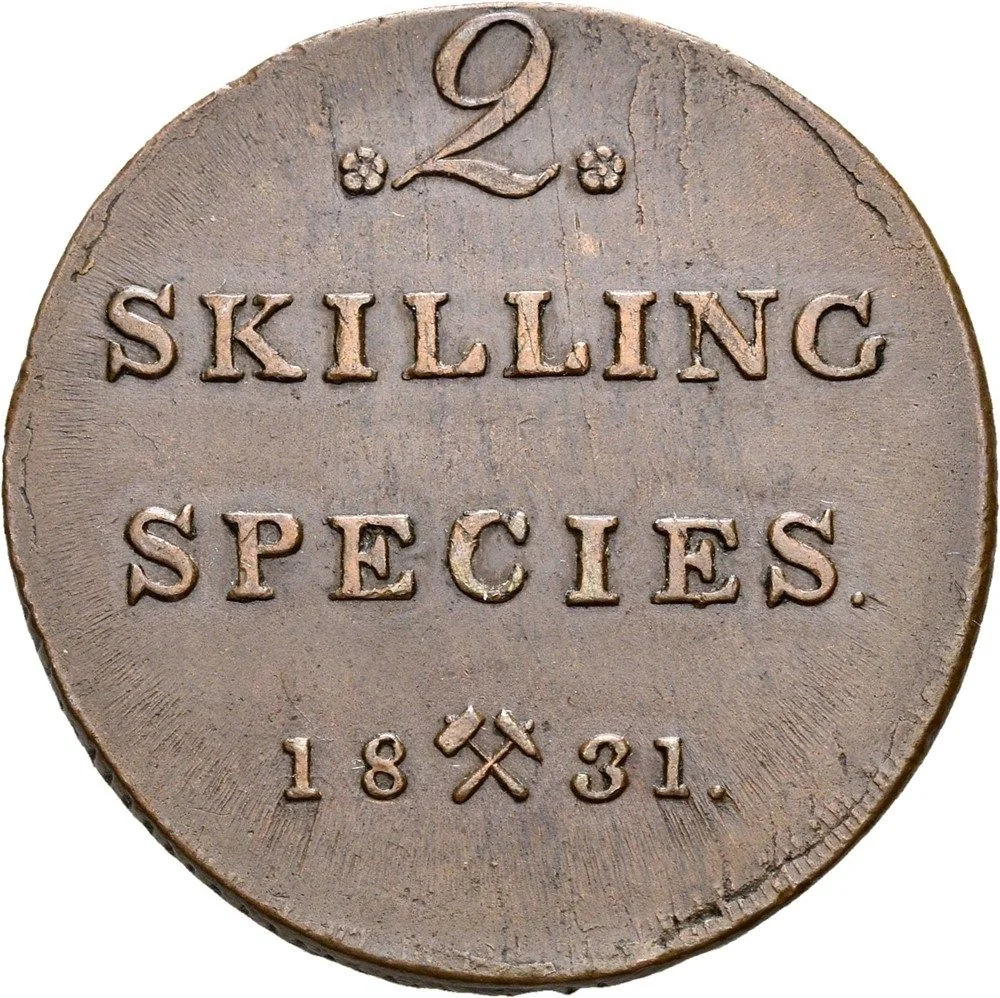
Reverse
Description:
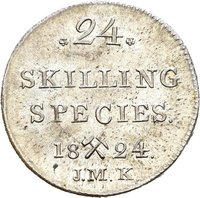
Value and date on four lines.
Date divided by mintmark.
Milled rim.
Date divided by mintmark.
Milled rim.
Inscription:
🏵2🏵
SKILLING
SPECIES.
18 ⚒ 31.
SKILLING
SPECIES.
18 ⚒ 31.
Script: Latin
Edge
Mints
| Name | Mark |
|---|---|
| Norwegian Mint | — |
Mintings
| Year | Mint Mark | Mintage | Quality | Collection |
|---|---|---|---|---|
| 1822 | — | 962,800 | ||
| 1824 | — | 548,800 | ||
| 1825 | — | 510,000 | ||
| 1827 | — | 288,000 | ||
| 1828 | — | 453,000 | ||
| 1831 | — | 723,000 | ||
| 1832 | — | — | ||
| 1833 | — | 60,000 | ||
| 1834 | — | 879,600 |
Historical background
In 1822, Norway found itself in a complex monetary situation, a direct consequence of its recent political union with Sweden following the Napoleonic Wars. The country was grappling with a severe shortage of official coinage, particularly small change for everyday transactions. This scarcity was exacerbated by the circulation of a wide array of foreign coins, alongside a substantial volume of privately issued "credit notes" from merchants and banks, leading to a chaotic and unreliable monetary environment that hindered trade and economic stability.
The core of the problem lay in the legacy of the previous union with Denmark. The Danish rigsdaler remained the official unit of account, but its value was unstable. Furthermore, the Norges Bank, established in 1816, had introduced the speciedaler as a new national currency, aiming for a silver standard. However, confidence in this new system was low, and the bank's notes often circulated at a discount to their face value. The state itself contributed to the confusion by issuing its own "currency notes" to cover fiscal shortfalls, creating a multi-layered and competing system of obligations.
Recognizing the crisis, the Storting (Norwegian parliament) took decisive action in 1822. It passed a law that demonetized all foreign coins and private credit notes, aiming to centralize the monetary system. Most significantly, it established a new, fixed exchange rate between the old accounting system (the riksdaler courant) and the new silver-based speciedaler. This reform, effective from January 1, 1823, was a crucial step toward monetary consolidation. It provided the stability needed for economic growth, firmly anchoring Norway's currency to a silver standard and strengthening the authority of Norges Bank as the sole issuer of legal tender.
The core of the problem lay in the legacy of the previous union with Denmark. The Danish rigsdaler remained the official unit of account, but its value was unstable. Furthermore, the Norges Bank, established in 1816, had introduced the speciedaler as a new national currency, aiming for a silver standard. However, confidence in this new system was low, and the bank's notes often circulated at a discount to their face value. The state itself contributed to the confusion by issuing its own "currency notes" to cover fiscal shortfalls, creating a multi-layered and competing system of obligations.
Recognizing the crisis, the Storting (Norwegian parliament) took decisive action in 1822. It passed a law that demonetized all foreign coins and private credit notes, aiming to centralize the monetary system. Most significantly, it established a new, fixed exchange rate between the old accounting system (the riksdaler courant) and the new silver-based speciedaler. This reform, effective from January 1, 1823, was a crucial step toward monetary consolidation. It provided the stability needed for economic growth, firmly anchoring Norway's currency to a silver standard and strengthening the authority of Norges Bank as the sole issuer of legal tender.
⭐ Somewhat Rare