

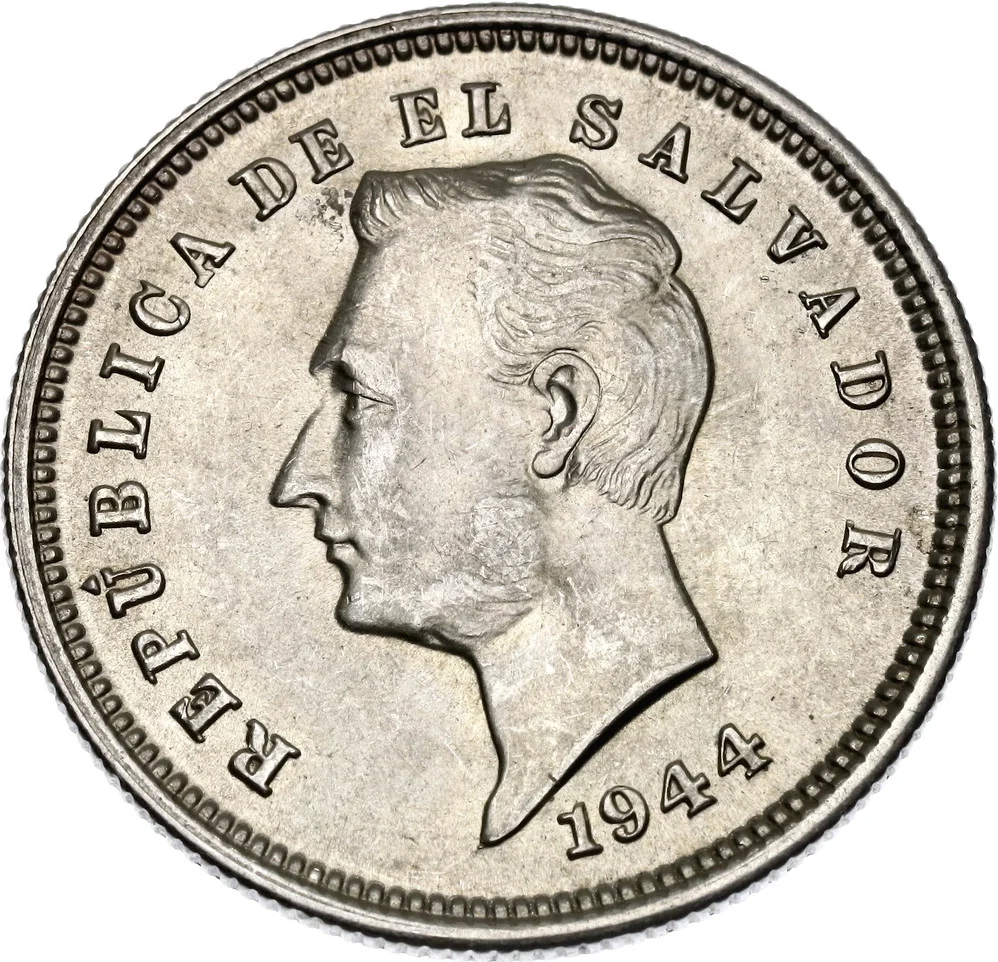
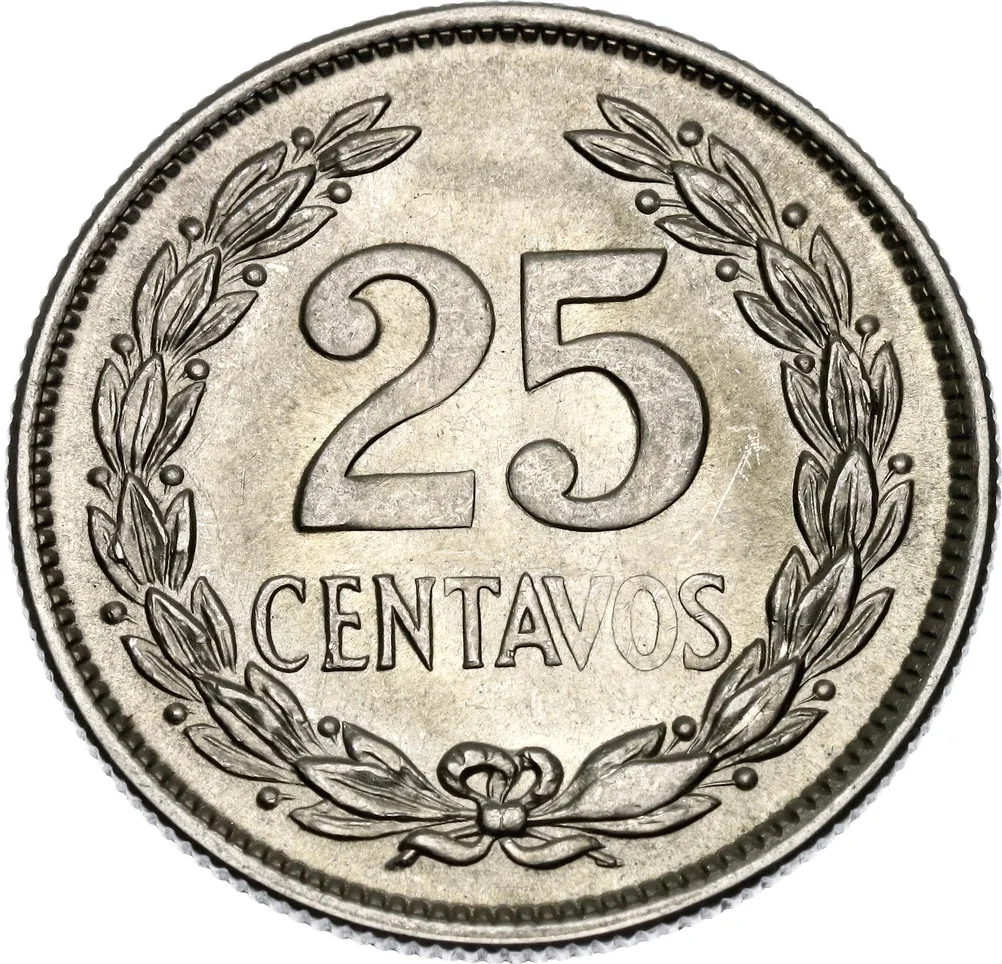
25 centavos – El Salvador
Add to wishlist
El Salvador
Context
Years: 1943–1944
Issuer: El Salvador
Issuing organization: Central Reserve Bank of El Salvador
Period:
(since 1841)
Currency:
(since 1892)
Demonetization: 1 January 2001
Total mintage: 2,200,000
Material
References
KM: #
Numista: #24710
Value
Exchange value: 0.25 SVC
Bullion value: $17.25
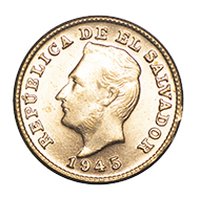
Obverse
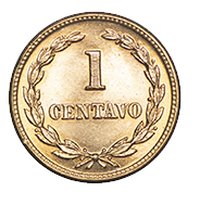
Reverse
Edge
Reeded
Categories
| Symbols> Coat of Arms |
| Symbol> Wreath |
Mints
| Name | Mark |
|---|---|
| United States Mint of San Francisco | — |
Mintings
| Year | Mint Mark | Mintage | Quality | Collection |
|---|---|---|---|---|
| 1943 | — | 1,200,000 | ||
| 1944 | — | 1,000,000 |
Historical background
In 1943, El Salvador’s currency system was defined by its adherence to the Colón, established in 1919 as the national currency replacing the Salvadoran peso. The Colón was firmly pegged to the United States dollar at a fixed rate of 2.5 colones to 1 USD. This peg, managed by the nation's central bank (the Central Reserve Bank of El Salvador, established in 1934), provided a crucial anchor for monetary stability during the turbulent global economic conditions of World War II. The fixed exchange rate facilitated predictable trade and investment, particularly with the United States, which was becoming El Salvador's dominant economic partner.
The Salvadoran economy in this period was overwhelmingly agrarian, with coffee exports constituting the primary source of foreign exchange and government revenue. The stability of the colón-dollar peg was therefore vital for the coffee oligarchy and the state, as it minimized exchange rate risk for exporters. However, the war disrupted global trade routes and markets, creating challenges. While demand for Salvadoran commodities remained, shipping and access to imported manufactured goods were constrained, leading to inflationary pressures and shortages that the rigid currency peg could not fully mitigate.
Politically, the country was under the authoritarian rule of President Maximiliano Hernández Martínez, who had been in power since 1931. His regime prioritized fiscal conservatism and the interests of the landed elite, which aligned with maintaining a hard currency peg to ensure stability. There was no serious consideration of abandoning the dollar link in 1943; it was seen as a bulwark against uncertainty. Consequently, the monetary policy of the time was largely passive, focused on maintaining the fixed exchange rate rather than managing domestic economic growth, a situation that would persist for decades until the colón's peg was finally adjusted in the 1980s.
The Salvadoran economy in this period was overwhelmingly agrarian, with coffee exports constituting the primary source of foreign exchange and government revenue. The stability of the colón-dollar peg was therefore vital for the coffee oligarchy and the state, as it minimized exchange rate risk for exporters. However, the war disrupted global trade routes and markets, creating challenges. While demand for Salvadoran commodities remained, shipping and access to imported manufactured goods were constrained, leading to inflationary pressures and shortages that the rigid currency peg could not fully mitigate.
Politically, the country was under the authoritarian rule of President Maximiliano Hernández Martínez, who had been in power since 1931. His regime prioritized fiscal conservatism and the interests of the landed elite, which aligned with maintaining a hard currency peg to ensure stability. There was no serious consideration of abandoning the dollar link in 1943; it was seen as a bulwark against uncertainty. Consequently, the monetary policy of the time was largely passive, focused on maintaining the fixed exchange rate rather than managing domestic economic growth, a situation that would persist for decades until the colón's peg was finally adjusted in the 1980s.
🌟 Uncommon