

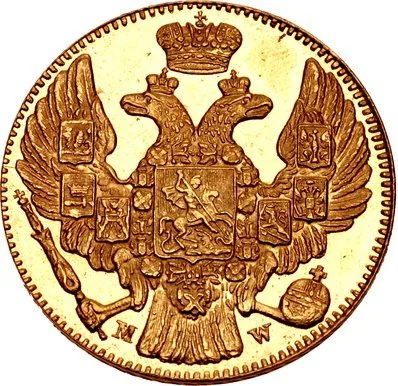
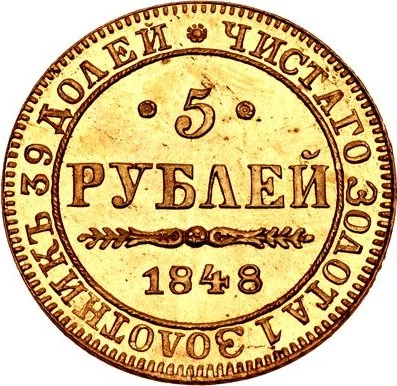
5 rubles – Russian Empire
Add to wishlist
Russia
Context
Years: 1842–1849
Country: Russia
Issuer: Russian Empire
Ruler: Nicholas I
Currency:
(1700—1917)
Demonetized: Yes
Total mintage: 1,375
Material
References
Numista: #97010
Value
Bullion value: $921.34
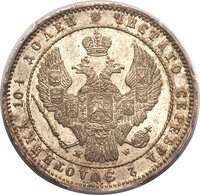
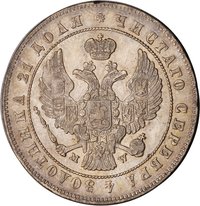
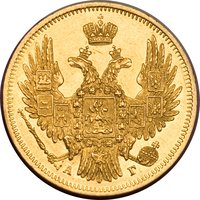
Obverse
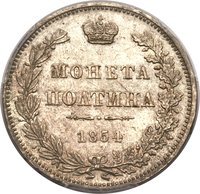
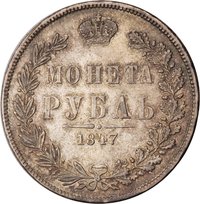
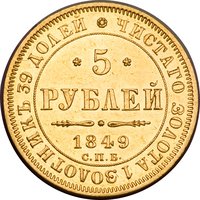
Reverse
Edge
Dashed
Mintings
| Year | Mint Mark | Mintage | Quality | Collection |
|---|---|---|---|---|
| 1842 | MW | 695 | ||
| 1846 | MW | 62 | ||
| 1848 | MW | 485 | ||
| 1849 | MW | 133 |
Historical background
In 1843, the Russian Empire undertook a significant monetary reform, making the state of its currency in 1842 one of transition and instability. The financial system was burdened by the simultaneous circulation of two depreciated paper currencies: the assignat (assignation ruble) and the depozitny bilet (deposit certificate). The assignat, introduced in the late 18th century to fund wars, had been printed in excess, leading to severe inflation and a wide gap between its value and the silver ruble. By 1842, one silver ruble was worth approximately 3.5 assignat rubles, creating complexity in trade and state accounting.
The situation was a legacy of earlier, partial attempts at stabilization. In 1839, Minister of Finance Yegor Kankrin had taken a pivotal step by declaring the silver ruble the primary monetary unit and fixing the devalued assignat at an irrevocable rate of 3.5 to 1. To build confidence, he also introduced the deposit certificate, a new paper currency fully backed by silver reserves and intended to circulate at par. However, by 1842, this created a clumsy dual system where both old, distrusted assignats and new, credible deposit notes were in use, undermining the goal of a unified, stable currency.
Therefore, the year 1842 represented the final preparatory phase before a comprehensive reform. The government, under Kankrin’s direction, was actively accumulating a silver reserve and preparing for the mass issuance of a new, single paper currency. This effort culminated in the Manifesto of June 1, 1843, which ordered the replacement of all existing paper money with a unified state credit note, the kreditny bilet. Thus, the currency situation in 1842 was characterized by the lingering problems of a discredited paper money system and the imminent launch of a reform aimed at establishing a stable, silver-backed currency for the empire.
The situation was a legacy of earlier, partial attempts at stabilization. In 1839, Minister of Finance Yegor Kankrin had taken a pivotal step by declaring the silver ruble the primary monetary unit and fixing the devalued assignat at an irrevocable rate of 3.5 to 1. To build confidence, he also introduced the deposit certificate, a new paper currency fully backed by silver reserves and intended to circulate at par. However, by 1842, this created a clumsy dual system where both old, distrusted assignats and new, credible deposit notes were in use, undermining the goal of a unified, stable currency.
Therefore, the year 1842 represented the final preparatory phase before a comprehensive reform. The government, under Kankrin’s direction, was actively accumulating a silver reserve and preparing for the mass issuance of a new, single paper currency. This effort culminated in the Manifesto of June 1, 1843, which ordered the replacement of all existing paper money with a unified state credit note, the kreditny bilet. Thus, the currency situation in 1842 was characterized by the lingering problems of a discredited paper money system and the imminent launch of a reform aimed at establishing a stable, silver-backed currency for the empire.
✨ Legendary