

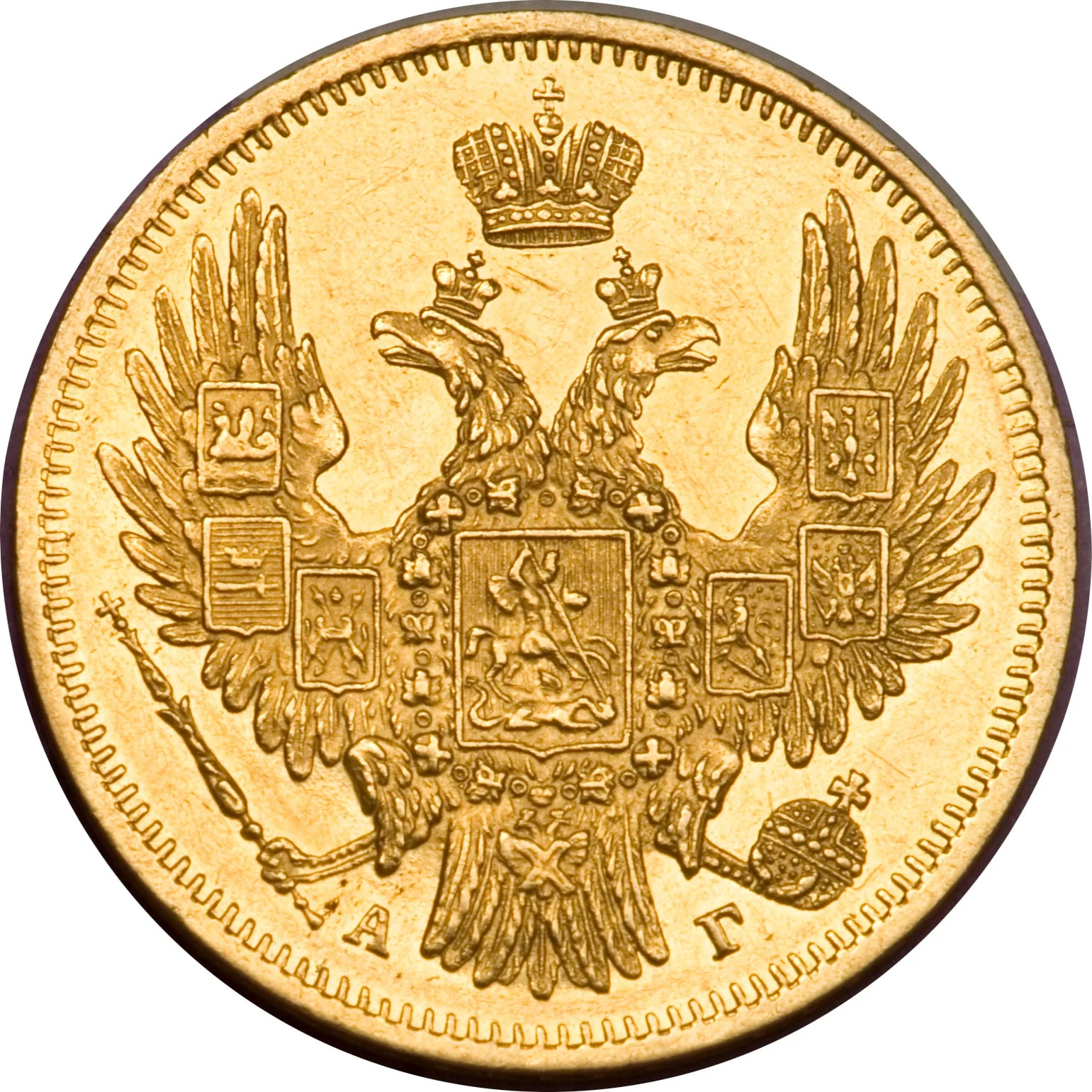
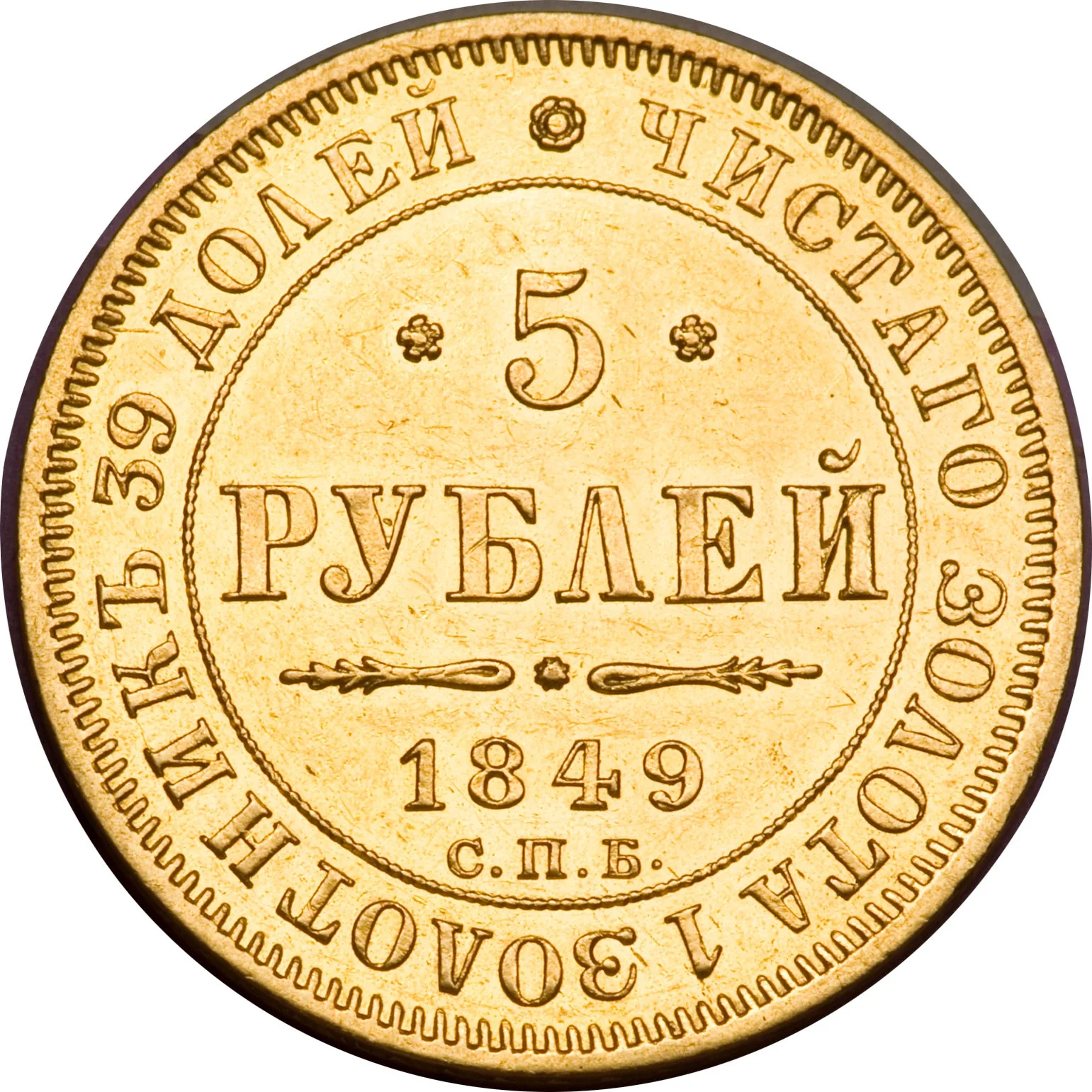
5 Rubles – Russian Empire
Russia
Context
Years: 1846–1854
Country: Russia 
Issuer: Russian Empire
Ruler: Nicholas I
Currency:
(1700—1917)
Demonetized: Yes
Total mintage: 28,900,024
Material
References
Numista: #97009
Value
Bullion value: $999.68
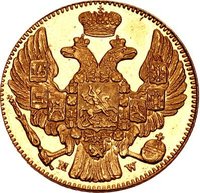
Obverse
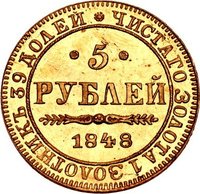
Reverse
Edge
Dashed
Mintings
| Year | Mint Mark | Mintage | Quality | Collection |
|---|---|---|---|---|
| 1846 | СПБ | — | BU | |
| 1847 | СПБ | 3,900,000 | BU | |
| 1848 | СПБ | 2,900,000 | BU | |
| 1849 | СПБ | 3,100,000 | BU | |
| 1850 | СПБ | 3,900,000 | BU | |
| 1851 | СПБ | 3,400,000 | BU | |
| 1852 | СПБ | 3,900,018 | BU | |
| 1853 | СПБ | 3,900,004 | BU | |
| 1854 | СПБ | 3,900,002 | BU |
Historical background
In 1846, the currency system of the Russian Empire was a complex and somewhat fragile bimetallic structure, officially based on both silver and paper. The foundational unit was the silver ruble, but the reality of circulation was dominated by paper banknotes known as assignatsii. These notes, first introduced in the late 18th century, had experienced significant depreciation due to over-issuance to finance wars, particularly against Napoleon. By the 1840s, a fixed exchange rate between silver and paper was artificially maintained by the state, but the actual value of the assignatsii on the market was lower, creating a persistent and problematic dual system of "silver rubles" and less valuable "paper rubles" for accounting and transactions.
The government of Nicholas I, through the financial reforms of Minister of Finance Yegor Kankrin (1839-1843), was actively attempting to stabilize this system. A key step was the 1843 introduction of a new paper currency, "credit notes" (kreditnye bilety), which were declared fully convertible to silver on demand and were intended to gradually replace the devalued assignatsii. By 1846, this transition was underway, and the new credit notes were circulating alongside the old assignats, which were being withdrawn. The reform aimed to restore public confidence in paper money by tethering it firmly to the silver standard.
Despite these efforts, the underlying weakness remained. The state's finances were strained by military expenditures and a rigid feudal economic structure, limiting the growth of a hard currency reserve. While the 1846 moment represented a point of cautious optimism within the government—a managed shift toward a more stable silver-backed paper currency—the system's health was ultimately dependent on fiscal discipline and substantial silver reserves, which were not yet fully secured. The Crimean War (1853-1856) would soon test this new structure to its breaking point, leading to the suspension of convertibility and renewed inflation.
The government of Nicholas I, through the financial reforms of Minister of Finance Yegor Kankrin (1839-1843), was actively attempting to stabilize this system. A key step was the 1843 introduction of a new paper currency, "credit notes" (kreditnye bilety), which were declared fully convertible to silver on demand and were intended to gradually replace the devalued assignatsii. By 1846, this transition was underway, and the new credit notes were circulating alongside the old assignats, which were being withdrawn. The reform aimed to restore public confidence in paper money by tethering it firmly to the silver standard.
Despite these efforts, the underlying weakness remained. The state's finances were strained by military expenditures and a rigid feudal economic structure, limiting the growth of a hard currency reserve. While the 1846 moment represented a point of cautious optimism within the government—a managed shift toward a more stable silver-backed paper currency—the system's health was ultimately dependent on fiscal discipline and substantial silver reserves, which were not yet fully secured. The Crimean War (1853-1856) would soon test this new structure to its breaking point, leading to the suspension of convertibility and renewed inflation.
💎 Extremely Rare