

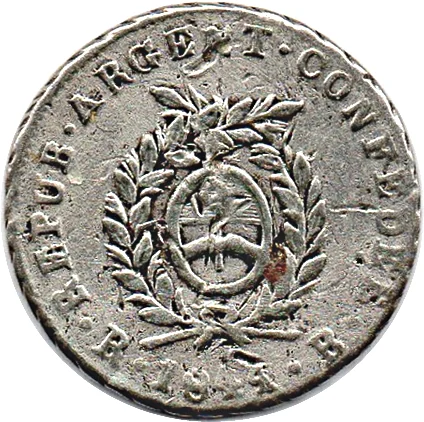
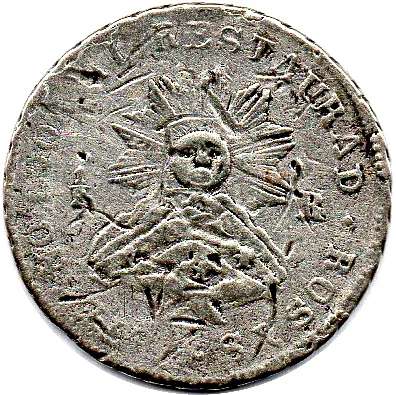
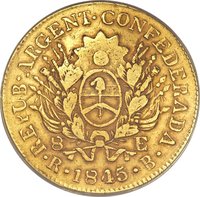
Obverse
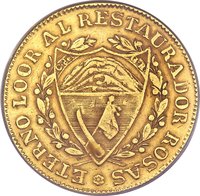
Reverse
Edge
Laureate
Mintings
| Year | Mint Mark | Mintage | Quality | Collection |
|---|---|---|---|---|
| 1844 | R | — |
Historical background
In 1844, the currency situation in the province of La Rioja, Argentina, was emblematic of the broader monetary chaos plaguing the young nation during the Guerras Civiles (Civil Wars). Following independence and the collapse of Spanish colonial authority, there was no unified national currency. The central government in Buenos Aires, under the leadership of Juan Manuel de Rosas, struggled to impose financial order, while powerful provincial caudillos (strongmen) like La Rioja's own Juan Facundo Quiroga and his successors exercised de facto control. This political fragmentation led directly to monetary fragmentation, with provinces, merchants, and even military commanders issuing their own promissory notes and coinage to facilitate local trade and pay troops.
The primary currency in circulation was a confusing mix of foreign coins—particularly Bolivian, Chilean, and Peruvian silver—alongside a plethora of low-quality copper coins minted by various provinces and private entities. La Rioja, like its neighbors, suffered from a severe shortage of precious metals, leading to the widespread use of moneda feble (debased coinage) and vales (IOUs or scrip). These local issues, often crudely struck and easily counterfeited, circulated at wildly fluctuating discounts against the more trusted foreign silver, causing price instability and hindering commerce both within the province and with other regions.
This unstable monetary environment was both a cause and a consequence of La Rioja's economic distress. The province's traditional wine and cattle economies were disrupted by constant military requisitions and conflict. The lack of trustworthy currency stifled investment and long-distance trade, as merchants could not be confident in the value of their payments. Ultimately, the currency chaos of 1844 was a symptom of the deeper problem: the absence of a strong, centralized Argentine state capable of enforcing a uniform monetary system, leaving provinces like La Rioja to navigate a precarious and inflationary financial landscape on their own.
The primary currency in circulation was a confusing mix of foreign coins—particularly Bolivian, Chilean, and Peruvian silver—alongside a plethora of low-quality copper coins minted by various provinces and private entities. La Rioja, like its neighbors, suffered from a severe shortage of precious metals, leading to the widespread use of moneda feble (debased coinage) and vales (IOUs or scrip). These local issues, often crudely struck and easily counterfeited, circulated at wildly fluctuating discounts against the more trusted foreign silver, causing price instability and hindering commerce both within the province and with other regions.
This unstable monetary environment was both a cause and a consequence of La Rioja's economic distress. The province's traditional wine and cattle economies were disrupted by constant military requisitions and conflict. The lack of trustworthy currency stifled investment and long-distance trade, as merchants could not be confident in the value of their payments. Ultimately, the currency chaos of 1844 was a symptom of the deeper problem: the absence of a strong, centralized Argentine state capable of enforcing a uniform monetary system, leaving provinces like La Rioja to navigate a precarious and inflationary financial landscape on their own.
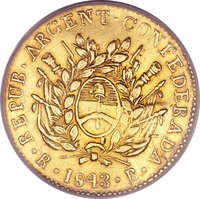
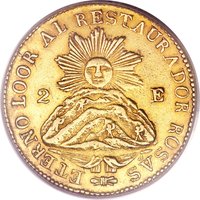
💎 Extremely Rare