

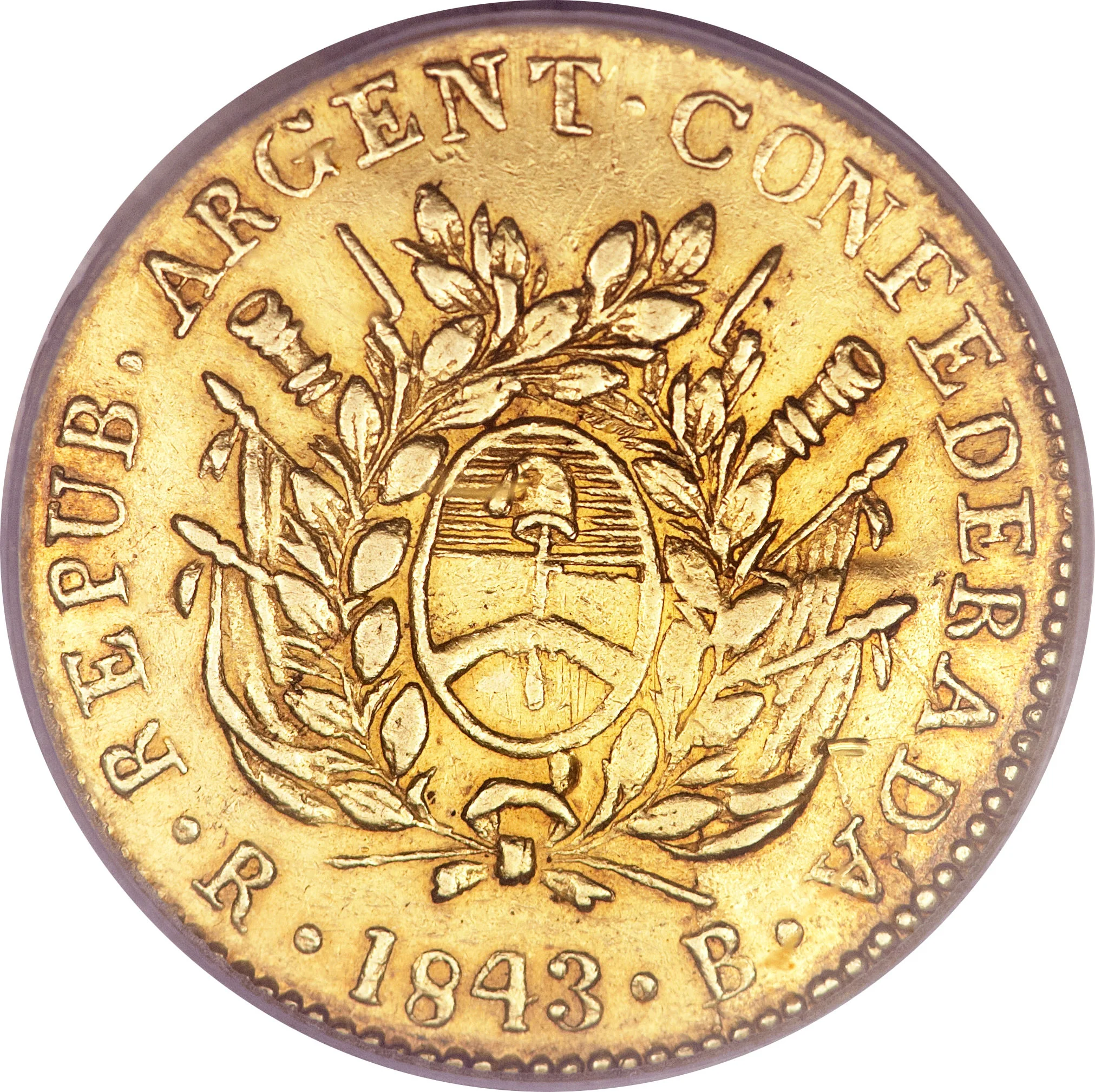
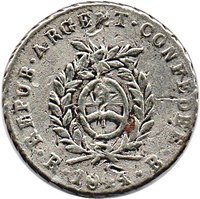
Obverse
Description:
Coat of arms with encircling legend.
Inscription:
REPUB·ARGENT·CONFEDERADA
·R·1843·B·
·R·1843·B·
Script: Latin
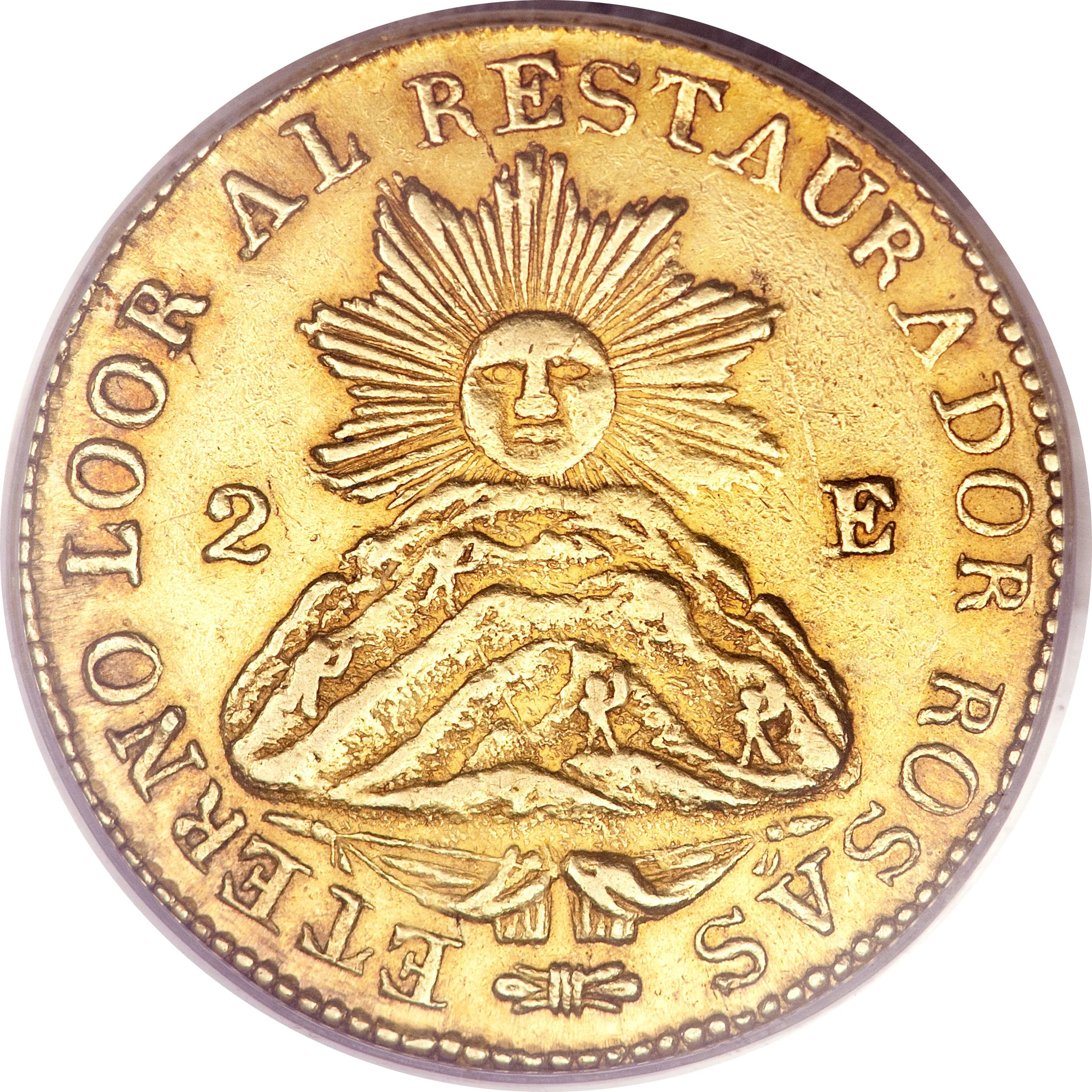
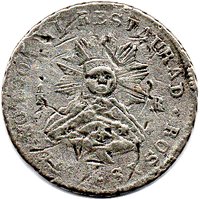
Reverse
Description:
Sun over split mountain, legend encircling.
Inscription:
ETERNO LOOR AL RESTAURADOR ROSAS
2 E
2 E
Script: Latin
Edge
Categories
| Symbol> Sun |
| Geography> Mountain |
| Symbols> Coat of Arms |
| Symbol> Phrygian cap |
| Symbol> Wreath |
| Object> Firearms |
Mintings
| Year | Mint Mark | Mintage | Quality | Collection |
|---|---|---|---|---|
| 1843 | RB | — |
Historical background
In 1843, the Argentine province of La Rioja was embroiled in the broader civil wars between the Federalist and Unitarian forces, a conflict that had severe economic repercussions. The central authority of the Argentine Confederation, led by Juan Manuel de Rosas, was weak, and provincial economies were isolated and drained by the constant warfare. La Rioja, under the control of the Federalist caudillo Juan Facundo Quiroga until his assassination in 1835, and later by leaders like Tomás Brizuela and Ángel Vicente Peñaloza (known as "El Chacho"), faced a chronic shortage of circulating currency. The national minting system was dysfunctional, and precious metals were scarce, crippling formal trade and tax collection.
To address this acute monetary shortage, La Rioja, like several other interior provinces, resorted to issuing its own provisional currency. These were typically low-value copper or bronze coins, known as moneda macuquina or señoreaje, often crudely stamped with the provincial name or insignia. Their value was not based on intrinsic metal content but on the decree of the local government, making them a form of fiat money. This practice led to a fragmented monetary landscape where La Rioja's currency had little to no acceptance beyond its own borders, and even within the province, its value was highly unstable and prone to depreciation.
The currency situation was a direct reflection of La Rioja's political and economic isolation. The province's coins circulated alongside older Spanish colonial coins, Bolivian and Chilean currency, and privately issued tokens or vouchers from local merchants and haciendas. This monetary chaos stifled economic recovery, encouraged barter, and deepened poverty. Ultimately, the precarious currency of 1843 symbolized the breakdown of national economic unity and the desperate, stop-gap measures provinces were forced to take to sustain themselves during the "Age of Caudillos."
To address this acute monetary shortage, La Rioja, like several other interior provinces, resorted to issuing its own provisional currency. These were typically low-value copper or bronze coins, known as moneda macuquina or señoreaje, often crudely stamped with the provincial name or insignia. Their value was not based on intrinsic metal content but on the decree of the local government, making them a form of fiat money. This practice led to a fragmented monetary landscape where La Rioja's currency had little to no acceptance beyond its own borders, and even within the province, its value was highly unstable and prone to depreciation.
The currency situation was a direct reflection of La Rioja's political and economic isolation. The province's coins circulated alongside older Spanish colonial coins, Bolivian and Chilean currency, and privately issued tokens or vouchers from local merchants and haciendas. This monetary chaos stifled economic recovery, encouraged barter, and deepened poverty. Ultimately, the precarious currency of 1843 symbolized the breakdown of national economic unity and the desperate, stop-gap measures provinces were forced to take to sustain themselves during the "Age of Caudillos."
💎 Extremely Rare