

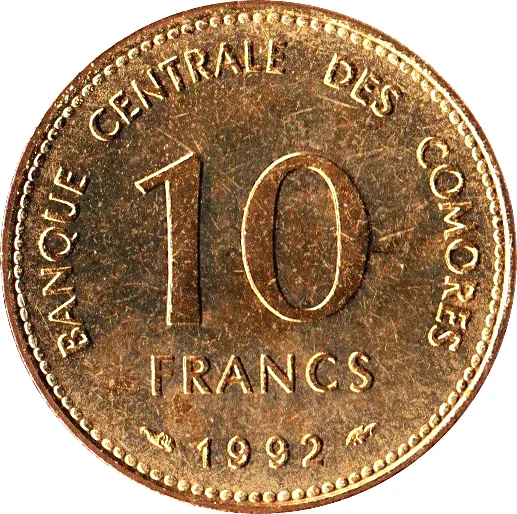
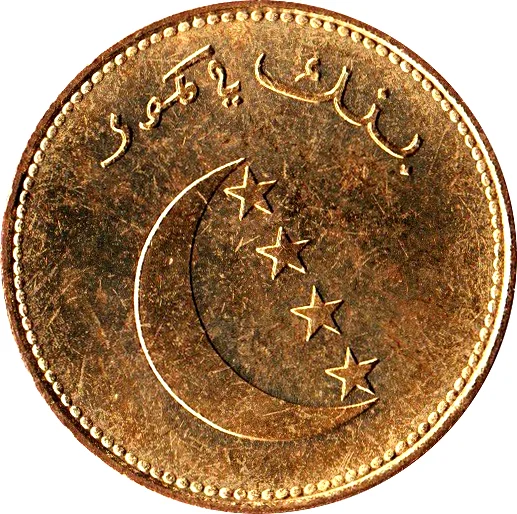
10 francs – Comoro Islands
Add to wishlist
Context
Year: 1992
Issuer: Comoro Islands
Issuing organization: Central Bank of the Comoros
Period:
(1975—2001)
Currency:
(since 1976)
Material
Diameter: 22.4 mm
Weight: 3.91 g
Thickness: 1.5 mm
Shape: Round
Composition: Aluminium bronze
Magnetic: No
Technique: Milled
Alignment: Coin alignment
flip
References
KM: #
Numista: #9652
Value
Exchange value: 10 KMF
Obverse
Reverse
Edge
Plain
Mints
| Name | Mark |
|---|---|
| Monnaie de Paris | — |
Mintings
| Year | Mint Mark | Mintage | Quality | Collection |
|---|---|---|---|---|
| 1992 | — | — |
Historical background
In 1992, the Comoro Islands operated under a complex and dependent monetary system, as the country was a member of the Franc Zone (Zone Franc). The official currency was (and remains) the Comorian Franc (KMF), which was pegged at a fixed exchange rate to the French Franc (FRF). This arrangement, established at independence in the 1970s, guaranteed convertibility and stability, as the Comorian Franc was backed by the French Treasury through an operations account. This peg provided crucial macroeconomic stability and low inflation but came at the cost of monetary sovereignty, tying Comoros' economic fortunes closely to France and limiting its ability to use exchange rate policy as a tool for adjustment.
The year 1992 fell within a period of significant political instability following the 1989 assassination of President Ahmed Abdallah. This turmoil, culminating in a constitutional crisis and the secession attempt of Anjouan in 1997, strained the economy. While the currency peg itself remained stable, the broader economic situation was challenging. The country relied heavily on imports and a few volatile agricultural exports like vanilla, cloves, and ylang-ylang. Consequently, the fixed exchange rate sometimes made Comorian exports less competitive, while the economy suffered from structural weaknesses, including a narrow production base and persistent trade deficits.
Therefore, the "currency situation" in 1992 was one of formal stability but underlying fragility. The institutional framework of the Franc Zone provided a secure anchor, preventing the hyperinflation or currency collapse seen in other developing nations. However, this stability existed alongside a struggling, aid-dependent economy with limited fiscal resources. The fixed peg to the French Franc was a double-edged sword: a cornerstone of financial order in a turbulent political climate, yet also a symbol of enduring colonial-era economic dependence that offered little flexibility to address the nation's deep-seated developmental challenges.
The year 1992 fell within a period of significant political instability following the 1989 assassination of President Ahmed Abdallah. This turmoil, culminating in a constitutional crisis and the secession attempt of Anjouan in 1997, strained the economy. While the currency peg itself remained stable, the broader economic situation was challenging. The country relied heavily on imports and a few volatile agricultural exports like vanilla, cloves, and ylang-ylang. Consequently, the fixed exchange rate sometimes made Comorian exports less competitive, while the economy suffered from structural weaknesses, including a narrow production base and persistent trade deficits.
Therefore, the "currency situation" in 1992 was one of formal stability but underlying fragility. The institutional framework of the Franc Zone provided a secure anchor, preventing the hyperinflation or currency collapse seen in other developing nations. However, this stability existed alongside a struggling, aid-dependent economy with limited fiscal resources. The fixed peg to the French Franc was a double-edged sword: a cornerstone of financial order in a turbulent political climate, yet also a symbol of enduring colonial-era economic dependence that offered little flexibility to address the nation's deep-seated developmental challenges.
🌱 Common