

50 francs – Comoro Islands
Add to wishlist
Context
Years: 1990–1994
Issuer: Comoro Islands
Issuing organization: Central Bank of the Comoros
Period:
(1975—2001)
Currency:
(since 1976)
Material
References
KM: #
Numista: #3172
Value
Exchange value: 50 KMF
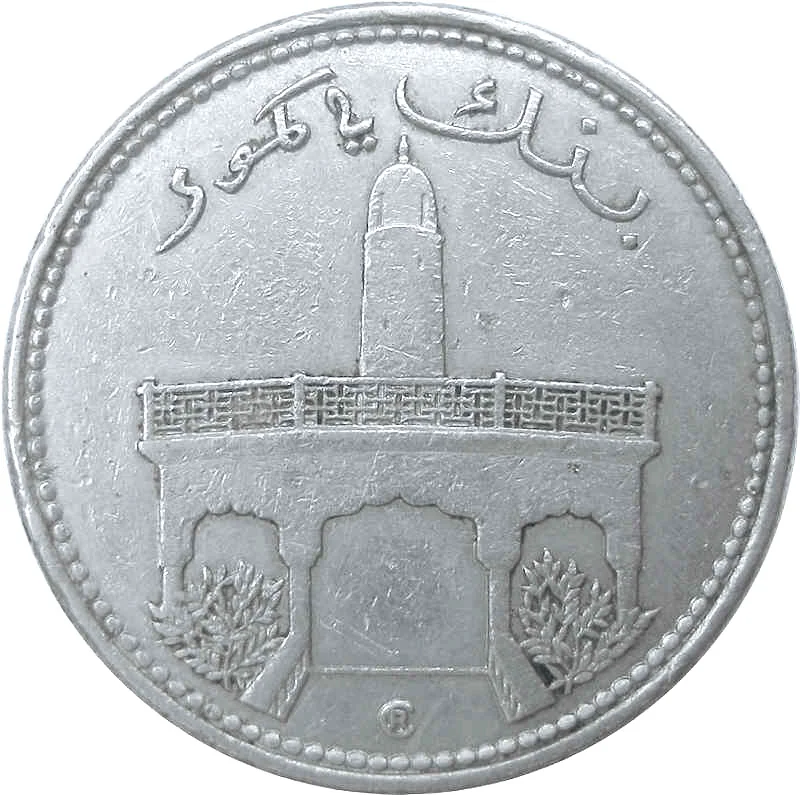
Obverse
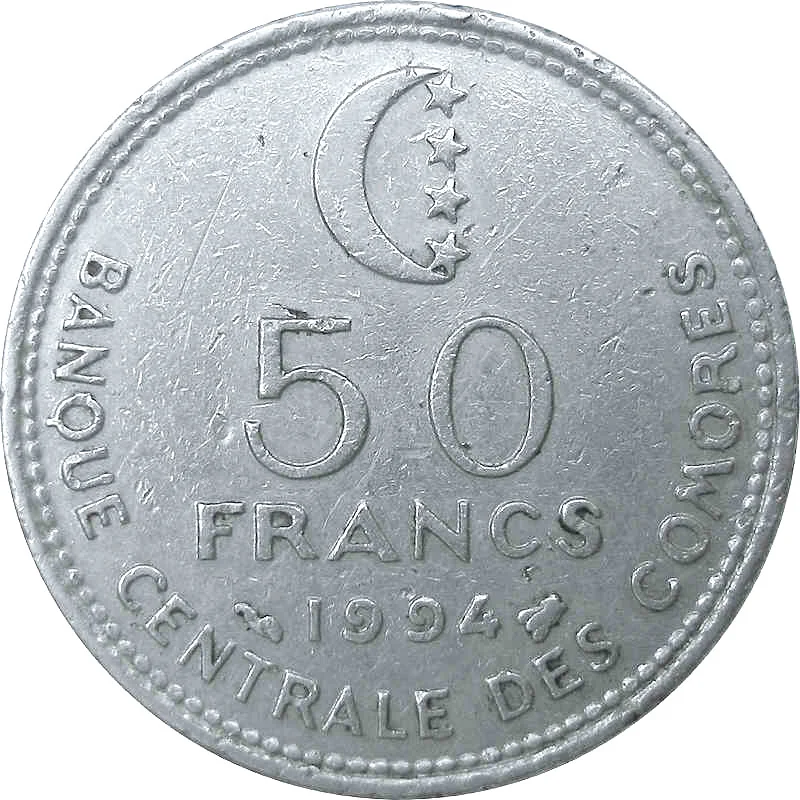
Reverse
Description:
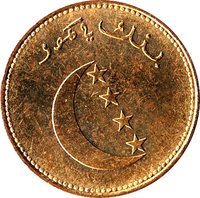
Moon and stars above, date below.
Inscription:
50 FRANCS 1994
BANQUE CENTRALE DES COMORES
BANQUE CENTRALE DES COMORES
Script: Latin
Edge
Reeded
Categories
| Building> Religious building |
Mints
| Name | Mark |
|---|---|
| Monnaie de Paris | — |
Mintings
| Year | Mint Mark | Mintage | Quality | Collection |
|---|---|---|---|---|
| 1990 | — | — | ||
| 1994 | — | — |
Historical background
In 1990, the Comoro Islands operated under a complex and dependent monetary system, as a member of the Franc Zone (Zone Franc). The official currency was the Comorian Franc (KMF), which was pegged at a fixed and irrevocable parity to the French Franc (FRF). This arrangement, established at independence in the 1970s, guaranteed the KMF's convertibility through the French Treasury, providing monetary stability but severely limiting national autonomy over monetary policy. The economy was fragile, heavily reliant on exports of vanilla, cloves, and ylang-ylang, making it vulnerable to commodity price shocks and chronic trade deficits.
The fixed exchange rate regime (1 French Franc = 75 Comorian Francs) provided low inflation and facilitated imports from France, the islands' dominant trading partner. However, it also locked Comoros into an overvalued currency, which hindered the competitiveness of its exports and discouraged economic diversification. Furthermore, the system required the government to maintain foreign exchange reserves with the French Treasury, constraining fiscal policy. The economy was characterized by widespread poverty, limited infrastructure, and a growing dependence on foreign aid and remittances from the Comorian diaspora.
Thus, the currency situation in 1990 was one of imposed stability with structural constraints. While the peg to the French Franc prevented the hyperinflation or currency collapse seen in some neighboring African states, it did so at the cost of economic flexibility. The monetary framework underscored the islands' continued post-colonial dependence on France, a relationship that provided a financial anchor but did little to stimulate the internal development needed to address the nation's deep-seated socio-economic challenges. This duality defined the financial landscape as the country navigated a politically turbulent decade.
The fixed exchange rate regime (1 French Franc = 75 Comorian Francs) provided low inflation and facilitated imports from France, the islands' dominant trading partner. However, it also locked Comoros into an overvalued currency, which hindered the competitiveness of its exports and discouraged economic diversification. Furthermore, the system required the government to maintain foreign exchange reserves with the French Treasury, constraining fiscal policy. The economy was characterized by widespread poverty, limited infrastructure, and a growing dependence on foreign aid and remittances from the Comorian diaspora.
Thus, the currency situation in 1990 was one of imposed stability with structural constraints. While the peg to the French Franc prevented the hyperinflation or currency collapse seen in some neighboring African states, it did so at the cost of economic flexibility. The monetary framework underscored the islands' continued post-colonial dependence on France, a relationship that provided a financial anchor but did little to stimulate the internal development needed to address the nation's deep-seated socio-economic challenges. This duality defined the financial landscape as the country navigated a politically turbulent decade.
🌱 Common