

100 francs – Comoro Islands
Add to wishlist
Context
Year: 1999
Issuer: Comoro Islands
Issuing organization: Central Bank of the Comoros
Period:
(1975—2001)
Currency:
(since 1976)
Total mintage: 500,000
Material
References
KM: #
Numista: #10560
Value
Exchange value: 100 KMF
Obverse
Description:
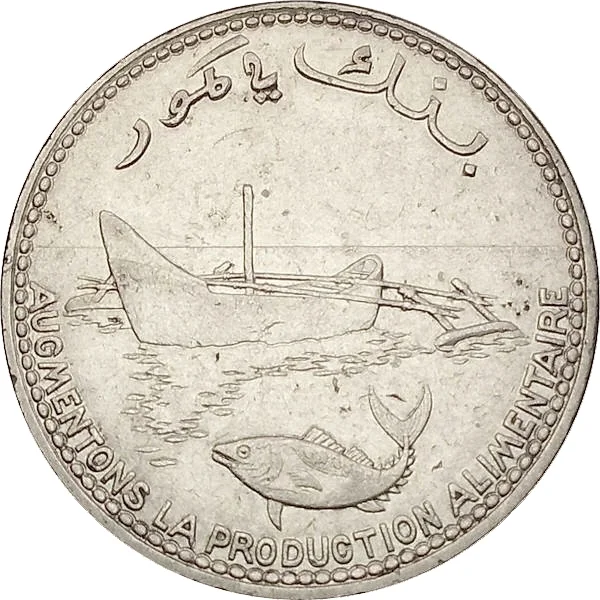
Boat, outrigger canoe, and fish encircled by legend.
Inscription:
AUGMENTONS LA PRODUCTION ALIMENTAIRE
Translation:
Let's Increase Food Production
Language: French
Reverse
Description:
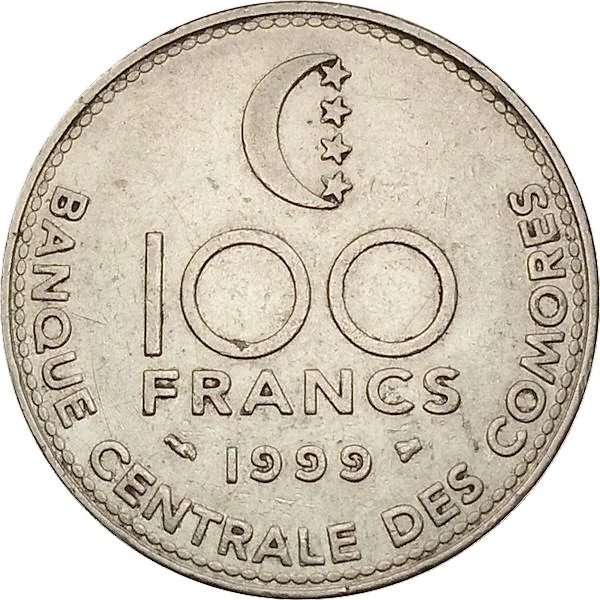
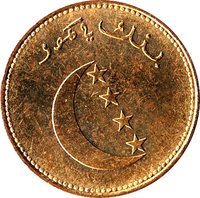
Right-facing crescent with four stars, central value and date, bank name below.
Inscription:
100
FRANCS
1999
BANQUE CENTRALE DES COMORES
FRANCS
1999
BANQUE CENTRALE DES COMORES
Edge
Plain
Categories
| Animal> Fish |
| Organization> FAO |
| Transportation> Watercraft |
Mints
| Name | Mark |
|---|---|
| Monnaie de Paris | — |
Mintings
| Year | Mint Mark | Mintage | Quality | Collection |
|---|---|---|---|---|
| 1999 | — | 500,000 |
Historical background
In 1999, the Comoro Islands operated under a complex and dependent monetary system, as it was a member of the Franc Zone (Zone Franc). The official currency was (and remains) the Comorian Franc (KMF), which was pegged to the French Franc at a fixed and guaranteed exchange rate. This arrangement, established at independence in the 1970s, provided monetary stability and low inflation but came at the cost of ceding national monetary sovereignty to France. The peg was managed through the Banque Centrale des Comores (BCC), which was obligated to hold at least 65% of its foreign reserves in an operations account at the French Treasury.
The year 1999 was particularly significant as it was the final year before the introduction of the Euro. The fixed parity of 75 Comorian Francs to 1 French Franc was effectively a proxy peg to the European Currency Unit (ECU), and by extension, to the soon-to-be-launched Euro. This impending change created an atmosphere of uncertainty, as the Comoros had to negotiate its continued place within the Franc Zone under the new European monetary architecture. Economically, the country was in a fragile state, grappling with political instability following the secession attempts of Anjouan and Mohéli, which severely disrupted governance and economic activity.
Consequently, the currency situation in 1999 was one of external dependency and transitional anticipation. While the peg provided a shield against hyperinflation and currency volatility, it did little to address underlying structural issues like widespread poverty, a narrow export base (primarily vanilla, cloves, and ylang-ylang), and a heavy reliance on foreign aid and remittances. The monetary stability existed alongside a struggling real economy, with the fixed exchange rate sometimes criticized for making Comorian exports less competitive. The core challenge was maintaining the benefits of the Franc Zone's credibility while navigating the Euro transition and fostering much-needed domestic economic development.
The year 1999 was particularly significant as it was the final year before the introduction of the Euro. The fixed parity of 75 Comorian Francs to 1 French Franc was effectively a proxy peg to the European Currency Unit (ECU), and by extension, to the soon-to-be-launched Euro. This impending change created an atmosphere of uncertainty, as the Comoros had to negotiate its continued place within the Franc Zone under the new European monetary architecture. Economically, the country was in a fragile state, grappling with political instability following the secession attempts of Anjouan and Mohéli, which severely disrupted governance and economic activity.
Consequently, the currency situation in 1999 was one of external dependency and transitional anticipation. While the peg provided a shield against hyperinflation and currency volatility, it did little to address underlying structural issues like widespread poverty, a narrow export base (primarily vanilla, cloves, and ylang-ylang), and a heavy reliance on foreign aid and remittances. The monetary stability existed alongside a struggling real economy, with the fixed exchange rate sometimes criticized for making Comorian exports less competitive. The core challenge was maintaining the benefits of the Franc Zone's credibility while navigating the Euro transition and fostering much-needed domestic economic development.
🌱 Fairly Common