

5 Maloti (Independence) – Lesotho
Circulating commemorative coins
Commemoration: 50 years of Independence
Lesotho

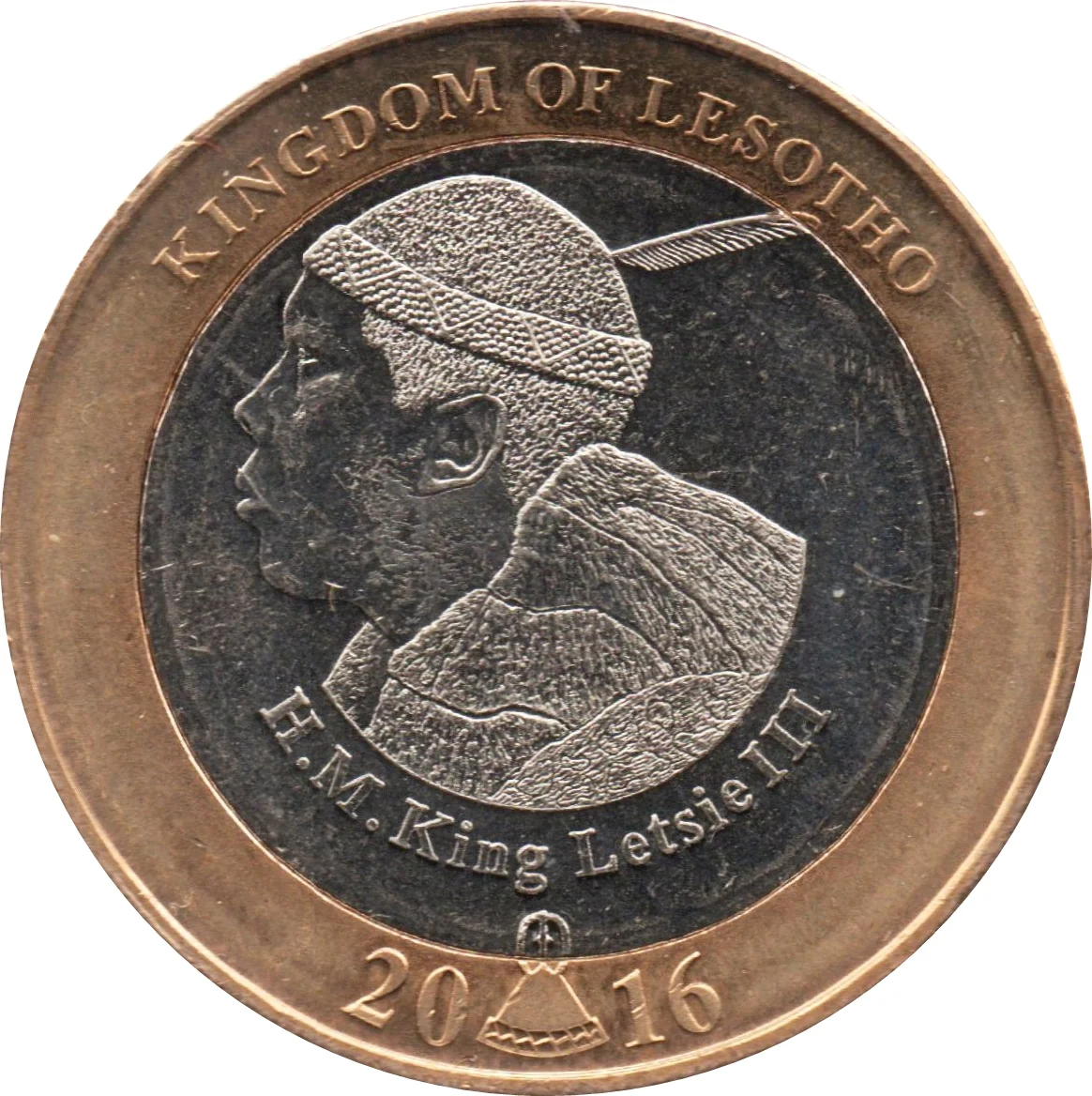
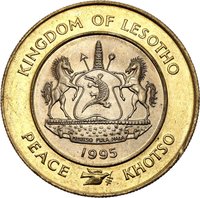
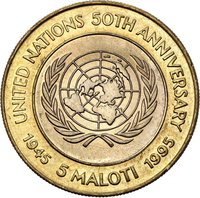
Obverse
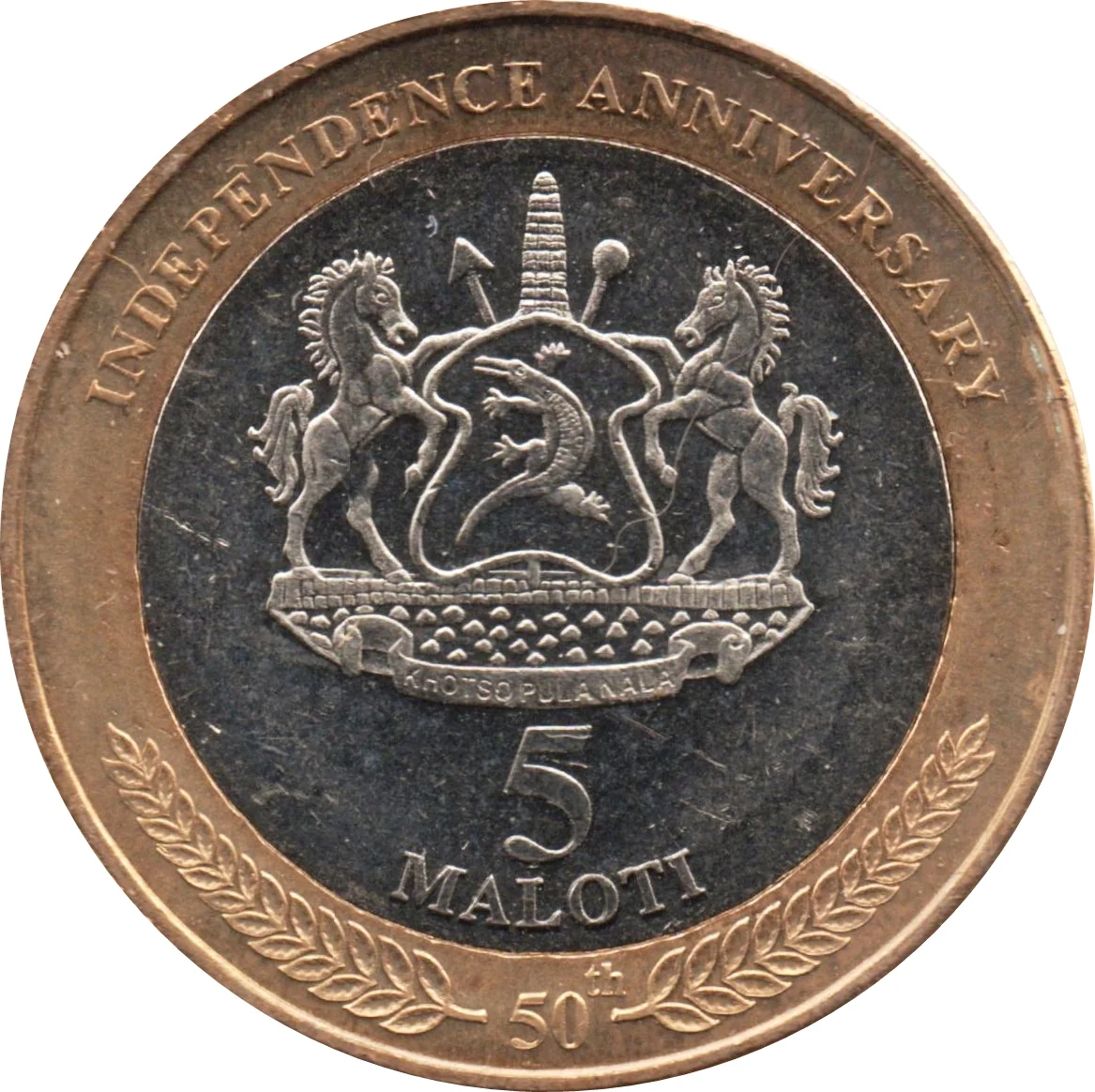
Reverse
Description:
Lesotho's national emblem.
Inscription:
INDEPENDENCE ANNIVERSARY
5
MALOTI
50th
5
MALOTI
50th
Script: Latin
Edge
Reeded
Categories
| Symbols> Coat of Arms |
| Person> Monarch |
| Event> Independence |
Mintings
| Year | Mint Mark | Mintage | Quality | Collection |
|---|---|---|---|---|
| 2016 | — | — |
Historical background
In 2016, Lesotho's currency situation was fundamentally defined by its membership in the Common Monetary Area (CMA), a key framework it shares with South Africa, Eswatini, and Namibia. The Loti (LSL), pegged at par to the South African Rand (ZAR), operated in a one-to-one, fixed exchange rate system. This arrangement meant Lesotho ceded direct control over its monetary policy to the South African Reserve Bank, with the loti's stability and value being a direct derivative of the rand's performance on international markets. Consequently, domestic economic management focused primarily on fiscal policy, as interest rates and money supply were largely determined by South Africa's economic conditions.
The year was challenging due to significant external pressures on the rand, which directly impacted Lesotho. The South African currency experienced volatility in 2015-2016, driven by concerns over China's economic slowdown, lower commodity prices, and domestic political uncertainty. This depreciation of the rand translated directly into a weaker loti, increasing the cost of imports and contributing to inflationary pressures within Lesotho. The situation highlighted the double-edged sword of the CMA peg: it provided stability and facilitated seamless trade with South Africa (Lesotho's dominant economic partner), but also imported economic vulnerability, leaving the country exposed to financial shocks originating beyond its borders.
Domestically, the currency peg imposed fiscal discipline but also constrained policy options. The government's budget, heavily reliant on Southern African Customs Union (SACU) revenue and facing pressures from a large public wage bill, had to be managed within the confines of a monetary system it did not control. While the fixed exchange rate provided predictability for businesses and helped control hyperinflation, it limited Lesotho's ability to use currency devaluation as a tool to boost the competitiveness of its exports, notably textiles and water. Thus, in 2016, Lesotho's currency narrative was one of managed stability at the cost of monetary sovereignty, navigating economic headwinds transmitted through its inescapable link to the South African rand.
The year was challenging due to significant external pressures on the rand, which directly impacted Lesotho. The South African currency experienced volatility in 2015-2016, driven by concerns over China's economic slowdown, lower commodity prices, and domestic political uncertainty. This depreciation of the rand translated directly into a weaker loti, increasing the cost of imports and contributing to inflationary pressures within Lesotho. The situation highlighted the double-edged sword of the CMA peg: it provided stability and facilitated seamless trade with South Africa (Lesotho's dominant economic partner), but also imported economic vulnerability, leaving the country exposed to financial shocks originating beyond its borders.
Domestically, the currency peg imposed fiscal discipline but also constrained policy options. The government's budget, heavily reliant on Southern African Customs Union (SACU) revenue and facing pressures from a large public wage bill, had to be managed within the confines of a monetary system it did not control. While the fixed exchange rate provided predictability for businesses and helped control hyperinflation, it limited Lesotho's ability to use currency devaluation as a tool to boost the competitiveness of its exports, notably textiles and water. Thus, in 2016, Lesotho's currency narrative was one of managed stability at the cost of monetary sovereignty, navigating economic headwinds transmitted through its inescapable link to the South African rand.
🌱 Common